
To all readers out there, you may be here for various reasons. Let us guess! You might start your tobacco business in the near future. Some other probable reasons may include your desire to purchase custom cigarette packaging boxes in bulk, preparing for travel, or managing your new launch budget. You might also be there due to your rising curiosity. No matter what you are having in your mind, what we know is that you are at the right place.
This blog post is for you as it’s going to answer all your queries about cigarette packs, cigarette cartons, sizes, dimensions, printings, types, and much more.
How many packs of cigarettes are in a carton?

This one question is getting viral not only among the tobacco industry but around the packaging world. We, pack role experts, will help you find the most appropriate answer in a 5-minute read.
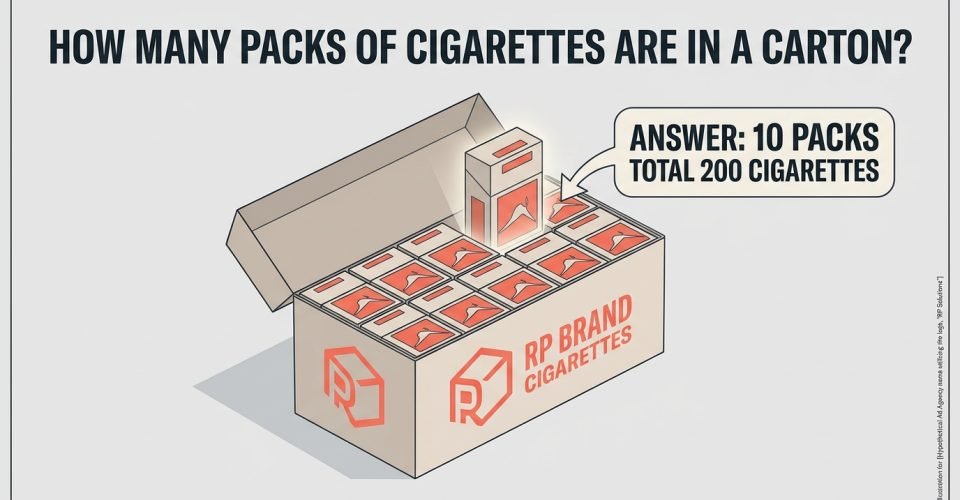
In the United States, typically a carton contains 10 packs of cigarettes. Each pack contains 20 cigarettes. So in total, you can answer popular questions about a pack of cigarettes in the following ways:
How many cigarettes are in a pack?
Answer: 20
How many cigarette packs are in a carton?
Answer: 10
How many cigarettes are in a carton?
Answer: 200
Wait! This is not a rule that a cigarette pack contains 20 cigarettes per pack; your customized cigarette packaging can have 19, 21, or even 30 cigarettes per pack. Thus, the statistics we provided just point to a common fact; it can not necessarily be 200, but can reach 300, 400, and even have 1000s of packs.
Confused? Read more to build a clear understanding!
What Exactly Is a Cigarette Carton?
A cigarette carton is a bulk packaging unit designed to hold multiple packs of cigarettes. It is usually factory-sealed, clearly labeled, and sold as a single item rather than as individual packs.
Cartons serve several purposes:
- They make transportation and storage easier for retailers.
- They allow consumers to buy multiple packs at once
- They help standardize wholesale and retail pricing.
In most U.S. settings, cartons are rectangular boxes containing 10 individual packs, often arranged in two rows of five packs each. These packs are identical to the ones sold individually, same size, same cigarette count, same labeling.
Cartons are commonly sold in:
- Convenience stores
- Gas stations
- Tobacco shops
- Duty-free stores
What’s Inside a Cigarette Pack?
To understand cartons, it helps to understand packs.
In the U.S., a standard cigarette pack contains 20 cigarettes. This has been the norm for decades and is widely recognized by consumers and regulators alike.
Why 20 Cigarettes per Pack?
There are a few reasons why 20 became the standard:
- Historical precedent: Early mass-produced cigarettes were packaged in counts of 20 for convenience and pricing consistency.
- Regulatory frameworks: U.S. regulations generally discourage the sale of packs smaller than 20 cigarettes.
- Consumer familiarity: The 20-cigarette pack became the expected unit, making pricing and comparison easier.
Because pack sizes are so standardized, carton sizes naturally follow a predictable structure. These are just some sizes of cigarette boxes, you can also get many benefits by customizing them fully with your brand logo then going towards the generic boxes. Because in the debates of generic packaging Vs custom packaging, custom packaging usually wins.
Regional Variations of cigarettes Per Pack:
| Region / Country | Typical Cigarettes per Pack |
| United States | 20 |
| Canada | 20 (25 also seen) |
| United Kingdom | 20 |
| European Union (most countries) | 20 |
| Australia | 20 (25–50 also sold) |
| New Zealand | 20 (25–30 also sold) |
| Japan | 20 |
| China | 20 |
| South Korea | 20 |
| India | 10 (20 also available) |
| Pakistan | 10 |
| Middle East (general) | 20 |
| Africa (varies by country) | 10–20 |
| Latin America | 20 (10 in some countries) |
Types of cigarettes Packs: A New YEAR Update
At first sight, all cigarette packs look more or less similar. From a packaging expert’s eyes, every minor detail counts when it comes to launching a perfect box. Style to design and typing to interlocking, everything can be updated from a dozen options. Even the count for how many packs in a carton also depends on whether your pack is large, mini, small, hard, or soft. Here is a simple difference between these types of packaging.
Hard Packs
This is also known as box packs. It’s one of the most popular cigarette packaging styles. Cardboard and rigid box material often take the form of hard boxes. Its closing style refers to the flip-top lid. It often has 20 cigarettes per pack.
Soft Pack
It’s made from flexible paper, not with cardboard and rigid material. It maintains its shape only till the pack has sticks in it. The moment it gets empty, it loses shapes and structure as well. These packs were once so popular, but due to less flexibility, it loses popularity. It still contains 20 cigarettes per pack.
Flip Top Pack
This type of packaging refers to flip-top packs. It’s popular among the business class for being luxurious and convenient. The flip top opening adds convenience to every cigarette stick burning, so you can enjoy every puff that brings calmness to your stressful life.
Slide Pack
You can also call the drawer packs. You can reach your tobacco by sliding out the inner trays. It usually has two pieces: a tray and a sleeve, giving easy unlocking.
Slim Packs
Slim packs are taller but narrower. They are customized packs built to hold extra slim cigarettes. They can also contain 20 cigarettes per pack. It’s easy to hold in your hands and can travel miles with you in your pockets and hand-carry.
Mini Packs
Mini Packs are the first choice of non- frequent smokers. They are compact and can hold 10 cigarettes per pack. Small size and less market price are some sought after qualities of these packs.
King size Cigarettes packs
They are large size Cigarette packs that can accommodate more than 20 sticks. You can customize them for even 30, 40, or 50 cigarettes. They are popular for reducing packaging costs and waste.
That’s not the end, there are various different types of packaging for pre rolls boxes, vape boxes, CBD tincture boxes, and CBD cannabis boss.
Dimensions Of Different Types of Cigarette: A Detailed Size Chart
| |
| Cigarette Pack Type | Approximate Box Size (Height × Width × Depth) |
| Standard Hard Pack (20s) | 85–88 mm × 55–57 mm × 22–23 mm |
| Standard Soft Pack (20s) | 85–88 mm × 55–57 mm × 20–22 mm |
| Flip-Top Pack | 85–88 mm × 55–57 mm × 22–23 mm |
| Slide / Drawer Pack | 88–90 mm × 55–58 mm × 22–24 mm |
| Rounded / Curved Pack | 85–88 mm × 55–57 mm × 22–23 mm |
| Slim Pack (20 slim cigarettes) | 100–110 mm × 45–48 mm × 20–22 mm |
| Super-Slim Pack | 110–120 mm × 40–45 mm × 18–20 mm |
| Compact / Mini Pack (10 cigarettes) | 70–75 mm × 50–55 mm × 18–20 mm |
| Large / Extended Pack (25–50 cigarettes) | 90–120 mm × 60–75 mm × 25–35 mm |
| Plain / Standardized Pack | Same as standard hard or slim pack (design only changes) |
Do All Cartons Always Have 10 Packs?

Usually, yes—but not always.
While 10-pack cartons are standard in the U.S., exceptions exist. These exceptions are the main reason people encounter conflicting information online.
Situations Where Carton Sizes May Vary
- International Markets
Some countries use different packaging norms. A “carton” in another country may not match the U.S. definition. - Duty-Free Purchases
Duty-free shops sometimes sell cartons packaged differently for international travelers. - Wholesale or Bulk References
In some wholesale contexts, the word “carton” is used loosely to mean a large boxed quantity rather than a strict 10-pack unit. - Online Misinformation
Forums, blogs, and social media posts sometimes mix global standards or repeat incorrect assumptions.
Because of this, the safest approach is always to check the product label, which typically lists, number of packs, number of cigarettes per pack, and total cigarette count.
Why Do People Buy Cigarettes by Carton?
People choose cartons over individual packs for several practical reasons:
1. Convenience
Buying a carton reduces the need for frequent trips to the store. They usually think buying a carton can reduce the per pack cost.
2. Cost Considerations
Cartons often have a lower price per pack, though savings depend on:
- State taxes
- Retailer pricing
- Location of purchase
Cost calculation is tricky but you can do it easily with the help of this guide.How Much Does Packaging Cost?
3. Long-Term Planning
Some buyers prefer having a steady supply rather than buying packs one at a time.
4. Travel
Cartons are commonly purchased before long trips, especially when availability may be limited.
It’s important to note that cartons are not always cheaper in every location, which is why price comparison is useful.
Carton vs Pack vs Sleeve: Terminology Explained
Understanding terminology helps avoid confusion.
| Pack | Carton | Sleeve |
| The smallest retail unit | A bulk unit | An informal term |
| Usually contains 20 cigarettes | Usually contains 10 packs | Sometimes used interchangeably with “carton” |
Retailers and consumers sometimes use these words loosely, which can lead to misunderstandings—especially online. Always rely on numerical labeling, not just terminology.
Common Myths and Misunderstandings
“All cartons contain 20 packs.”
This is false for the U.S. market. The standard is 10 packs per carton.
“Cartons are always cheaper.”
Not necessarily. Taxes and pricing vary widely by state and retailer.
“All cigarette packs worldwide contain 20 cigarettes.”
Pack sizes vary internationally, even though 20 is standard in the U.S.
“All brands use the same carton size everywhere.”
Brand packaging may differ by region due to local regulations.
Legal and Regulatory Standards on Cigarette Packaging
Cigarette packaging is subject to strict legal and regulatory controls in many countries, driven primarily by public health objectives. Governments regulate packaging to reduce the appeal of tobacco products, communicate health risks, and prevent misleading marketing. These regulations are guided internationally by the World Health Organization’s Framework Convention on Tobacco Control (WHO, FCTC), particularly Articles 11 and 13, which focus on packaging, labeling, and advertising restrictions.
Most jurisdictions mandate health warnings on cigarette packs, often covering a significant portion of the front and back surfaces. Many countries require graphic health warnings depicting smoking-related diseases, which research shows are more effective than text-only warnings. Regulations also prohibit misleading descriptors such as “light,” “mild,” or “low tar,” which historically implied reduced harm.
In recent years, several countries have introduced plain or standardized packaging laws, removing brand imagery, logos, and distinctive colors. These laws aim to reduce brand appeal while increasing the visibility and impact of health warnings. Pack size regulations are also common; for example, many regions enforce a minimum of 20 cigarettes per pack to discourage youth access.
Overall, cigarette packaging laws are a central tool in global tobacco control policy and continue to evolve based on emerging scientific evidence.
Cigarette Packaging Warning Keynotes Table
| Regulatory Element | Key Requirement |
| Health Warning Coverage | 30–90% of pack surface (varies by country) |
| Graphic Warnings | Mandatory in many countries |
| Text Warnings | Required in all regulated markets |
| Plain Packaging | Mandatory in several countries |
| Misleading Terms | Prohibited (“light,” “mild,” etc.) |
| Minimum Pack Size | Commonly 20 cigarettes |
| Language Requirement | Warnings must appear in official national language(s) |
| Rotation of Warnings | Periodic updates required |
Key Takeaways and Final Summary
So, how many packs of cigarettes are in a carton? In the United States, the answer is clear: 10 packs per carton, usually totaling 200 cigarettes. This standard applies to most retail purchases and is what consumers should expect unless clearly informed otherwise.
Confusion arises mainly from international differences, informal terminology, and online misinformation. By understanding how packs and cartons are structured—and by checking product labels when in doubt, you can avoid misunderstandings and make informed decisions.
Simple rule to remember:
If it’s a standard U.S. carton, think 10 packs, 200 cigarettes.