
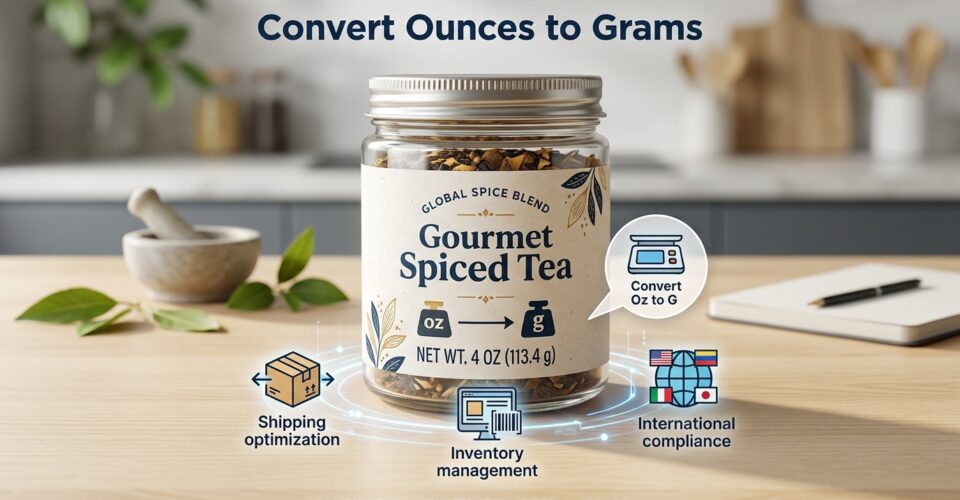
In the packaging industry, accurate product measurements are extremely important. No matter if you’re creating bespoke boxes, working out shipping charges, labeling products, or preparing retail packaging, businesses can prevent major errors by knowing how to convert weights.
Among them the more popular conversion is ounces to grams. Simply put,
1 ounce = 28.3495 grams
This easy-to-make conversion is used prominently in packaging, ecommerce, logistics, food packaging, cosmetics, supplements, and a host of other fields.
This guide will cover the conversion of grams to ounces, why this conversion is important in packaging, and the potential benefits for businesses of using accurate measurements to optimize efficiency and customer satisfaction.
Understanding Ounce to Gram Conversion in Packaging
Today, packaging is so much more than product protection. In the present times, packaging is used by brands to:
- Product presentation
- Shipping optimization
- Weight labeling
- Inventory management
- International compliance
- Customer convenience
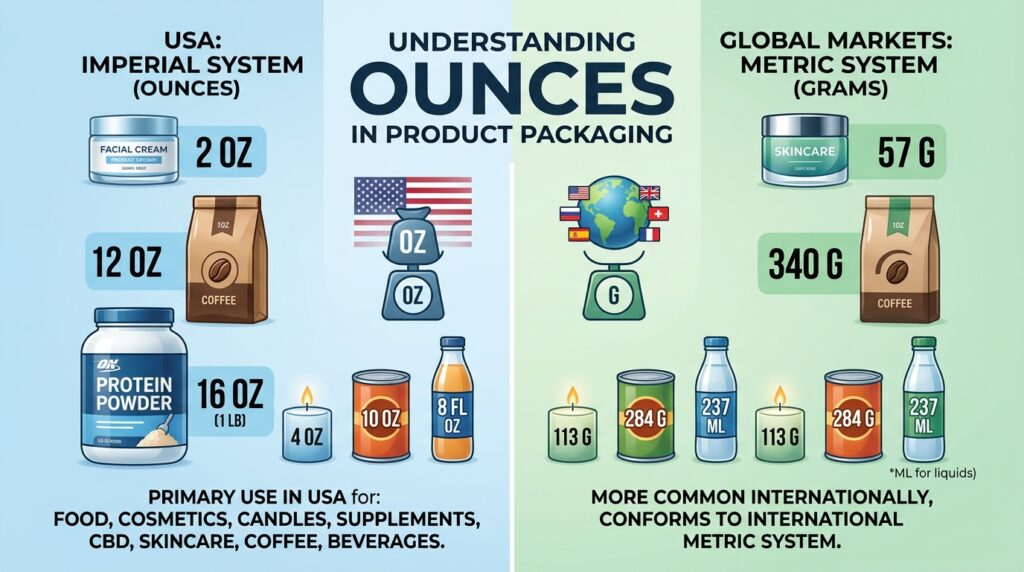
Many countries have adopted the metric system of measurement, whereas others have gone with the imperial system of measurement, so packaging companies may need to provide both ounces and grams on product labels.
For example:
- A skincare cream may show “2 oz (56 g)”
- A protein powder can might have the words “16 oz’ (453 g)” on it.
For global markets, the packaging is often labelled twice to accommodate both the local and the global market.
Brands can ensure consistency and professionalism with accurate conversions. Keep it in your finger tips so easy ounce to grams conversation by reading this blog:
How many grams of a product are in an ounce?
One ounce is equal to 28.3495 grams.
For calculations, most businesses will round this number to 28.35 grams.
Ounces to Grams:
Grams = Ounces x 28.3495
It is common practice to use this type of conversion in:
- Food packaging
- Cosmetic packaging
- Pharmaceutical packaging
- Retail boxes
- Flexible packaging
- Ecommerce shipping
Ounces to Gram Conversion Chart For Packaging:
This is a handy table used in the packaging and shipping sector.
| Ounces | Grams |
| 1 oz | 28.35 g |
| 2 oz | 56.7 g |
| 4 oz | 113.4 g |
| 8 oz | 226.8 g |
| 12 oz | 340.2 g |
| 16 oz | 453.6 g |
Ecommerce companies or packaging manufacturers might make use of this kind of chart to mark or shipping calculations.
Real-World Example: Food Packaging Industry
The food packaging industry relies heavily on ounce-to-gram conversions because products are often sold in multiple countries with different measurement systems.
For example, a snack company selling potato chips in the United States may label a product as:
- 8 oz Potato Chips
However, the same product exported to Europe or other international markets may also need metric labeling:
- 8 oz (226.8 g)
Without accurate conversion, the packaging could violate labeling regulations or confuse customers. This is why professional packaging companies carefully calculate both ounces and grams before printing labels and designing packaging artwork.
How Incorrect Measurements Can Affect Packaging Businesses
Even small conversion mistakes can create major problems in packaging and shipping operations.
For example:
- Incorrect product weights can increase shipping costs
- Wrong label information may lead to compliance issues
- Oversized boxes waste packaging materials
- Customers may lose trust due to inaccurate labeling
Imagine a supplement company labeling a protein powder jar incorrectly. If the actual weight differs from the printed weight, the business could face product returns, legal concerns, or customer complaints.
This is why professional packaging companies always verify ounce-to-gram conversions before production begins.
Understanding Ounces in Product Packaging
An ounce is a unit of weight primarily used in the United States and in some countries that use the imperial system of measurement.
Ounces are used for:
- Food items
- Cosmetic products
- Candles
- Supplements
- CBD products
- Skincare jars
- Coffee bags
- Beverage containers
However, in international markets it is more common to use grams as it conforms to the international metric system.
Difference Between Ounces and Fluid Ounces in Packaging
Ounces and Fluid Ounces are two different terms used in packaging. A frequent error in labeling is mixing up the ounces with fluid ounces.
Weight Ounces
Weight ounces are used to measure the actual weight of a product.
Examples:
- Protein powder
- Coffee beans
- Dry snacks
- Candles
Fluid Ounces
Fluid ounces are used to measure volume, not weight.
Examples:
- Shampoo
- Juice
- Lotion
- Essential oils
It is important when designing the package because it could lead to labeling problems and misinformation for consumers.
The Role of Accurate measurements packaging designs
Accurate product measurement is directly related to the performance of packaging.
Better Box Sizing
When manufacturers know the product weight, they have the option of:
- Suitable packaging materials
- Proper box dimensions
- Protective inserts
- Shipping strength
Excess packaging waste and shipping costs are associated with oversized packaging. If you want to know how a box dimension is measured see our latest post on How to Measure Your Product Dimensions for a Perfect Box
Improved Shipping Efficiency
The shipping companies charge the rates according to weight and dimensions. Any conversion errors, no matter how minor, can add to transportation expenses.
The right ounce to gram conversions are helpful for ecommerce businesses:
- Reduce shipping expenses
- Improve warehouse efficiency
- Prevent labeling mistakes
International Packaging Compliance
Lots of countries ask for metric measurements on labels. Ounces and grams are sometimes used side by side, as businesses selling internationally may want to adhere to the regulations.
For example:
Packaging is in ounces in the USA. The typical European packaging comes in grams.
Global customers can more easily understand the use of both units.
How Packaging Companies Use Gram Conversions
All of the following are a regular part of the packaging industry’s work like:
- Custom rigid boxes
- Folding cartons
- Mylar bags
- Corrugated shipping boxes
- Cosmetic packaging
- Food containers
- Pharmaceutical packaging
The manufacturer of a supplement, for instance, might ask for packaging for:
- 600 Ibs of protein bars
- 2 oz skincare creams
- 16 oz coffee bags
The precise gram weight guarantees proper packaging and a professional image.
How to Convert Ounces to Grams Manually
To do this manually, follow the instructions below. To convert ounces to grams, you can just use a simple conversion.
Multiply the value of the ounce by 28.3495.
Example 1
4 oz x 28.3495 = 113.398
Therefore, 113.4 grams are roughly equal to 4 ounces.
Example 2
16 oz x 28.3495 = 453.592 g
Thus, 16 ounces are approximately equal to 453.6 grams.
Why Metric Measurements Are Becoming More Popular in Packaging
The use of metric measurements is growing in packaging, and there are several reasons for this. The metric system is becoming increasingly common in packaging, mainly for the following reasons.
Packaging industry worldwide has embraced the metric system because it provides:
- Better precision
- Easier international trade
- Simplified manufacturing
- Standardized labeling
There are many ecommerce brands that make packaging that includes metric and imperial measurements to cater to all.
For example:
Net Weight: 8 oz (226 g)
Contents: 2 oz (56 g)
This makes things more transparent and builds customer trust.
Tips for Packaging Businesses
Some useful tips for packaging companies and ecommerce brands.
Use Dual Measurements
When addressing overseas customers always include both ounces and grams.
- Choose a scale that is accurate.
- Digital scales increase accuracy of packaging and minimize product variations.
Train Packaging Teams
Basic knowledge of weight conversions should be known by employees dealing with labeling and shipping.
Avoid Oversized Packaging
Accurate measurements can minimize waste and shipping expenses.
Frequently Asked Questions
How Many Grams Are in One Ounce?
One ounce is equivalent to 310 grams.The number of grams in 1 ounce is 310.
28.3495 grams of mass is exactly 1 ounce.
Why Do Packaging Labels Show Both Ounces and Grams?
Both measurements are used by brands to meet different customers’ needs in various countries and to adhere to international labeling codes.
Is an Ounce Bigger Than a Gram?
Yes. There are about 28.35 grams per one ounce.
How many grams are there in 16 oz?
There are about 453.6 grams of 16 ounces.
Why Are Accurate Weight Measurements Important in Packaging?
Accurate measurements support:
- Correct labeling
- Better shipping calculations
- Packaging efficiency
- Customer trust
- Regulatory compliance
Simply put, before customizing a perfect box especially e-commerce boxes, subscription boxes, or shipping boxes packaging weight matters. This simple conversation helps people convert the weight and estimate the exact shipping cost.
Final Thoughts
Businesses in packaging, shipping, retail, and ecommerce require an understanding of the amount of grams in an ounce.
The standard conversion is:
1 ounce = 28.3495 grams
Precise measurements are crucial in various industries, from retail product packaging to food packaging and cosmetic product boxes, enabling businesses to optimize processes, minimize waste, and produce professional product presentations.
The importance of measurement, both imperial and metric, will continue to be a part of packaging and marketing strategy in the future, as global ecommerce grows. If you yourself are too busy to get this calculation done, don’t fret. We (Pack Role) are fully aware of these conversations and will never let you disappoint at any stage of custom packaging manufacturing. All you need to do is order us now! If you find trouble in measuring the box weight see our detailed guide on How much does a Box Weight? A Complete Guide.