When you’re shipping books, packaging has two jobs. First, it protects the product during handling and transportation. Second, it delivers the kind of presentation your customers expect. For publishers, bookstores, authors, ecommerce sellers, and book distributors, choosing between a custom book box and a book mailer can affect product protection. Likely, order fulfillment efficiency, shipping costs, and the customer experience depend on the right book box choices.
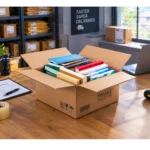
Choosing the right box type helps in maintaining your book agency or store. In a nutshell, a box mailer is the most suitable choice if you are shipping a single book. On the flip side, you must choose a heavier shipping book box for oversized coffee table books and bulk book shipments.
The right choice ultimately depends on the book’s dimensions and weight, the number of books per shipment, how the package will be handled, and your brand’s packaging requirements.
Custom Book Boxes vs Book Mailers: What’s the Difference?
Although both are designed to ship books, their structural approaches are different.
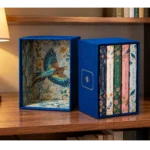
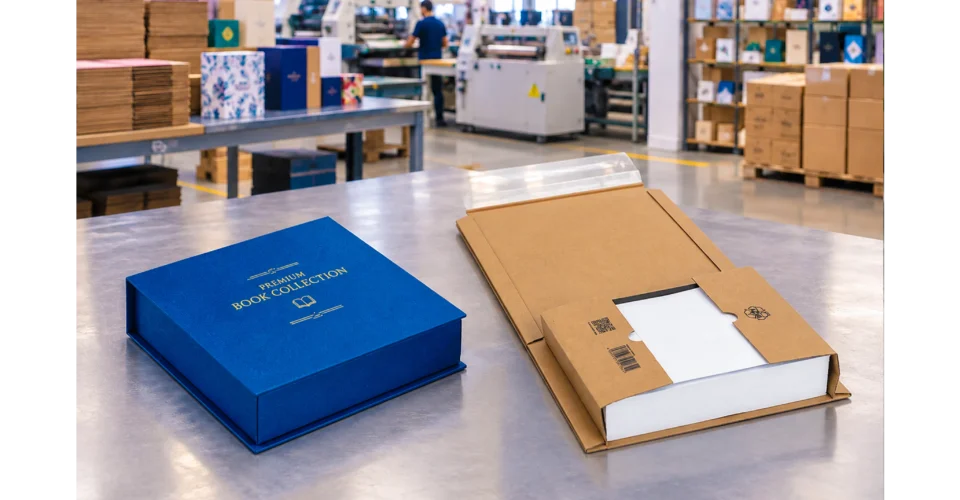
A custom book box is a more structured packaging solution that surrounds the book with a defined outer container. It can be manufactured to accommodate one or several books and can include inserts, partitions, cushioning, or additional protective features. This makes it particularly useful when the shipment is heavy, valuable, bubble-wrapped, unusually shaped, or vulnerable to crushing. It comes in lots of varieties, including rigid boxes, Kraft boxes, and premium magnetic closure boxes.
A book mailer, on the other hand, is generally designed as a compact, foldable package that wraps closely around the book. Its strength comes from the board construction, folded panels, edges, and closure rather than from the larger three-dimensional structure of a conventional box.
This distinction is important because there is no universal answer to the question of which packaging protects books better.
Protection depends on the entire packaging system, not simply whether the package is called a box or a mailer.
The International Safe Transit Association (ISTA) recommends considering the actual distribution environment when selecting packaging and testing procedures. Factors such as vibration, drops, compression, handling, and storage can influence packaging performance.
Book Packaging Comparison at a Glance
| Factor | Custom Book Box | Book Mailer |
| Structural protection | Higher potential | Moderate to high, depending on construction |
| Best for | Multiple, heavy, premium, or oversized books | Single and standard-size books |
| Storage | Requires more warehouse space | Usually stores efficiently when flat |
| Fulfillment | Suitable for larger or complex orders | Fast and efficient for individual orders |
| Branding | Excellent | Excellent |
| Internal inserts | Easy to incorporate | More limited |
| Space efficiency | Depends on design | Generally high |
| Premium presentation | Excellent | Good to excellent |
| Bulk book shipments | Strong option | Better for individually packed orders |
The important point is that customization changes the equation. A well-engineered mailer can outperform a poorly designed box, while an appropriately specified book box can provide substantially more protection for demanding shipments.
When Should You Use a Book Mailer?
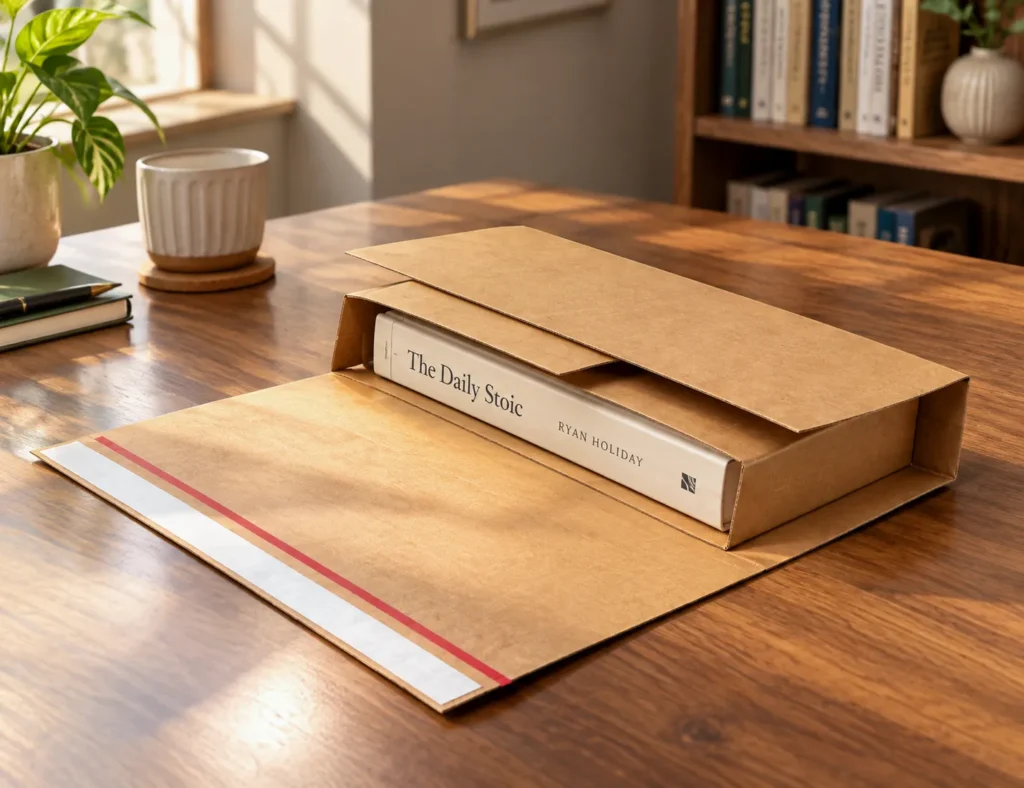
For many ecommerce businesses, the book mailer is the practical starting point.
If your typical order contains one paperback or standard hardcover, a mailer can closely fit the product without requiring a large amount of packaging material or warehouse space. The design also allows fulfillment teams to pack individual orders quickly.
This makes book mailers particularly suitable for online bookstores, independent authors, subscription businesses, and publishers that regularly ship standardized books directly to consumers.
Consider an online bookstore selling a 300-page paperback. The book has relatively low weight, standardized dimensions, and no special inserts. A properly sized custom mailer can hold the book securely, provide protection around the edges and corners, and present the retailer’s branding without the additional volume of a conventional carton.
The key is fit.
USPS packaging guidance states that void spaces should be filled or stabilized so that contents do not shift. It adds that the parcels should be appropriately sized for their contents.
That principle applies well beyond USPS shipments: a package that allows a book to move excessively during transportation creates unnecessary opportunities for corner, cover, and spine damage.
Book mailers make the most sense when:
- Most orders contain one book.
- Book sizes are relatively standardized.
- Storage space is limited.
- Fast fulfillment is important.
- You want a compact branded shipping format.
In other words, a mailer is usually the efficient choice when the product itself is relatively simple to ship.
When Is a Custom Book Box the Better Choice?
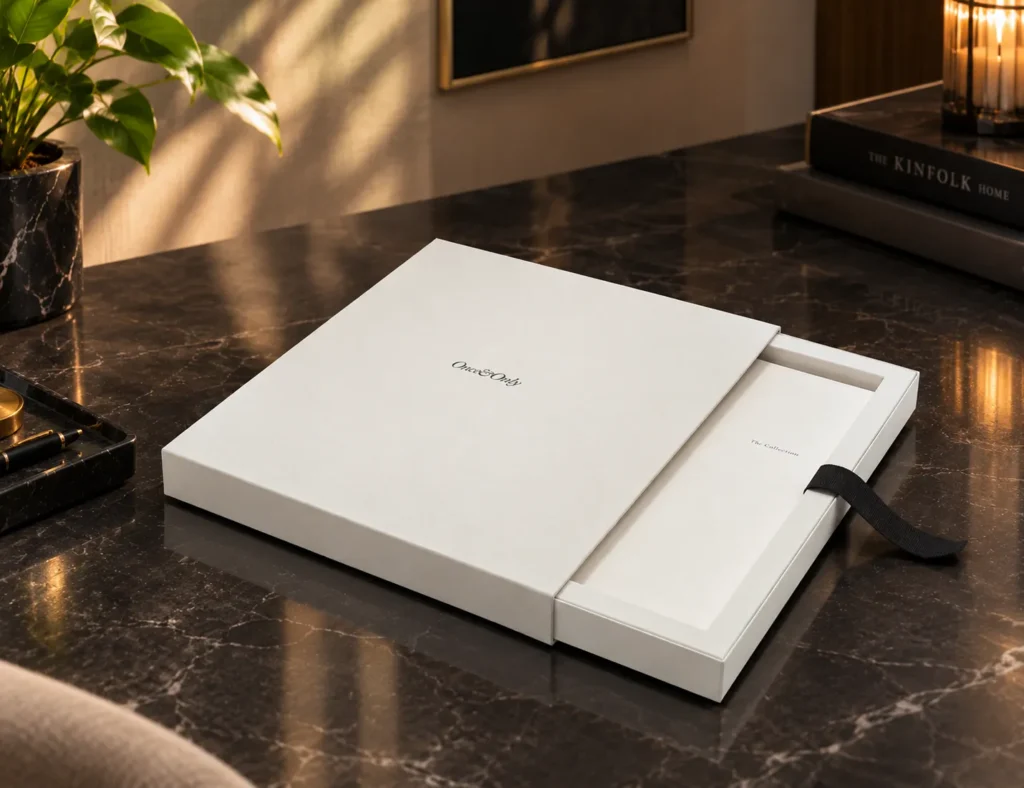
A custom book box becomes more compelling as the demands placed on the package increase.
Suppose a publisher sells a premium hardcover edition with a dust jacket. The book has a higher retail value, a rigid cover, and a presentation that customers expect to arrive in excellent condition. The packaging needs to do more than simply contain the book; it needs to reduce the likelihood of corner crushing, surface damage, and movement. A custom box gives the packaging designer more structural options.
The same is true when an order contains several books. Three hardcovers packed together create a very different shipping load from one paperback. A custom box can be designed around the combined dimensions and weight and can accommodate internal stabilization where necessary.
This becomes particularly relevant as shipment weight increases. USPS guidance specifies progressively stronger packaging requirements for book shipments in higher weight categories; for example, shipments from 25 to 50 pounds require specified fiberboard box strengths, with additional requirements for shipments from 50 to 70 pounds.
The lesson is straightforward: as the physical demands of the shipment increase, packaging structure becomes increasingly important.
Which Packaging Protects Books Better in Shipping?
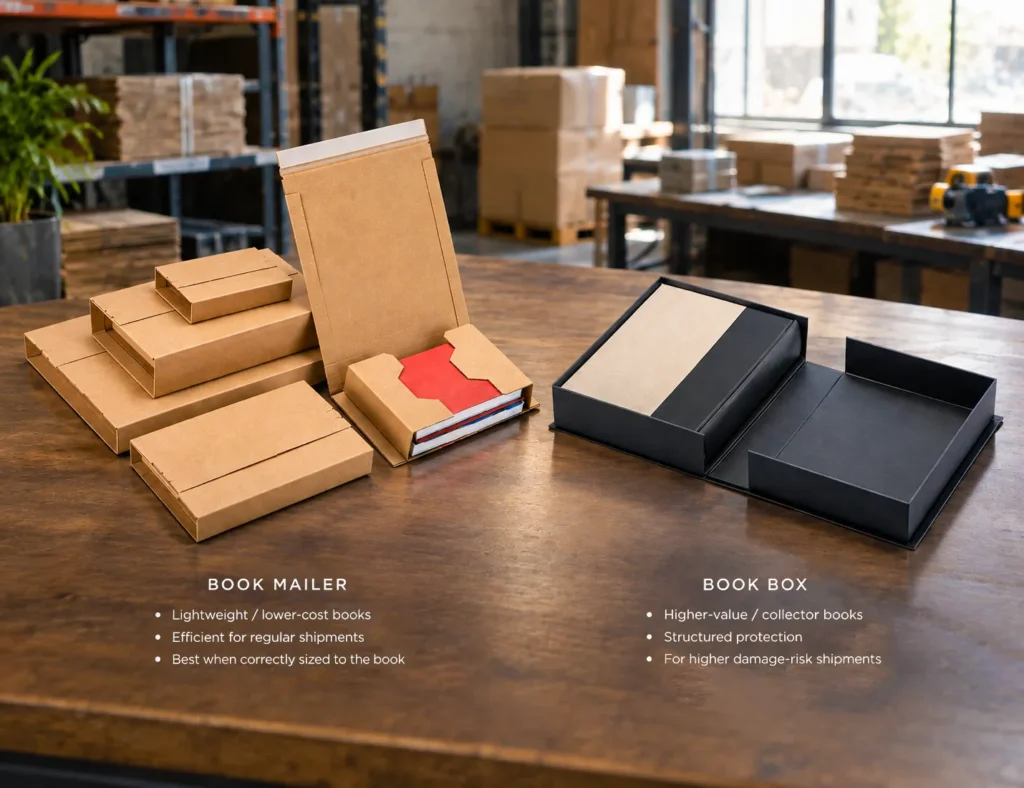
There is a common assumption that a box is automatically safer than a mailer. That is too simplistic.
The real question is:
Which package provides sufficient protection for this particular book under its expected shipping conditions?
A strong, correctly sized mailer can be highly effective for an individual paperback. Conversely, a poorly sized box with excessive empty space can allow a book to move around and sustain damage. For more demanding shipments, however, a custom book box generally gives designers greater freedom to build structural protection into the package. That can include internal supports, partitions, cushioning, or a deeper protective cavity around the book.
Packaging testing follows the same principle. ISTA testing can evaluate packaged products against hazards such as drop shock, vibration, and compression, while the appropriate test depends on the distribution environment and product configuration.
So, when asking which packaging protects books better in shipping, the most accurate answer is:
The packaging that is correctly engineered for the book, shipment weight, handling environment, and distribution route will provide the best protection.
Book Box or Mailer for Bulk Orders?
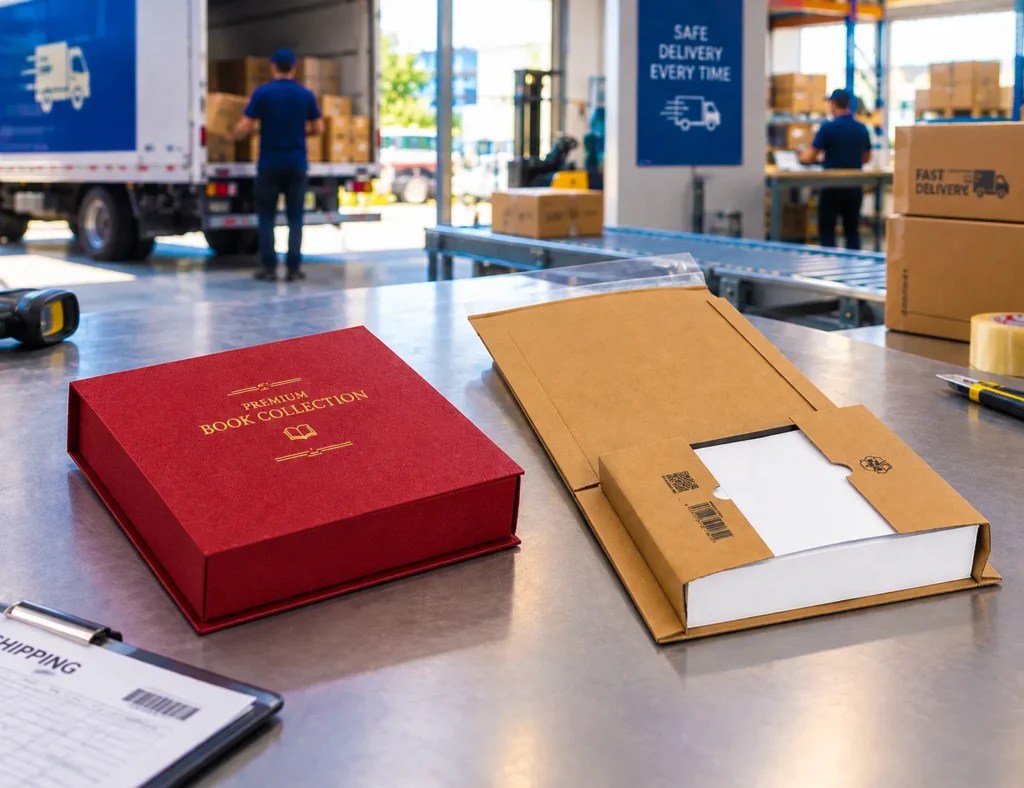
This depends on what you mean by a “bulk order”. If a bookstore receives 100 separate customer orders containing one book each, using individual book mailers may be operationally efficient.
If a publisher sends 100 books to one retailer in a consolidated shipment, individual mailers would usually make little sense. The business may instead need larger corrugated cartons or custom book boxes designed for the combined weight and dimensions. This distinction is especially important for publishers and distributors.
Bulk customer fulfillment favors individual mailers; bulk B2B distribution favors stronger consolidated packaging.
For example, an academic distributor shipping several heavy textbooks to a university needs to consider not only the weight of the books but also stacking, compression, handling, and palletization. A custom shipping carton is likely to be more appropriate than individual mailers.
Custom Book Packaging for Ecommerce
The importance of efficient book packaging has grown alongside online book sales.
The Association of American Publishers reported that U.S. publishing revenue reached $33.4 billion in 2025, with trade consumer-book revenue estimated at $21.7 billion. Publisher sales through online retail grew 3.1% during the year and represented the largest reported sales channel at $12.3 billion.
For ecommerce sellers, this makes packaging part of the customer journey. The customer does not see your warehouse, packing station, or shipping workflow. They see the package that arrives at their door. That package communicates whether your business is careful, professional, premium, sustainable, or simply transactional. This is where custom book packaging solutions can create an advantage.
A custom package can be designed around the actual product dimensions rather than forcing the book into a generic container. It can also incorporate your logo, brand colors, printed messaging, inserts, or other elements that make the delivery experience more recognizable.
Structural Difference Between a Book Box and a Mailer
The difference becomes clearer when you look at the way each package manages physical forces.
A book box creates a more substantial external structure around the product. Its walls and panels help resist external pressure and can provide space for additional protective components. A mailer generally uses folded panels positioned closely around the book. This reduces unnecessary package volume and makes the package easier to store and handle.
Neither structure is inherently superior. The correct choice depends on the balance between protection and efficiency.
For a standard paperback, adding a large amount of packaging may provide little commercial benefit. For a premium art book, the opposite may be true: saving a small amount of packaging cost could be insignificant compared with the cost of replacing a damaged product and disappointing a customer.
Examples: Which Packaging Should You Choose?
Example 1: Independent Author
An author sells signed paperback novels through an e-commerce website. Most orders contain one book, and the books have consistent dimensions.
A custom book mailer is likely the better solution.
It provides an appropriately sized shipping format while allowing the author to add branding without introducing unnecessary packaging volume. Get a free shipping book box choosing guide for publishers, authors, and online sellers today.
Example 2: Premium Publisher
A publisher sells limited-edition hardcovers with dust jackets and premium finishes.
Here, a custom book box is the stronger candidate.
The higher product value and presentation requirements justify a more structured packaging solution, particularly when additional protection is needed around the book’s corners and surfaces.
Example 3: Children’s Book Subscription
A subscription company sends three different children’s books to customers every month.
A custom book box makes more sense because the packaging needs to accommodate several products while keeping them organized and protected during shipment.
The box can also serve as part of the subscription experience, giving the brand more space for printed messaging and promotional elements.
Example 4: Academic Distributor
A distributor sends textbooks to universities and educational institutions.
Because textbooks can be relatively heavy and shipments may contain multiple books, the packaging specification should prioritize structural strength, closure, stacking, and handling performance.
A stronger custom carton or book box is generally more appropriate than an individual mailer.
How to Choose the Right Book Packaging
The decision should start with the product rather than the packaging supplier.
First, measure the book’s length, width, and thickness. Then determine the average number of books per order and the combined shipment weight.
Next, consider how the package will travel. A book shipped locally through a controlled fulfillment network may experience a different handling environment from one moving through multiple parcel hubs.
Finally, consider what happens when the package fails.
If a damaged paperback costs relatively little to replace, your acceptable risk may be different from that of a publisher shipping a $100 collector’s edition.
This is why professional packaging decisions should consider product value, damage risk, fulfillment requirements, shipping environment, and total cost, rather than packaging unit price alone.
What About Sustainability?
Sustainability should also be considered, but it should not be reduced to the simple idea that “mailers are greener than boxes”. The Best book mailers for shipping books safely are now easy to find. Packrole creates them by adopting manufacturing standards that make them green, printed, tear-resistant, water-resistant, and much more affordable.
The environmental impact of packaging depends on its material, weight, dimensions, recycled content, manufacturing, transportation, end-of-life options, and whether it successfully protects the product.
A package that uses slightly less material but results in frequently damaged books and replacement shipments may not deliver the intended environmental or economic benefit.
For businesses seeking paper-based book packaging, recyclable paperboard or corrugated solutions may be appropriate depending on the construction and local recycling infrastructure.
The better objective is right-sized packaging that uses no unnecessary material while still providing adequate protection.
Custom Book Boxes vs Book Mailers: Final Decision
The best choice depends on what you are shipping and how you are shipping it.
Choose a book mailer when your priority is efficient single-book fulfillment. It is particularly suitable for standardized paperback and hardcover orders where compact storage, fast packing, and an appropriately fitted package are important.
Choose a custom book box when your shipment requires greater structural protection or flexibility. Multiple books, heavy textbooks, premium editions, oversized publications, collector’s editions, and gift sets are stronger candidates for a box-based solution.
Faqs:
What is the purpose of book boxes?
Book boxes ship books safely, prevent damage, and help in eco-friendly transit. They are affordable and sustainable.
Why are mailers required for shipping boxes?
Mailer boxes are required to provide lightweight product protection, minimize packaging waste, and reduce shipping costs.
Book boxes or book mailers: which is more expensive?
Book boxes are usually more expensive than book mailers. However, the number of units manufactured, printing technique, packaging sizes, and design complexity all affect the total cost of each of these box types.
Are book mailers suitable for bulk orders?
No, book mailers are usually not suitable for bulk shipping. Shipping cartons and large-sized boxes are required for bulk book shipping.