
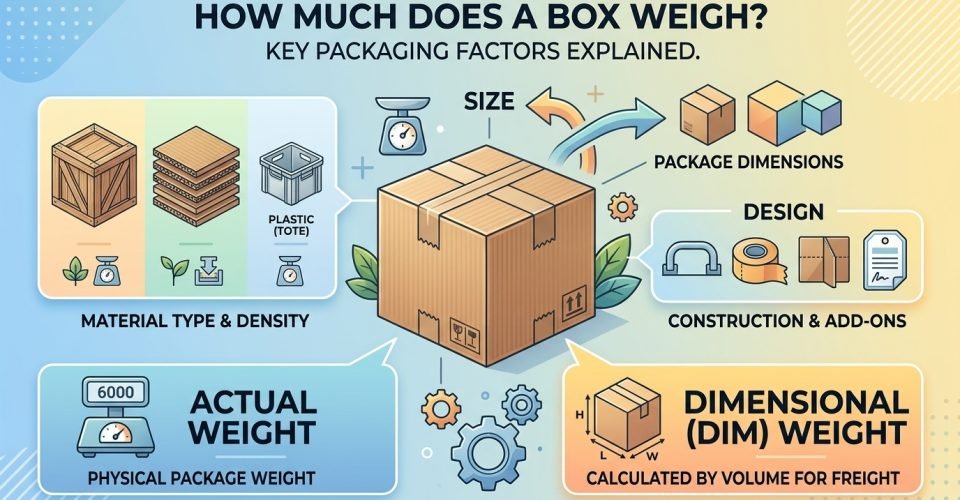
Ordering a perfect box every time is tricky. It needs to focus on many things that could otherwise negatively impact the outcome. Understanding the weight of a box not only helps in better coverage of products but also aids in shipping. The cost of packaging depends on the box and product weights. There is a strong correlation between the product’s weight and the box’s overall weight.
To put it simply, the box’s material must not be too heavy or too light. Heavy boxes affect the product handling, but the lightweight box might not accommodate the product effectively. The correct balance between the box weight, size, and material is vital for businesses looking for safe shipping and impressive presentation.
This blog post is all for those businesses that are juggling between finding the appropriate box weight for their product. To all businesses out there, we want to strike the right balance between product safety and managing the product shipping cost. No worries, we are here to solve this query. Read the blog and know that the accurate box weight can be the game-changer.
Factors Affecting the Weight of a Box:
When determining how much a box weighs, several factors come into play. Choosing the right box material is the most important factor in determining the weight of a custom pack.
Cardboard:
The most common type of box material is cardboard. Cardboard boxes are usually easy to craft, die-cut-friendly, sustainable, and lightweight. It usually doesn’t add to the overall weight of the products, so choosing it would be a nice option.
Corrugated Paperboard:
Corrugated boxes fiberboard consists of a fluted type inner material between two sandwiched outer layers of paper. It’s thicker than other materials, so it’s used for heavyweight electronic equipment and lightweight, fragile items that need additional protection.
Other materials:
Boxes can also be made from materials such as kraft paper, plastic, or even wood. Plastic boxes, for example, have every potential of being heavier than paper-based boxes. Very heavy or oversized products are normally packed in wooden crates; thus, they may significantly increase the overall package weight and shipping costs.
Size of a Box:
The size of a box largely determines its weight. As a general rule of thumb, the larger the box, the more material will be required to construct it. More material means more weight, and the reverse is true for small boxes. Small boxes mean less utility of material and light weight.
Volume & Surface Area:
Volume and Surface area are technical terms. It tells the box makers that a large box would have more length, width, and height. It means more material is needed; again, the exact weight depends on which material you choose.
Design Consideration:
A box with a separate lid, inserts, and cushions affects the weight of the box. Though with smart customization, you can keep the box weight less while ensuring high protection and safety. You must rely on well- structured boxes with lightweight inserts to reduce cost but enhance safety.
Thickness of Material:
The thickness of packaging materials also directly affects the weight of a printed box. Generally, the greater the thickness, the greater the weight. Even adjusting the grades and flutes also impacts the weight of a box.
- Single-walled boxes are usually lighter than double-walled boxes.
- Grams per square meter (GSM) or Points (PT) indicate the thickness of the material. Higher values result in more thickness that eventually increases the weight as well.
Let’s do the Necessary Calculations for Measuring Box weight:
Measuring the dimensions of a perfect box is quite easy, whereas measuring the weight of a box is not. All you need is a measuring balance and confirm it’s properly calibrated. Place the sheet of your selected material of predetermined thickness and note the reading. It would be the weight of a box; however, the total shipping cost depends on your box plus the product weight. So you can measure the net weight also and go through the shipping process hassle-free.
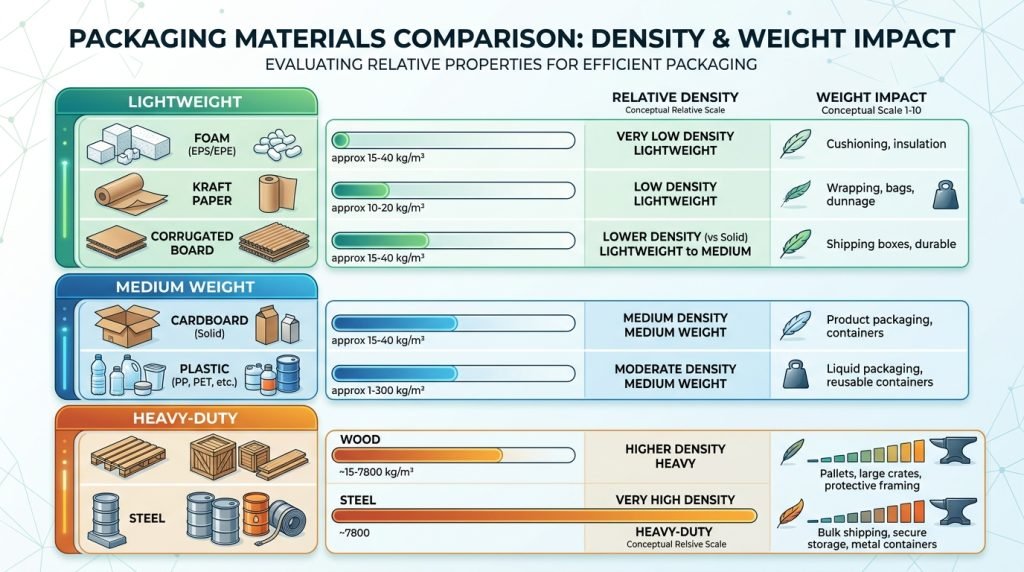
Method to calculate the weight of a box
Weight=Volume × Density× Gravitational Acceleration (g)
Where,
Vol= Length X Width x Height
Density: Density is fixed for different material and mentioned in the table
G= Gravitational constant= 9.18 m/s2
| Material | Density (KG/M3) |
| Cardboard | 700-900 |
| Corrugated | 350-450 |
| Kraft Paper | 800-1200 |
| Wood | 500 – 900 |
| plastic | 920-960 |
| Aluminum | 2,700 – 2,900 |
| Steel | 7,850 – 8,050 |
| Glass | 2,400 – 2,800 |
| Concrete | 2200-2500 |
| Rubber | 1,500 – 1,700 |
| Foam | 30 – 250 |
Weight of a box in Kg
Formula for Weight in Kilograms:
Box Weight (kg)=Length (cm)×Width (cm)×Height (cm)/ 6000
Here,
Length (L), Width (W), and Height (H) are in centimeters (cm).
6000 is the constant used to convert the volume (in cm³) into kilograms based on the average density of cardboard.
Example:
- If you have a box of size 28 x 12 x 17 cm, then its weight will be 0.952kg
- A small box of size 30.48 x 22.86 x 10.16, weighs 1.17 kg.
- A medium size box of size 40.64 x 30.48 x 20.32 cm weighs 4.17 kg.
- A large box of size 45.72 x 45.72 x 40.64 cm weighs 14.01 kg.
Weight of a Box in Pounds
To calculate the weight of a cardboard box in pounds, you can use this formula:
Weight in pound= Length (cm) x Width (cm) x Height (cm)/ 6000 x 2.20462
Here=
L= Length of the box
W= Width of the box
H= Height of the box
2.20462 a constant used to convert the kg to pounds when the density of the material to make the box is fixed.
For example:
- If you have a box of size 28 x 12 x 17 cm, then its weight will be 2.1 pounds.
- A small box of size 30.48 x 22.86 x 10.16, weighs 2.58lbs.
- A medium size box of size 40.64 x 30.48 x 20.32 cm weighs 9.18lbs .
- A large box of size 45.72 x 45.72 x 40.64 cm weighs 30.88 lbs.
Weight of a Box in Grams:
The weight of a box in grams is calculated by this modified formula:
Box weight (gms) = (Length (cm) x Width (cm) x Height (cm))/6
6 is the constant used to convert the box’s volume (in cubic centimeters, cm³) to grams, assuming the average density of cardboard
For Example:
1.If you have a box of size 28 x 12 x 17 cm, then its weight will be 952g
2. A Small Box of dimensions 30.48 x 22.86 x 10.16 cm weighs 1165.6g.
3. A medium Box of dimensions 40.64 x 30.48 x 20.32 cm weighs 4165.2g.
4. A large Box of dimensions 45.72 x 45.72 x 40.64 cm weighs 14005.5g.
Material of a BOX and Its Unit Conversing Constant:
| Material of a box | Conversion coefficient in Kg | Conversion coefficient in grams | Weight in pounds |
| Cardboard | 6000 | 6 | Weight in Kg x 2.2046 |
| Corrugated | 7000 | 7 | Weight in Kg x 2.2046 |
| Kraft Paper | 6500 | 6.5 | Weight in Kg x 2.2046 |
| Wood | 5000 | 5 | Weight in Kg x 2.2046 |
| plastic | 6200 | 6.2 | Weight in Kg x 2.2046 |
| Aluminum | 1200 | 1.2 | Weight in Kg x 2.2046 |
| Steel | 1000 | 1.0 | Weight in Kg x 2.2046 |
| Glass | 1500 | 1.5 | Weight in Kg x 2.2046 |
| Concrete | 1800 | 1.8 | Weight in Kg x 2.2046 |
| Rubber | 7500 | 7.5 | Weight in Kg x 2.2046 |
| Foam | 500 | 0.5 | Weight in Kg x 2.2046 |
Final thoughts:
When you sit to order a proper box that fulfils are your requirements, gathering enough information about the weight is necessary. We understand not every box is worth buying, so we focus on every detail. This complete box weight guide has simply put all the coefficients and constants in table format. Now you just need to select the material and the box size. The relevant formula will help you know the weight of the box that’s coming your way.
If finding the best box seems impossible to you, believe in the transparency. Believe in Pack Role. We help you customize a box that meets all your requirements, from weight to dimensions. Contact our experts now!