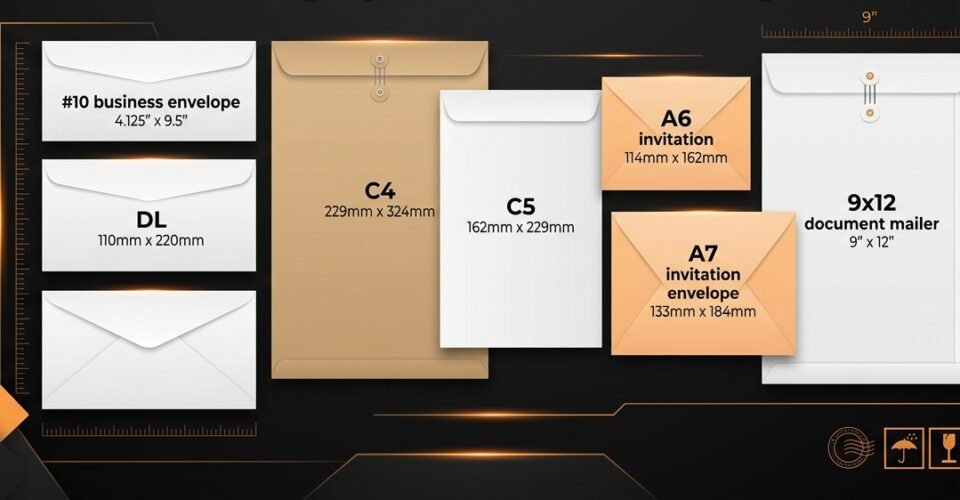
Businesses, packaging and professional mailers need to know the standard envelope sizes and how they are used.
Even the smallest of details, such as envelope sizes, have a big impact on branding, postal efficiency, customer perception, and optimizing costs in today’s packaging and printing industry. The universal message from the leading print companies and packaging companies in the United States is that it is a vital point of professional communication as well as scalable business mailing systems to use standard envelope sizes.
Whether you’re sending out enterprise mailers or for small business, knowing your envelope dimensions is not a choice, it’s a business necessity!
The importance of standard envelope sizes in business packaging
The leading US packaging and mailing providers emphasize the direct effect of the envelope size on mail processing time, postage classification, and brand presentation uniformity.
These envelopes are divided into two types: “letter” and “flat”, based on the size and thickness to influence postage levels and the automation compatibility.
The non-standard envelopes can cause:
- Higher postage costs
- Delayed or rejected mail
- Poor document presentation
- Reduced automation efficiency
That’s why companies such as USPS-friendly suppliers and commercial packaging manufacturers are developing their products around standard sizes, like 10, DL, C5 and C4.
Global Standard Envelope Sizes standards (USA vs International)
One of the biggest confusions with packaging is that envelope sizes are not standardised. There are two systems mainly adhered to by the industry:
1. US Standard Envelope System
This system is extensively used in the USA and Canada and consists of:
- Commercial envelopes (business mail)
- Announcement envelopes (invitations)
- Large numbers of catalog envelopes (bulk documents)
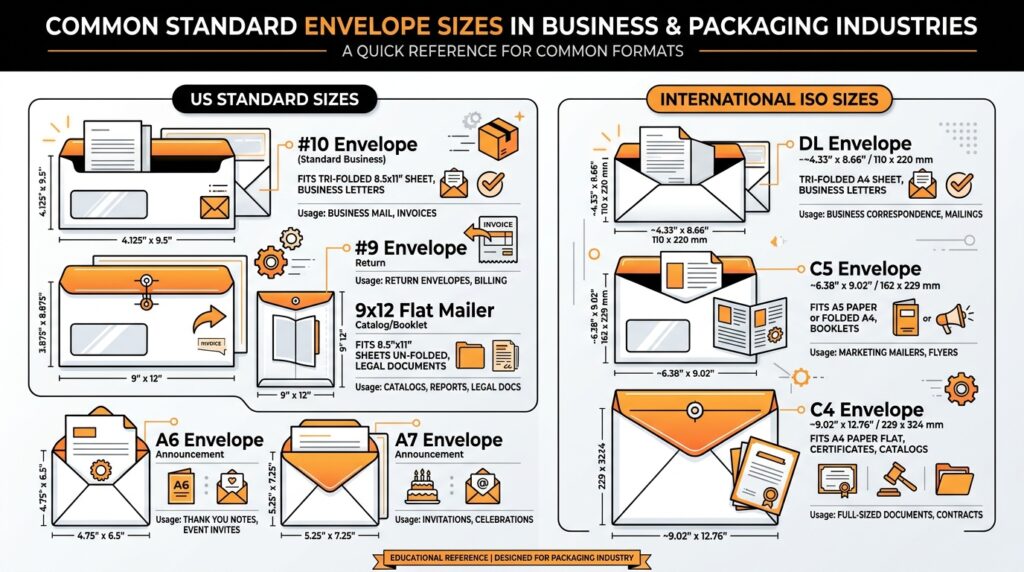
The most popular size is the 10 envelope (4.125 x 9.5 inches) size that is recognized as the business communication standard.
2. ISO (International) Envelope System
It is used throughout Europe, Asia, and most of the world, and uses A-series paper sizes and consists of:
- C series (folded/unfolded documents)
- DL format (most common business international envelope)
For example:
- DL = A4 folded into 1 third folded
- C5 = A4 folded in half
- C4 = A4, no folding (Envelopes US)
The standardized relationship of the paper and envelope size is what makes ISO standards more internationally uniform.
Most common standard envelope sizes in the USA are listed below!
The following is a summary of the most commonly used envelope sizes in the American packaging and mailing industry:
- 10 Envelope (Business Standard)
- Size: 4.125 × 9.5 inches
- Placement: Modern, left hand page side.
- Fits: regular letter size paper folded in thirds.
This size is the most common postal size used in the office and the most automated postal size.
9 Envelope (Reply Envelope Standard):
- Often used on envelopes for business mail, as a return envelope.
- Slightly smaller than 10
- For inserts, payments, and responses it is used commonly
A2, A6, A7 (Announcement & Invitation Series)
Common applications include events, premium stationery, and marketing.
- B2 refered for small card and RSVP mail
- A6: used for small cards and invitation
- A7: a common pick for premium event mail and wedding invitations.
These sizes are often employed for high quality branding materials and luxury invitations for US packaging companieslikw Pack Role.
C-Series Envelopes (International Standard)
The C5 box contains folded pieces of A4 paper (C4: A4 sheets – no folds (full A4)).
C-series envelopes are widely used in high-quality reporting systems, legal documents, and worldwide communication within the corporate world.
9×12 Envelope (Flat Mailer)
It’s a best partner of documents that are to be kept unfolded.
- Reports
- Certificates
- Portfolios
- Legal paperwork
This size is referred to as a “flat” and typically applied in professional packaging systems that are used to protect documents.
How US Packaging Companies are using Envelope Standards:
Three key business needs drive envelope solutions designed by leading US packaging companies and print service providers:
1. Automation Compatibility
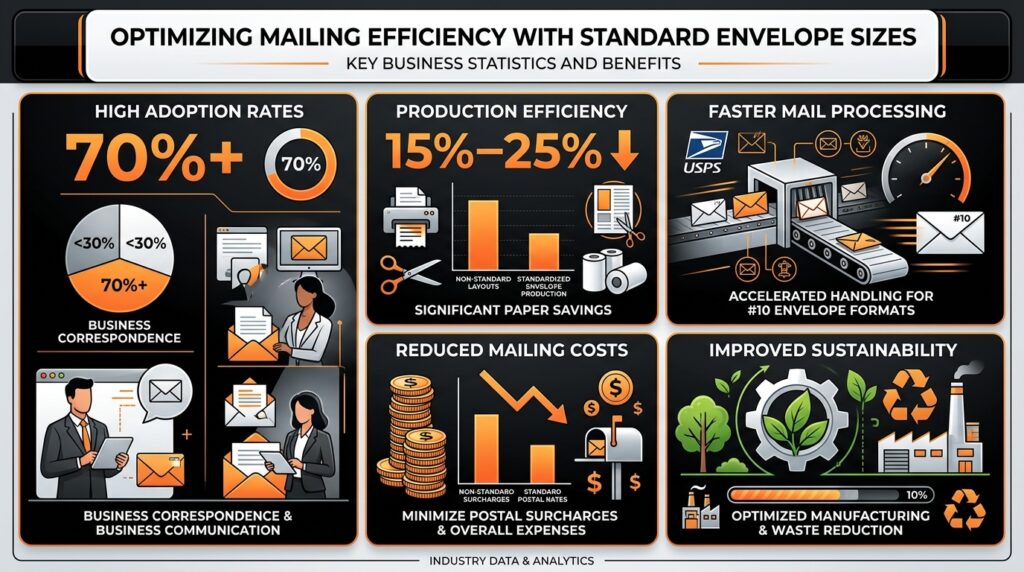
The sizes of envelopes such as 10, have been designed for the high-speed mailing machines that are part of bulk mailing systems.
2. Branding & Custom Printing
Companies provide tailored envelopes that are available in regular sizes to keep up:
- Logo placement consistency
- Brand color accuracy
- Marketing message visibility
3. Cost Efficiency
Standard sizes reduce:
- Material waste
- Printing setup costs
- Postal surcharges
That’s why most direct mail marketing campaigns are strictly based on standard format.
Envelope Size Selection: A Strategic Business Decision
Envelopes are not only functional, they are strategic.
Key decision factors:
1. Document Type
Letters → 10 or DL
Certificates → C4 or 9×12
Invitations → A6 or A7
2. Folding Requirement
To save on mailing costs, folded documents are also sent through.
Unfolded documents = premium presentation
3. Brand Positioning
No business look → 100, DL
As a luxury car brand, A7, C4 provides high-end communication.
4. Postal Cost Optimization
USPS sorts mail by size and thickness which affects postage rates.
What are the reasons behind the shift towards standardized envelope systems?
Extended use of the container shelf life, which is why more and more modern packaging companies are turning to a standardized envelope system, as it allows for:
- Quicker delivery of ecommerce and direct mail products.
- Lower operational complexity
- Consistent customer experience
- Reduce material waste to create better sustainability.
Standardization is not only a design decision, it’s a supply chain optimization strategy.
Sustainability in Envelope Manufacturing
Top Packaging Companies USA are also making efforts to incorporate sustainability into their production of envelopes and taking the some considerable measures like Using Recycled kraft paper and other FSC-certified materials, use Soy-based inks, and choosing minimal adhesive designs.
Furthermore, utilization of standard envelopes promotes sustainability in a variety of ways, such as through efficient cutting patterns and minimizing waste in mass production.
Understanding Envelope Sizes With Real World Examples:
Real-World Fact Block 1: USPS Mail Classification & Cost Impact
The United States Postal Service (USPS) says that in addition to weight, envelope size, thickness, and machinability are also significant factors in determining mail pricing. The standard-sized letters (10 envelope) are deemed “automation-compatible” letters and are processable at high speed.
Automation-compatible mail can be sorted at thousands of pieces per hour, versus irregular-sized envelopes that may be manually sorted and charge more for postage. An automation-compatible piece is defined as a mail piece that has not been intentionally altered for sorting by a machine.
That’s one reason why companies in America demand standardized formats, such as bulk mail 10 envelopes, for invoices, direct mail, and other business correspondence.
Real-World Fact Block #2: Size Standardization for Envelopes in the global printing industry
According to industry packaging reports by the largest US and European print companies, more than 70% of all business correspondence is still being printed in standard envelope sizes including:
- 10 (US business standard)
- DL (international business standard)
- C5 and C4 (Document mailing formats)
These sizes are used extensively in various businesses, including commercial print and packaging manufacturers, and are important for maximum paper utilization, reduced cutting waste, and faster production cycles.
That’s why regular envelope sizes are essential to any industrial printing solution worldwide.
Real-World Fact Block 3: Paper Efficiency & Manufacturing Optimization
Standardization is an important aspect of packaging production, particularly in terms of material usage.
From a packaging engineering point of view based on the commercial converting industry, standard envelope sizes could save up to 15-25% of paper in mass production when compared to custom irregular sizes.
This efficiency is achieved through:
- Optimized die-cutting layouts
- Reduced offcut material
- A wide range of batch production support.
This means cost reduction and better sustainability measures for packaging manufacturers.
Final Thoughts
The world’s communication systems rely on standard envelope sizes as their underlying infrastructure. Every size of US 10, ISO DL, and C series has a purpose like efficiency, clarity, and professional presentation.
For businesses, the right envelope size isn’t a matter of mailing, it’s a matter of reducing costs, improving brand perception, ensuring postal compliance, and enhancing customer experience.