Cereal boxes come in lots of different sizes, shapes, colors, and dimensions. Just like its countless flavors, cereal boxes’ dimensions and shapes also come with endless possibilities. The best part is it’s totally customizable in this era. Affordable, eye-catching and totally accountable. Custom cereal boxes are one of the favorite marketing tools for businesses just stepping into or endeavoring in the food and beverages industry for years.
You might be here to know what size of a box you can go for easily for your next launch. Don’t worry, in this blog post we will help you come out with a choice that would definitely work. Stay here and learn how tall a cereal box should really be.
Prepare Your Notes First!
Whenever it’s time to make a wonderful cereal box that speaks for the volume, strong planning always succeeds. Before getting your hands dirty in the process of manufacturing a box for cereal, you must know everything about your dream packaging. Every business, small business or large business, has a plan to follow. Packaging for food products must implement it strongly.
While making such notes you must think about the following aspects of packaging.
- Does one size fit all my products?
- What is the net weight of cereal servings to be sold?
- Do I need to follow the industry trends or this time going beyond the boundaries can do wonders?
- What do I actually need in a box?
- Do I have any ideas for my cereal box packaging?
Know Your Audience:
To whom I am making cereal? If a manufacturer starts with such queries getting resolved in preliminary stages of customization, getting closer to a mastery creation becomes a breeze. No excuse, no regret. Everything that is superb.
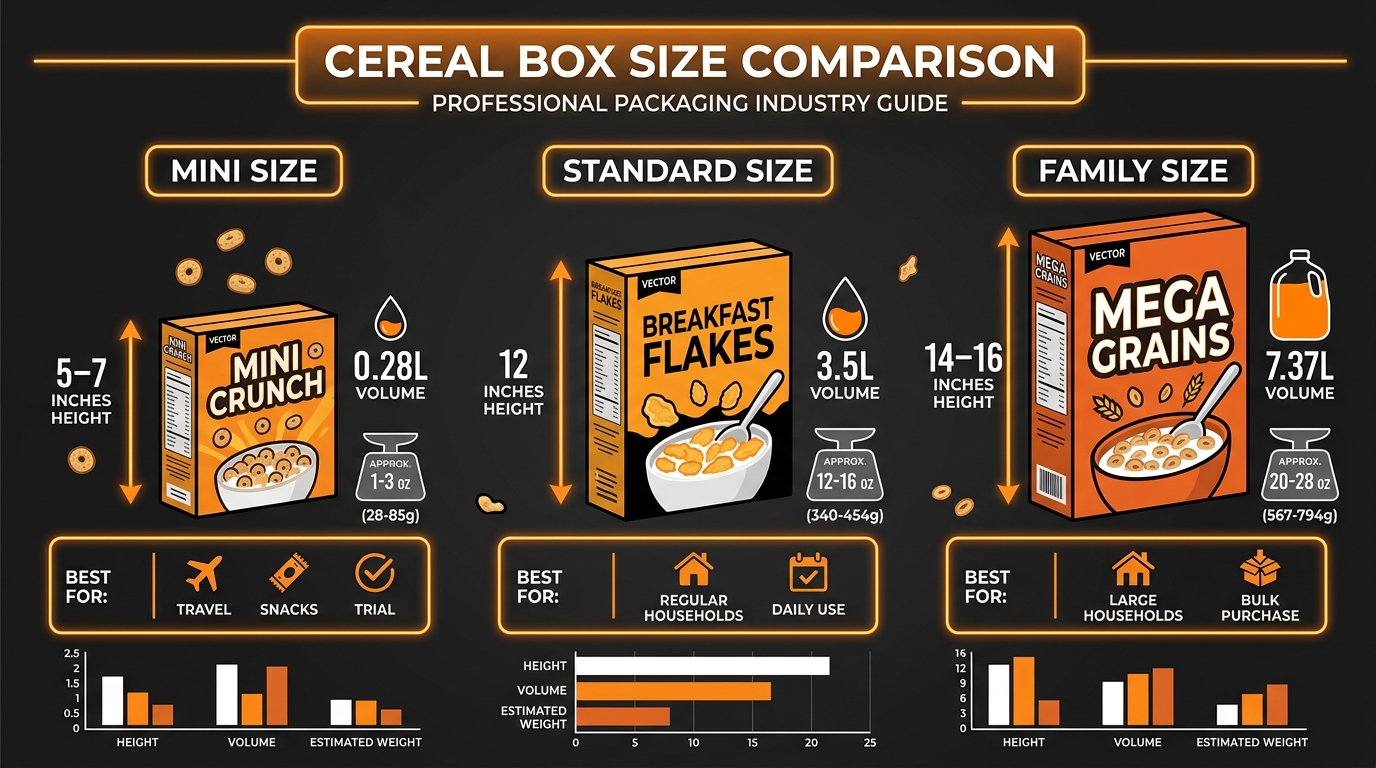
Cereal boxes usually come in three sizes standard, small or mini, and large or family size. This guide will elaborate these sizes (weight, and dimensions) in detail. However, knowing your audience will help you get your boxes designed in a perfect way. It means a perfect box in terms of branding, functionality, and promotions as well.
Do’s and Don’t of Cereal Packaging:
| Category | Do’s for Cereal Packaging | Why It Matters | Don’ts for Cereal Packaging | Negative Impact |
| Material Selection | Use food-grade and durable packaging materials such as cardboard or kraft paperboard | Ensures product safety and prevents contamination | Don’t use low-quality or non-food-safe materials | May damage product quality and reduce consumer trust |
| Freshness Protection | Add an airtight inner plastic or biodegradable liner | Protects cereal from moisture, air, and contamination | Don’t leave cereal exposed without proper sealing | Cereal can become stale and lose crunchiness |
| Box Strength | Choose sturdy packaging that can handle shipping and stacking | Prevents crushing during storage and transportation | Don’t use weak or thin boxes | Boxes may collapse or tear easily |
| Product Information | Clearly print nutritional facts, ingredients, expiry dates, and barcode | Helps customers make informed buying decisions | Don’t hide important information in small fonts | Can confuse consumers and reduce credibility |
| Branding & Design | Use attractive colors, readable fonts, and eye-catching graphics | Improves shelf appeal and brand recognition | Don’t overcrowd the design with too much text or imagery | Packaging may look unprofessional and difficult to read |
| Sustainability | Use recyclable or eco-friendly materials whenever possible | Supports environmental responsibility and modern consumer preferences | Don’t rely heavily on unnecessary plastic packaging | Increases environmental waste and harms brand image |
| Package Size | Design the box according to the cereal quantity | Maintains customer satisfaction and reduces wasted space | Don’t use oversized boxes with too much empty space | Customers may feel misled about product quantity |
| Storage Protection | Ensure packaging provides resistance against humidity and external damage | Extends shelf life and preserves quality | Don’t ignore environmental storage conditions | Product quality may deteriorate quickly |
| Transportation | Use compact and stackable packaging designs | Makes shipping and warehousing more efficient | Don’t create unstable or awkward box structures | Increases risk of transport damage |
| Consumer Convenience | Make packaging easy to open and reseal if possible | Enhances user experience and product usability | Don’t use difficult-to-open seals or weak closures | Creates frustration for customers |
Takeaway A Few Quick Dimensions for Cereal box:
Standards Cereal Box Dimension:
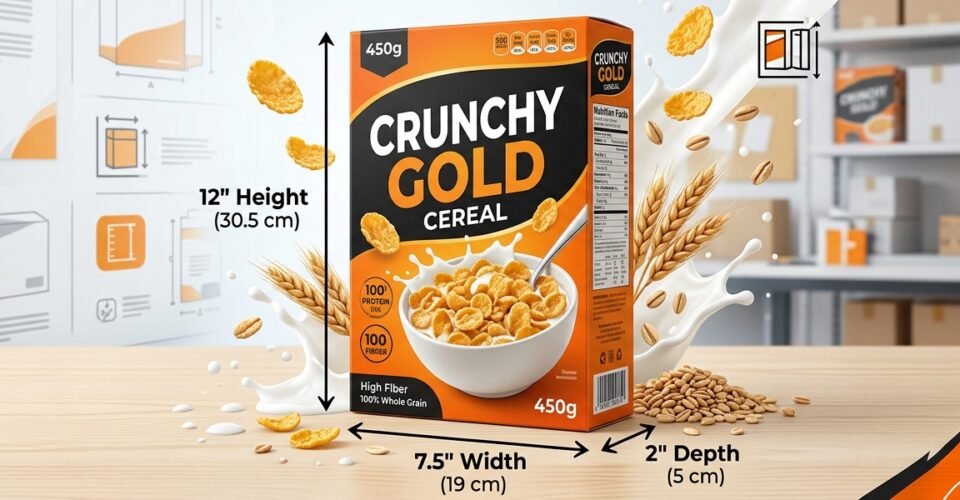
Whatever is your requirement about a cereal box. Here is a standard dimension that big brands often choose for their packaging of their cereals.
Height= 12 inches or 30.5 cm
Width= 7.5 inches or 19 cm
Depth = 2 inches or 5 cm
How tall is a cereal box?
It’s the height of a box that determines how tall the box is. Usually it’s 12 inches and 30 .5 cm. You might for its variations as well. Other versions of a cereal box height includes:
Family Size= 14 – 16 inches
Mini Cereal box or Single Serving= 5-7 inches
How thick is a box of Cereal?
For customizing a perfect box you must also know about its thickness as well. The standard thickness for a cereal box is about 2 to 2.5 inches thick. However, it varies as the cereal manufacturers’ requirements vary. For a mega or family size box it is about 3 inches. Likely, a single box such as single serving or mini box it’s thickness reduces to about 1 inch.
What Should Be The Volume of A Cereal Box?
Volume is another important factor about the cereal boxes manufacturing. The volume of a box varies as its dimension changes.
For sample:
If you are ready to move with the flow, your standard cereal box volume would be approximately 216 cubic inches or 3540 cubic centimetres. That would be approximately 3-3.5 liters. Likewise:
- A family size or a large box volume is 450 cubic inches or 7374 cubic centimeters (7.37 liters).
- A mini Cereal box (single serving) box volume is approximately 17.5 cubic inches or 287 cubic centimetres (0.28 liters).
What is the approximate Weight of a Cereal box?
The weight of a box for cereals is important for protecting these crispy delights. Light weight boxes may fail in giving the maximum protection to good products, either in shipping or storing. Here are quick notes that help you customize boxes in an appropriate weight range.
- For a standard cereal box the weight must be around 12 to 18 ounces or 28 to 56 grams.
- Family size boxes usually weigh between 20 to 24 ounces (570 to 680 grams).
- Mini or single servings are usually customized in weight range between 1 to 2 ounces (approximately 28 to 56 grams)
If you feel trouble converting grams to ounces, see our details guide on how many grams in an ounce.
Net Weight Vs Gross Weight:
Net Weight vs. Gross Weight of a Cereal Box
When discussing cereal packaging, it is important to understand the difference between net weight and gross weight. The net weight refers to the actual amount of cereal inside the package, excluding all packaging materials. On the other hand, the gross weight includes the cereal along with the cardboard box, plastic pouch, labels, and other packaging components.
For example, imagine a cereal brand selling a box containing 500g of cornflakes. If the cardboard box and inner plastic packaging weigh an additional 50g, the total package weight becomes 550g. In this case:
- Net Weight = 500g
- Gross Weight = 550g
Understanding these terms is essential in the packaging industry because net weight helps consumers know how much product they are buying, while gross weight is important for shipping, storage, and transportation calculations.
Note: If you go for a standard size that means you would have ample space for branding and appropriate box size for product protection. If you want to know about food packaging please see ‘how to choose the right food packaging for your product’.
For more accurate weight measurement of a cereal box you can see our blog post: how much does a box weight? A complete guide.
Choose the Right Material For A Cereal Box Packaging:
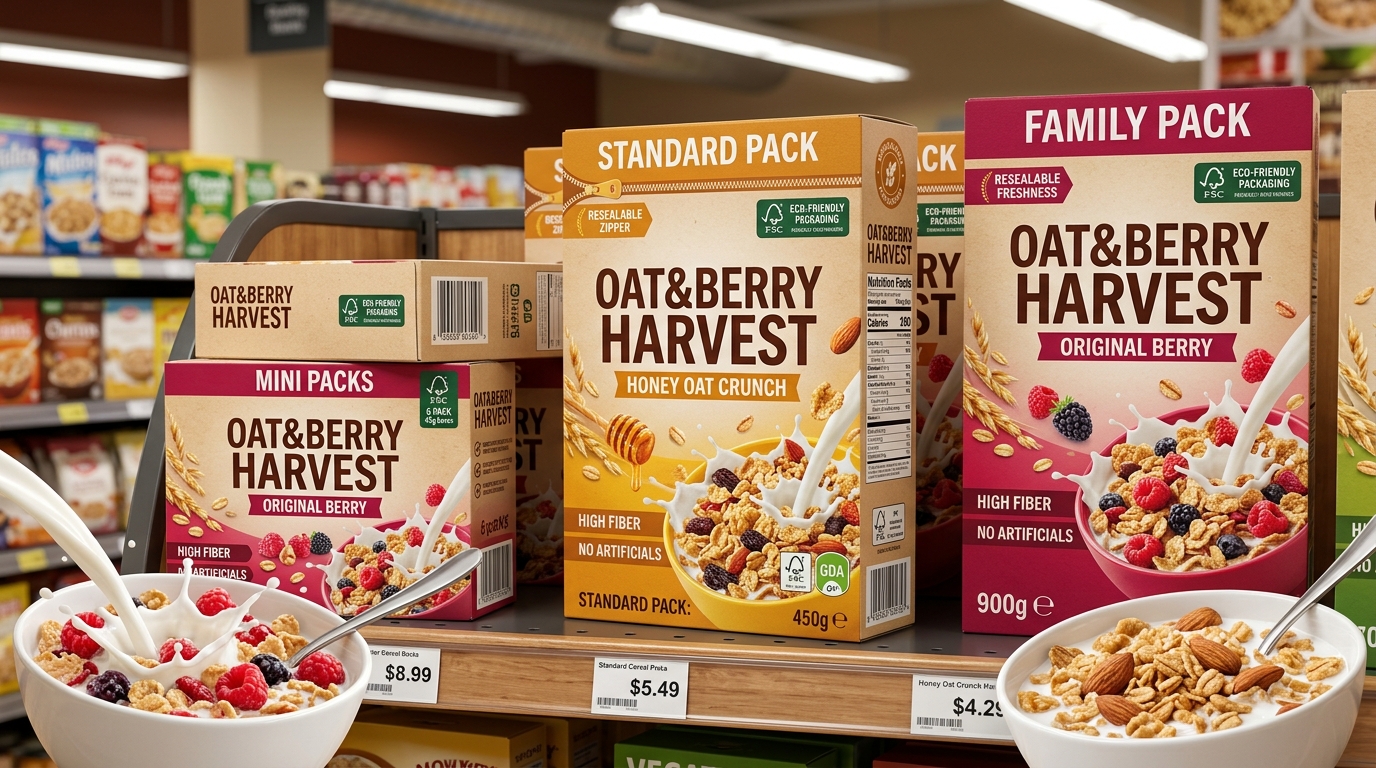
Packaging defines how best your product will perform in the market. To make it a strategic move, cereal box packaging materials also matter a lot. Here are a few simple things that help you get your hands on the best possible material.
The best options available this time for a perfect cereal box is Paperboard or cardboard. It’s up to the mark, follows all food grade packaging standards, and is printing friendly. However, it’s weak in giving your cereals protection against moisture and humidity. Thereby, it’s often lined with a thin polyethylene lining that protects food from extreme weather, shipping, and branding problems.
For example, a typical cornflakes package may include a printed cardboard carton combined with a sealed inner plastic pouch. The cardboard folding carton offers strength and shelf appeal, while the plastic liner preserves crunchiness and extends shelf life. Many modern cereal brands are also shifting toward eco-friendly and recyclable packaging materials to reduce environmental impact. Sustainable kraft paperboard and biodegradable liners are becoming popular choices among environmentally conscious brands and consumer