When unlimited packaging styles make it difficult to choose the right box for your books, cardboard mailer boxes find their way. Books are judged by their cover, so we design boxes to protect not only the cover but also the corners and spine. When it comes to choosing book boxes to prioritize protection while shipping, corrugated mailers are at top. Likely, if affordability and sustainability are the major brand concerns, cardboard mailer boxes are the best option available.
Book brands choose cardboard for making mailer boxes due to their environmental advantages. The U.S. Environmental Protection Agency reported that 32.1 million tons of corrugated boxes were recycled in 2018, equal to a 96.5% recycling rate. This makes corrugated cardboard one of the most widely recycled packaging materials in the United States.
Despite their eco-friendly nature, they are completely printable. Brand logos, adhesive-free interlocking, and smart presence all make these boxes the first choice for branded books- so from now on, all books reach their destination in pristine condition.
What Are Cardboard Book Mailers? How Do Cardboard Book Mailers Look?
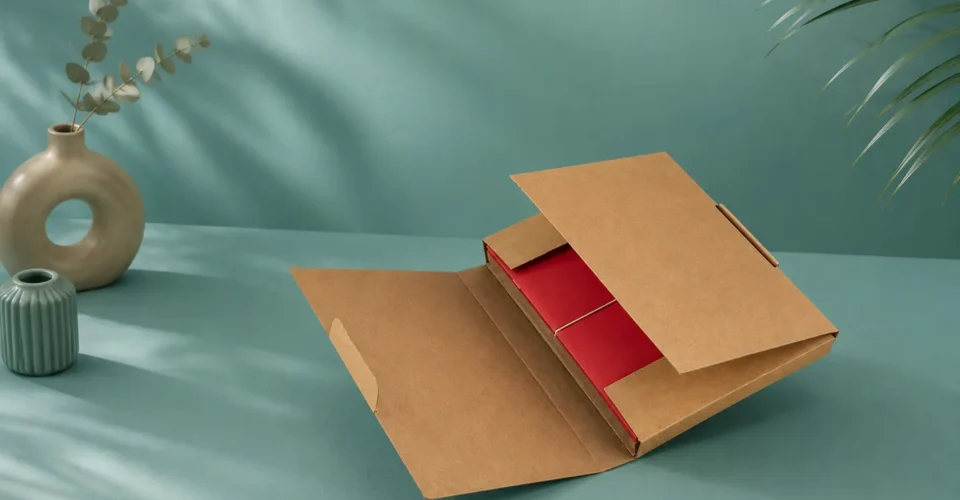
Self-locking Cardboard mailers are a flat, die-cut packaging type that folds around a book to create a close-fitting protective pack. Most designs use scored lines and overlapping panels, allowing the mailer to accommodate different book thicknesses. Protective side and corner flaps help keep the book stable, while self-seal adhesive strips can speed up packing.
Why Are They Used?
Books can be damaged by corner impacts, cover scuffing, bending, and movement inside oversized packaging. Thus, these book boxes are designed to reduce this unused space by wrapping closely around the product. Their purpose-built structure can also reduce the need for separate padding and filling materials. They streamline order packing and reduce material usage by making exact dimension of cardboard book wrap packaging.
Who Needs Cardboard Book Mailers?
Online bookstores, publishers, book subscription services, and independent booksellers can use book mailers for direct-to-customer deliveries. Gift boxes, shipping boxes, rigid boxes, and folding cartons are also used for shipping books by self-publishing authors, fulfillment companies, and libraries. They are particularly useful for businesses shipping single books or small quantities through postal and courier networks.
Cardboard Book Mailers vs Other Book Packaging
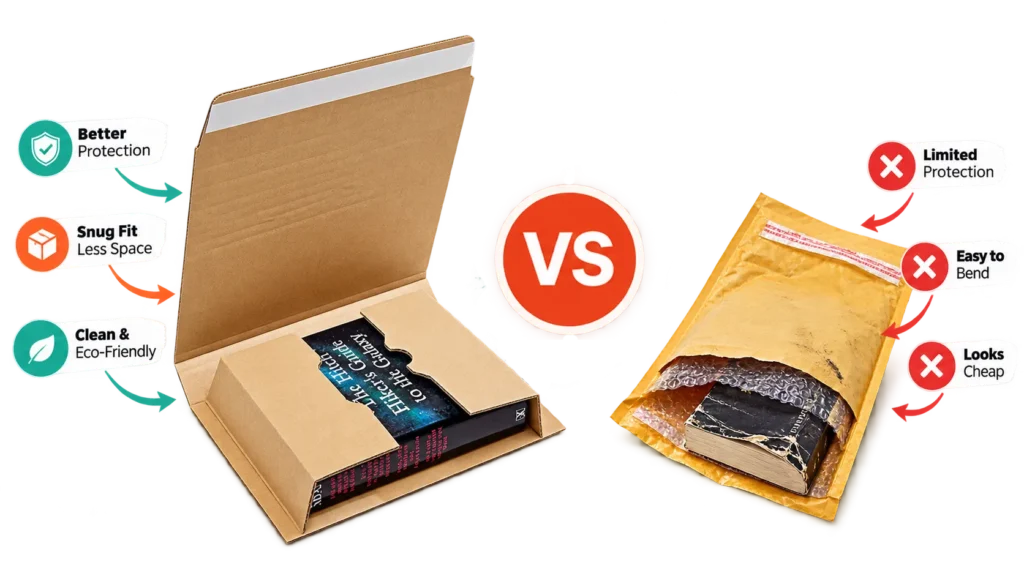
Market practices show that wholesale cardboard book mailers occupy a practical position between lightweight bubble mailers and larger corrugated shipping boxes. Bubble mailers are commonly chosen for lighter books because they are compact and provide cushioning, but they offer limited resistance to bending.
Corrugated boxes provide stronger protection for multiple or heavier books but often require additional void fill. Cardboard book mailers provide a closer fit, helping secure individual books while using less space. Packaging selection generally depends on book weight, binding type, order quantity, and the level of protection required during postal or courier delivery.
| Book Packaging | Protection | Best For | Space Efficiency | Main Limitation |
| Cardboard Book Mailers | High | Hardcovers, paperbacks, premium books | High | Less suitable for very large multi-book orders |
| Bubble Mailers | Moderate | Lightweight paperbacks and low-value books | High | Limited rigidity and corner protection |
| Corrugated Boxes | Very High | Multiple, heavy, or oversized books | Moderate–Low | More material and often requires void fill |
| Paper Mailers | Low–Moderate | Lightweight, low-risk shipments | High | Limited protection against crushing and bending |
| Padded Paper Mailers | Moderate | Single books needing light cushioning | High | Less rigid than dedicated cardboard mailers |
Quick takeaway: For single-book shipments, cardboard mailers offer a strong balance of rigidity, product protection, compactness, and material efficiency. Corrugated boxes become more practical as shipment weight and quantity increase.
The Secret Behind the Eco-Friendly Nature of Cardboard Book Mailer Boxes
Made from a Renewable Paper-Based Material
The environmental advantage of cardboard book mailers begins with their primary material: paperboard or corrugated fibre. Paper-based materials can come from responsibly managed forests and recycled fibre. The Forest Stewardship Council notes that paper and cardboard are renewable and recyclable when responsibly sourced and processed.
High Recycling Potential
Recyclability is one of cardboard’s strongest environmental benefits. According to the American Forest & Paper Association, 71–76% of cardboard available for recovery in the United States was recycled in 2023. This high recovery rate supports the environmental value of cardboard book mailers by showing that cardboard has an established collection and recycling system.
Supports a Circular Material System
Recycling allows recovered paper fibres to return to paper and board production rather than becoming waste. In Europe, the paper recycling rate reached 75.1% in 2024, according to industry data from Cepi, demonstrating the established scale of paper recovery systems.
Design Also Matters
A cardboard mailer is not automatically sustainable simply because it is paper-based. Its environmental performance depends on factors including material quantity, recycled content, responsible sourcing, coatings, adhesives, and whether the finished package can be effectively recycled. Therefore, a right-sized cardboard book mailer made with responsibly sourced or recycled fibre can combine product protection with a lower-material, recyclable packaging approach.
Cardboard Book Mailers Price:
The economics of book packaging depend on more than the purchase price of one mailer. Material usage, package size, storage, shipping weight, and packing time all affect the final cost. Current packaging-market guidance confirms that smaller, lighter packaging can reduce both packaging and transportation expenses, while correctly sizing a mailer can help avoid unnecessary volumetric shipping charges.
| Packaging option | Example U.S. price | Bulk-saving potential | Best suited for |
| Cardboard book mailer | From $0.35–$0.44/unit | High | Individual books |
| Corrugated literature mailer | $0.84–$1.48/unit | High | Books & flat products |
| Custom book mailer, small quantity | $2.59–$5.20/unit | High | Short custom runs |
| Standard book shipping box | From $0.50/unit | High | Larger/heavier books |
For example, one U.S. supplier currently lists a literature mailer at $1.48 for 50 units, falling to $0.84 at 1,250 units. This demonstrates an important market trend: the per-unit cost decreases substantially with volume, making cardboard mailers particularly economical for publishers, bookstores, and high-volume e-commerce sellers.
Important: These are packaging prices only; actual shipping costs depend on dimensions, weight, destination, carrier, and service level.
Cardboard Book Mailer Size Guide
Choosing the right dimensions helps prevent excessive space while maintaining adequate protection. U.S. packaging guidance recommends sizing the mailer around the product’s length, width, and thickness.
| Book Type | Suggested Mailer Size |
| Digest/small paperback | 9 × 6½ × 1¾–2¾ in |
| Standard paperback | 10 × 7–10 × 2 in |
| Hardcover/booklet | 12⅛ × 9¼ × 2 in |
| Multiple books | 16 × 12 × 4 in |
Pro Design Tips
Use adjustable depth folds, strong corrugated board, secure closures, and minimal space. Flat-shipping construction can also reduce storage requirements. However, you must avoid some common mistakes when designing booklet boxes. Like, designing the box without measuring the book dimensions and ignoring book weight while deciding material thickness. Get a free consultation about the designs from Packrole cardboard book mailer packaging designers.
Brand Benefits
A well-designed mailer can protect products, streamline fulfillment, reduce excess packaging, and create a stronger unboxing experience.Custom graphics and inserts can further reinforce brand identity and customer recognition.
Conclusion
Cardboard book mailers offer a practical balance of protection, cost efficiency, and material responsibility for modern book shipping. Their close-fitting construction helps protect covers, edges, and corners while avoiding the unnecessary space often associated with oversized boxes. For publishers, online bookstores, independent sellers, and subscription businesses, choosing the correct size and board strength can improve packing efficiency and support more consistent deliveries. Their paper-based construction also gives them an established recycling pathway in many markets. Ultimately, the best mailer is not simply the cheapest option—it is one that matches the book’s dimensions, weight, value, and shipping conditions while using packaging material efficiently.
FAQs
What is the best mailer box for books?
An adjustable long-fold and wrap-style mailer is the best type of book mailer. They prevent the edges and spine from being damaged.
What size cardboard book mailer do I need for my book?
The correct size depends on the book’s length, width, and thickness. A close fit helps limit movement during transit.
Are cardboard book mailers recyclable?
Cardboard mailer boxes are recyclable after removing the laminations, coatings, and other non-recyclable materials, if any.
Which material is strong enough to protect books during shipping?
32 ECT singled- wall corrugated (E and F flute) mailer boxes are best for shipping books.
Which book mailers are cheaper than shipping books in boxes?
A standard brown corrugated Kraft mailer box in small size ( 5 x 4 x 2 or 4 x 4 x 3 inches) is the most affordable option for a book e-commerce brand.
How to seal a cardboard book mailer?
Place the book inside the mailer box and press the pre-scored fold lines gently. Fold the flaps and peel the protective paper to expose the adhesive strips to seal them.