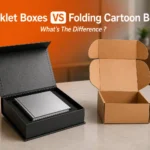
Packaging in this era is all about showing your creative side to customers. Choosing the right color, style, and material are important, but finding which type your respective industry particularly appreciates matters the most. If you have a proper logo, brand theme, and color combination for your brand, you might stick on whether a rigid box goes well or folding cartons are what your customers would expect. Read this blog till the end and decide on your own.
The decision between these two isn’t only a matter of visual appeal; it’s a strategic choice that can affect your profitability, shipping operations, and brand image. From high-end perfumes to eco-friendly snack packaging, it’s crucial to grasp all the basic differences between the two.
What is the real difference? Defining the Contenders.
Before we get to the “which is better” conversation, let’s clarify what we’re taking a look at. They both consist of paper materials, but their construction and “vibe” are totally different. Lets see how:
What is a Folding Carton?
Consider a box that your favorite cereal is stored in, or the light box with your favorite tube of toothpaste. Folding cartons are made from a single sheet of paperboard (also known as SBS or Kraft board). They are die-cut, folded, and sent to your warehouse flat.
Thickness: Usually between 10pt to 24pt (0.010 to 0.024 inches).
Main Feature: They “fold” flat, allowing for huge storage space savings.
What’s a Rigid Box?
They are also called “set-up boxes” and are heavy weights. Consider the iPhone box or a fancy jewel box. Made from a very stiff chipboard (typically 40pt to 80pt in thickness) and then covered with a “skin” of high quality printed paper or cloth. Explore more in our post Why Rigid Boxes Are the Ultimate Luxury Packaging Choice
Thickness: Much thicker and denser than folding cartons.
Key Feature: They do NOT “collapse”. They stay in shape from the manufacturing facility to the customer’s hand.
Structural Showdown – Durability and Protection
When your product is easily breakable or quite heavy, the strength of your box is not an optional feature; it’s a must.
Folding Cartons – The versatile Sprinter
Cartons are a very effective package for the light weight protection of products. They are flexible and will take a bit of “bounce” during transport. They do not, however, have “crush resistance. When 10 heavy folding cartons are placed one atop the other, the bottom carton will probably bend under the weight.
Rigid Boxes: The Fortified Fortress
Rigid boxes are the best option for protection. The exoskeleton is provided by the dense chipboard core. That is why almost all electronics and glassware are packaged in rigid packaging. It conveys a sense of permanency, you don’t discard a stiff box; you reuse it.
Interesting Fact: Apple Unboxing Experience is patented! The hardness of their rigid boxes is designed in such a manner that the bottom tray slides out at an appropriate speed, which gives the customer a moment of “anticipation”.
| Feature | Folding Carton | Rigid Box |
| Unit Cost | Low ($0.10 – $2.00) | High ($2.00 – $15.00+) |
| Tooling/Setup | Moderate | Higher (often requires custom molds) |
| Shipping Cost | Low (Ships flat) | High (Ships “full of air”) |
| Storage Space | Minimal | Substantial |
| MOQ | Usually 500 – 1,000+ | Usually lower (often 250+) |
The “Hidden” Costs of Rigid Boxes
A hard box will look better but you need to consider “Air Tax.” Rigid boxes cannot be folded, which means that you are paying to transport and store empty air. For small businesses who have a small space in their warehouses, a huge order of rigid boxes can turn into a bad dream overnight. See our post on How Much Does Packaging Cost? It covers almost all factors that can impact the total cost of a custom packaging.
Sustainability: The Green Factor
- By 2026, sustainability is no longer a trend, it’s a legal and consumer requirement.
- There are several reasons why Folding Cartons are considered the “greener” choice:
- Reduced Carbon Footprint: They ship flat resulting in more units on one truck, saving transportation emissions.
- Recyclability: 100% of folding cartons are recyclable and many are composed of high percentages of post-consumer waste.
Rigid Boxes are a challenge. The chip board core may be of recycled paper, but the decorative “wraps” (foils, laminates, and magnetic closures) may be more difficult to recycle. The longevity however is helpful for them. A stiff box is much more likely to be used by a consumer for years of trinket storage, instead of a disposable folding carton going into the landfill.
Customization and Aesthetics: The “Wow” Factor
This is where Rigid Boxes excel. Rigid is the route to go if you wish to suggest luxury.
Customization options for rigid boxes: Textures can be added such as linen, velvet or embossed leatherette. Magnetic lids can be incorporated, as well as ribbon pulls and complex foam inserts.
Folding Carton Customization: Foil stamping and UV spot coating can still be used, but there will be limitations on the thickness of the paper. It is impossible to get the same “clunk” or tactile feel in the same way.
Industry Use Cases: Where Do You Fit?
Still undecided? Let’s take a look at which industries favour which style.
When you can select Folding Cartons:
- Food & Beverage: Tea boxes, granola bars, and craft chocolate boxes.
- Cosmetics (Mass Market): Lipsticks, eye liner, skin care boxes samples.
- Pharmaceuticals: Over-the-counter meds and vitamins.
- Apparel: T-shirts or socks (where product is not fragile).
When you can select Rigid Boxes:
- Luxury Tech: Smart phones, headphones, and smart watches.
- High-End Beauty: Luxury perfumes, or a full skin care lines.
- Jewelry & Watches: Anything that calls for a “presentation” moment.
- Spirits: Gift sets of wine or whiskey, these are usually limited edition.
The Hybrid Strategy, ‘Can You Have Both’?
Many savvy brands are now using a Hybrid Approach.
You’re in the business of selling premium skin care products.
The Strategy: Keep the cost down and shipping efficient by using a high quality folding carton for individual daily sales. But develop a Limited Edition Rigid Box for “Vault Sets” or influencer PR kits. This helps you to keep the luxury brand image without having to deal with the high cost of the boxes on each and every single unit.
Did You Know?
That’s why many bakery folding cartons are pink. In the 1970s, there was a cost-cutting measure to make many bakery boxes pink. Today’s iconic ‘donut box’ style was born when a company purchased an excess amount of red ink and mixed it with white to save money.
Weight Matters: Rigid boxes can handle up to 10 lbs of weight without bending, but a regular folding carton will bend after 2 to 3 lbs.
Acoustics: Apremium brand invests in the “sound” of a rigid box closing. Quality is marked by a “whoosh” of air and a soft “thud”.
Checklists: Final Decision Matrix
Use a Folding Carton when:
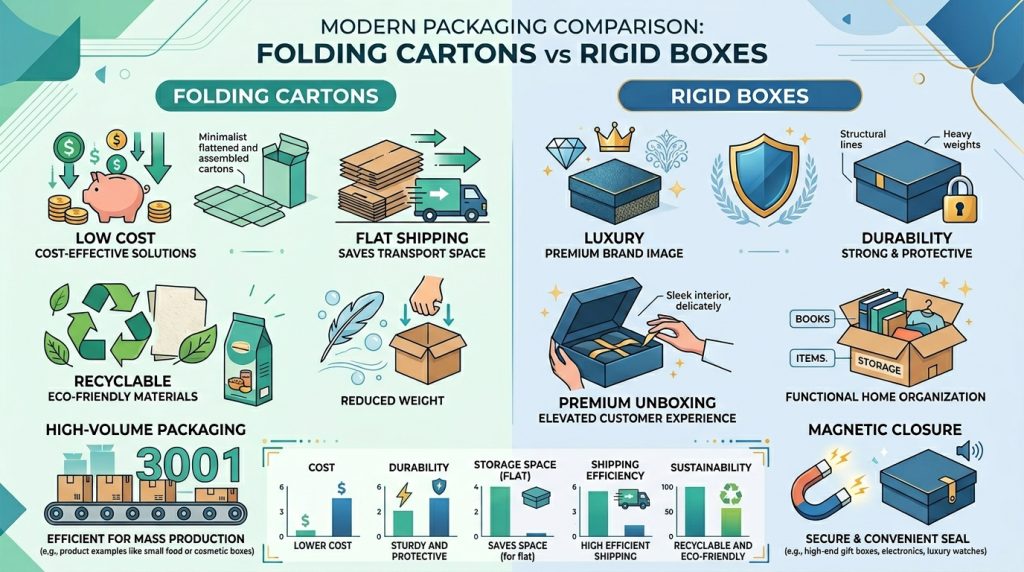
- Your budget per unit is less than $2.00.
- You need to store a lot of information.
- Your product does not require lots of packing.
- You sell in high volumes (10,000+ units).
- You want the most convenient recycling opportunities for customers.
Use a Rigid Box when:
- You can afford $50.00 or more for your retail price.
- You have an unboxing experience as part of your marketing.
- Heavy or very fragile product.
- Your product is difficult to move.
- You wish to have the box re-used and retained by the consumer.
- You are creating a “Gift” or “Collector’s” Edition.
There’s no “right” or “wrong” in the Rigid Boxes vs. Folding Cartons argument; it’s just a matter of what is the right match for your business model. In fact, no matter what you choose, a bad manufacturer can make you feel worse. Try Pack Role custom packaging survive and get full control in your next packaging boxes, whether its folding cartons or rigid boxes.
The folding carton is a friend to any high-volume, environmentally-friendly brand seeking efficiency. It is a workhorse of the packaging world. However, for companies that are building a legacy brand where each impression matters and must communicate “premium,” the cost of the rigid box can be justified in terms of the value of the brand and the customer loyalty it builds.
Pro-Tip: Always ask for a “white sample” (unprinted prototype) on both styles prior to an order for production. You’ll get more of an idea by feeling the weight in your hands and trying the opening mechanism than you will from a thousand words.