
Custom Booklet Box Design: Common Mistakes and How to Avoid Them
When a store shelf is full of similar products, how your product would get a special place in the customer’s cart. A stand-alone solution can give your products that personality to always stay on customer priority. Product presentation to safety, custom booklet boxes are up to the mark for every brand.
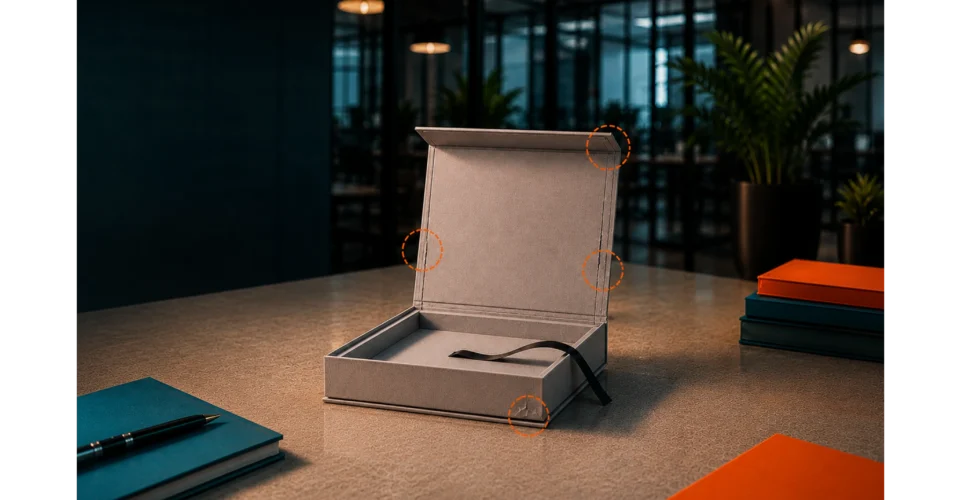
What are booklet boxes? It is simply a book-style box that attracts the elite class while they plan to go shopping. A cover, a tray or base, or a middle connector or hinge collectively make these boxes simply stunning. However, we have just summed up the appearance of these boxes, but it offers you an open ground to ensure more mind-blowing design ideas.
Whether simple or elevated, your design is surely according to your business. But here in this single post we are going to make you aware of some mistakes that must be deliberately avoided to get a perfect booklet box, every time.
What Is a Booklet Box?
What are booklet boxes? Booklet boxes Vs Folding cartons, or finding the right size of booklet boxes. All knowing these facts before customizing booklet boxes is necessary. However, here are a few simple mistakes that would optimize your cosmetic boxes, retail boxes, or candle boxes in booklet style efficiently.
Why Structural Engineering Matters in Booklet Box Packaging
The structure of booklet boxes is largely determined by its material strength and durability. Along with sustainability, recyclability, and biodegradability – kraft boxes, cardboard boxes, and rigid boxes in booklet style offer a variable strength, thickness, and depth. The custom creation around brand requirements make every package like gift boxes, premium product boxes, and watch boxes sturdy enough to perfectly hold the weight and marketing responsibility.
The designer must determine the dimensions of the base, cover, side walls, flaps, hinge area, and closure components. These dimensions cannot always be calculated by simply adding the product’s length, width, and height because board thickness, fold radius, material compression, and assembly tolerances also influence the finished package.
For example, a rigid board construction behaves differently from a lightweight folding carton. A thicker substrate like corrugated board may provide superior compression resistance but require more allowance around folds and hinge areas.
This is why professional Custom Booklet Boxes should be developed using a production-ready structural specification rather than a purely visual mockup.
Mistake 1: Designing the Box Before Measuring the Product
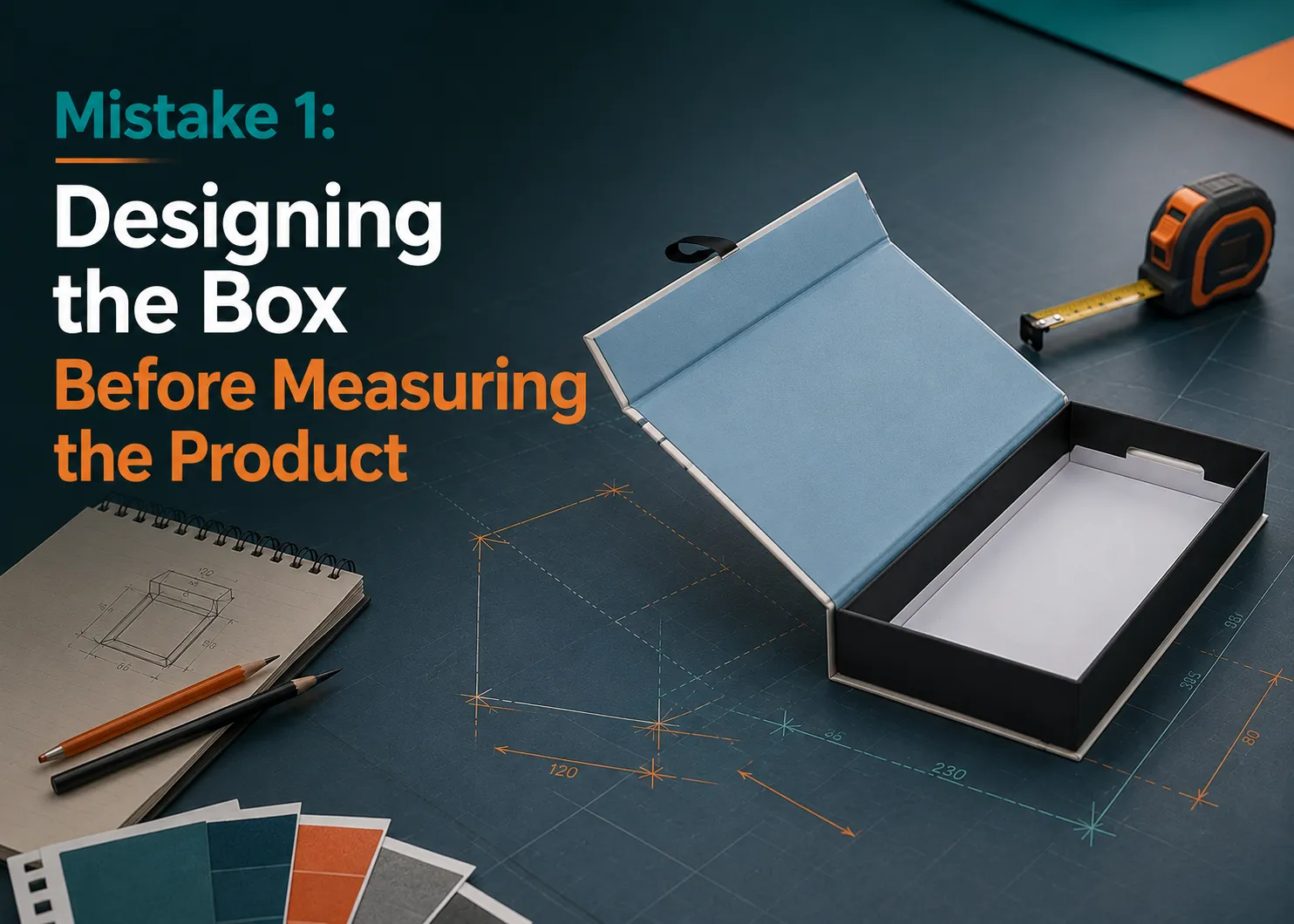
- One of the most fundamental errors is beginning with a preferred box size rather than the actual product dimensions.
- The correct approach is to establish the product’s dimensional envelope first. Measure its length, width, and height at the points of maximum dimensions. If the product has protruding components, irregular geometry, rounded corners, caps, handles, or accessories, these must also be included in the dimensional assessment.
- Too little clearance can create insertion problems and excessive compression. Too much clearance allows the product to shift inside the package and may reduce its resistance to impact during transportation.
- For this reason, how to choose the right booklet box size should be answered through product measurements, material thickness, insert requirements, and intended distribution conditions, not by selecting a standard box dimension.
Mistake 2: Ignoring Material Thickness and Board Caliper
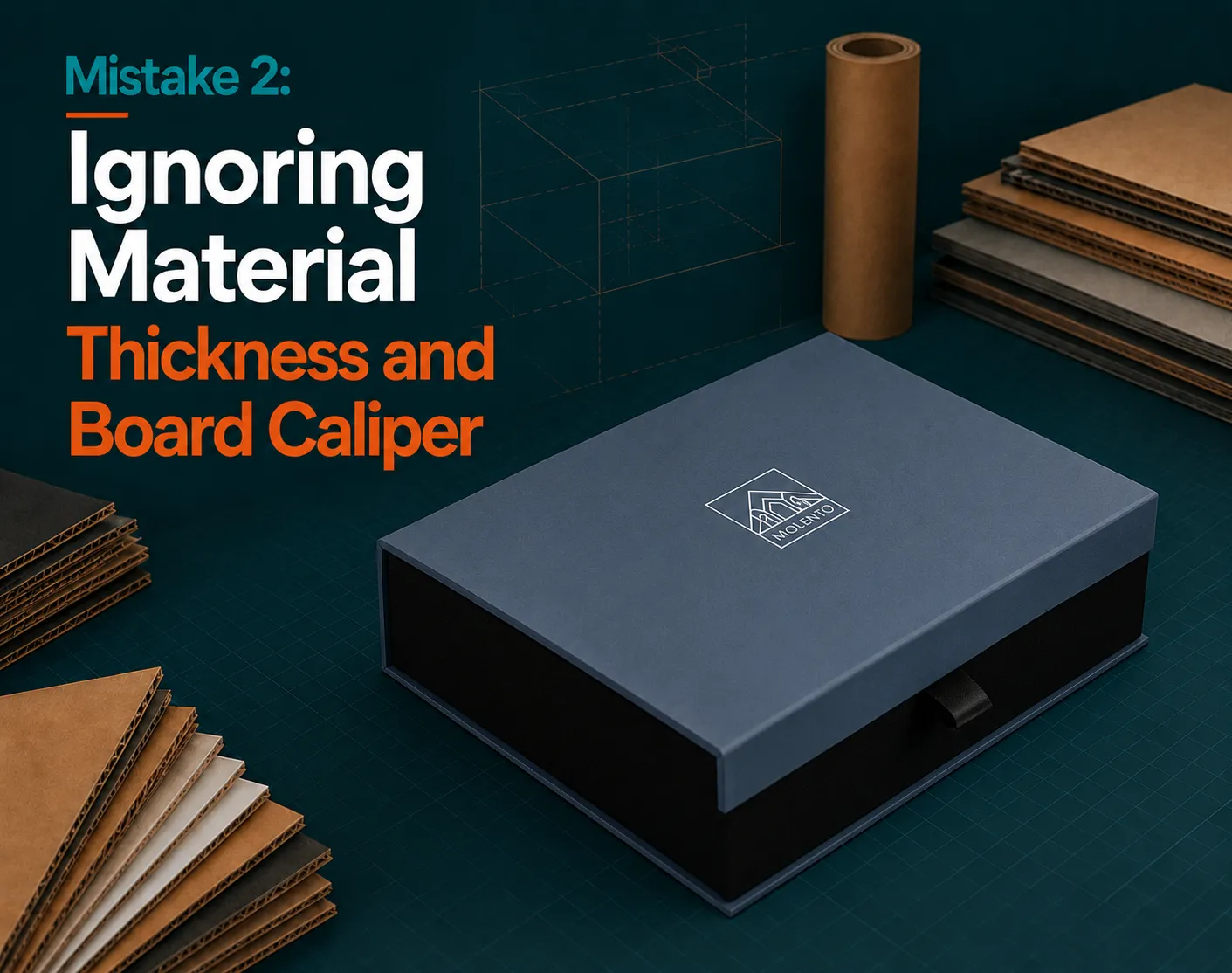
- Board thickness, commonly described as caliper, directly affects the internal dimensions and structural behavior of packaging.
- If a box is designed using dimensions that ignore the actual board thickness, the finished package may not match the dimensions of the digital dieline. This becomes particularly important when several panels overlap or when a rigid board is laminated with printed paper.
- Material selection should therefore consider more than appearance.
- Folding carton board may be suitable for lightweight products and high-volume retail applications, whereas rigid board is more appropriate when greater structural strength and a premium hand feel are required.
- The material should also be evaluated according to its resistance to compression, folding performance, surface finish, printing compatibility, and expected transportation environment.
Mistake 3: Creating an Inaccurate Dieline
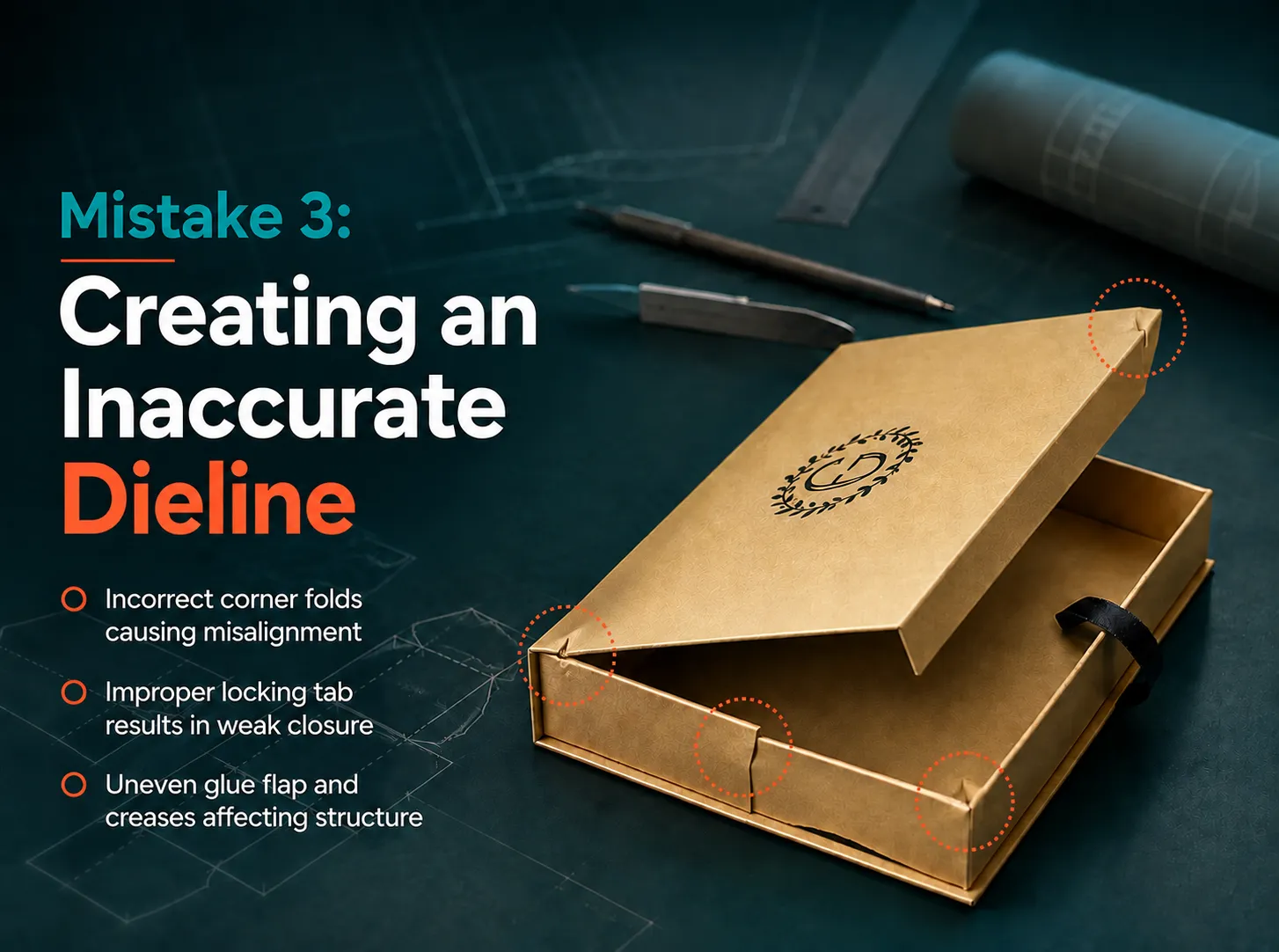
- The dieline is the technical blueprint of the package. It defines cut lines, crease lines, fold positions, bleed areas, glue zones, and the relationship between structural panels.
- An inaccurate dieline can produce problems throughout manufacturing.
- For example, if a logo is positioned too close to a crease, folding may distort the artwork. If the bleed area is insufficient, trimming may expose an unprinted edge. If the hinge region is incorrectly calculated, the cover may sit unevenly against the base.
- A production-ready dieline should therefore be reviewed at both the structural and graphic levels before artwork approval.
- Designers should distinguish clearly between cut lines and crease lines and ensure that artwork follows the manufacturer’s required bleed and safe-area specifications.
Mistake 4: Underestimating Hinge Geometry
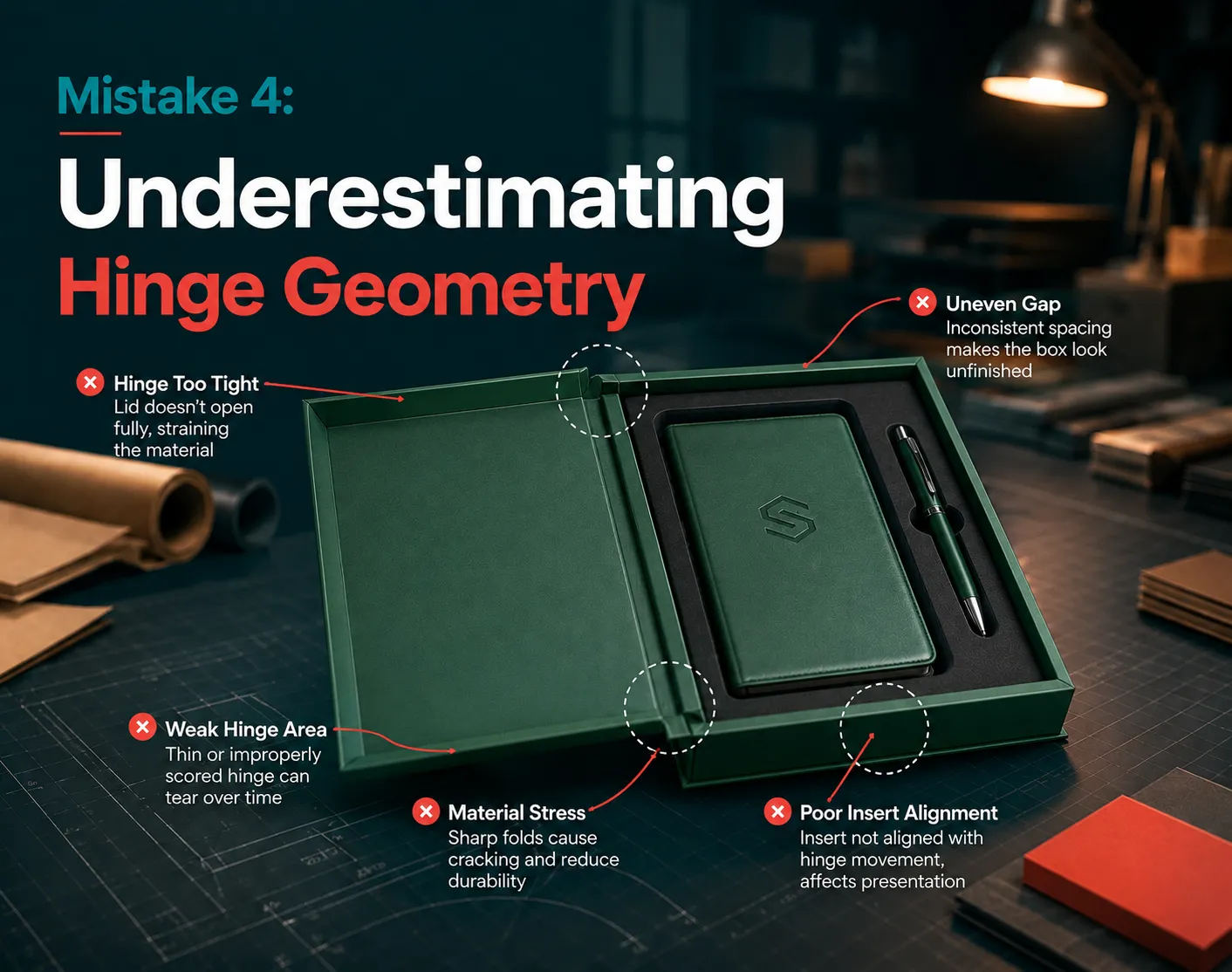
- The hinge is one of the most technically sensitive areas of a booklet box because it must allow repeated opening and closing without excessive stress.
- The hinge construction depends on the packaging material and manufacturing method. A rigid board structure may require a defined hinge gap or flexible covering material, while a folding carton may rely on scored board.
- If the hinge allowance is too narrow, the cover can bind against the base. If it is too wide, the package may appear loose or poorly aligned.
- A properly engineered hinge should provide sufficient rotational movement while maintaining controlled alignment between the lid and base.
- This is particularly important for luxury packaging because consumers often associate smooth opening and precise lid alignment with manufacturing quality.
Mistake 5: Choosing the Closure Without Considering Product Weight
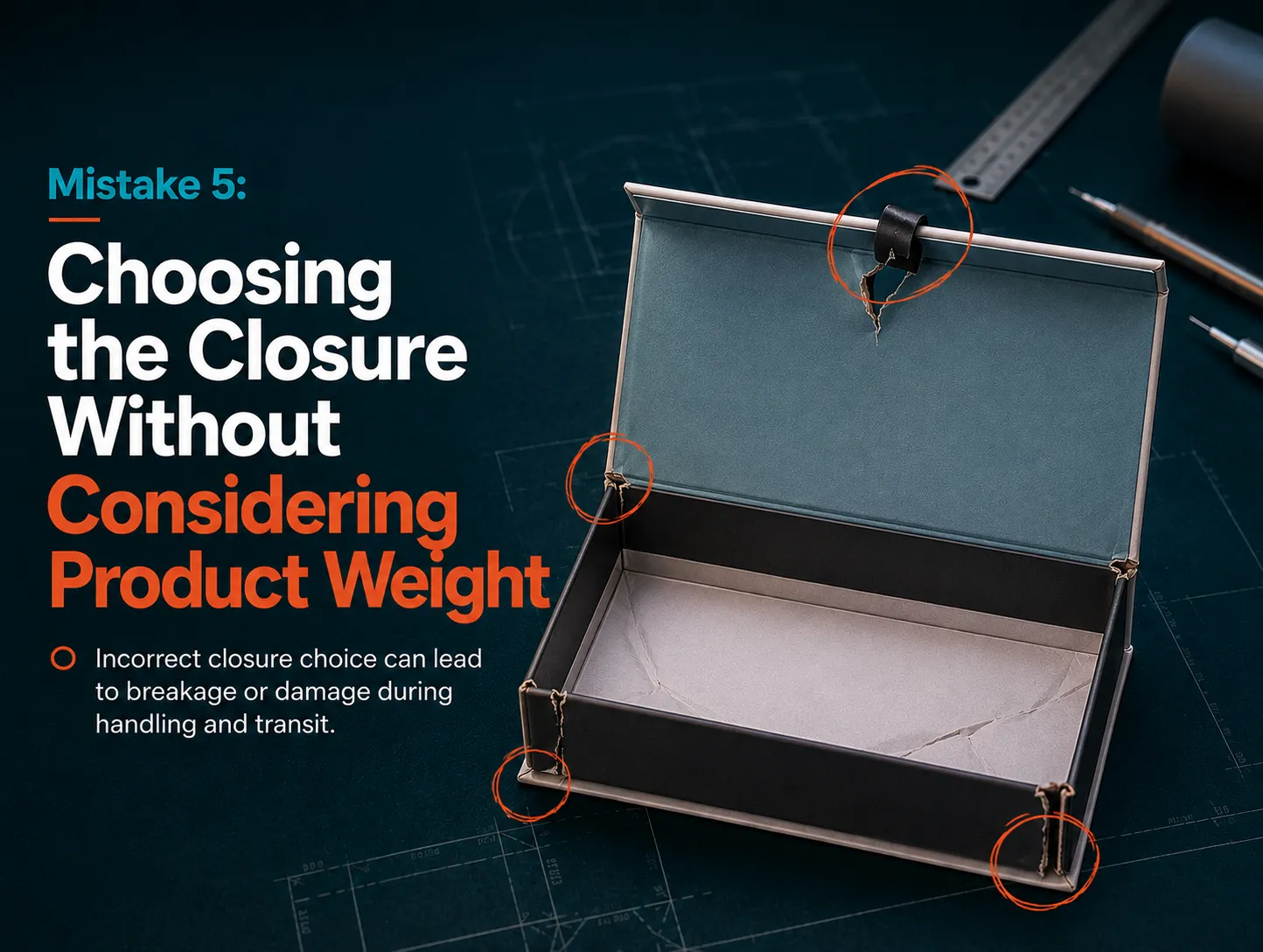
- The closure mechanism should be selected according to the weight and characteristics of the product.
- A lightweight cosmetic box may work effectively with a tuck closure or friction-based mechanism. A heavier product or premium rigid box may require magnets or another stronger closure system.
- The closure also affects the opening force required by the customer. If it is too weak, the package may open during transportation. If it is excessively strong, the customer may struggle to open the box.
- A technically sound Booklet Box Design therefore considers both transportation security and user ergonomics.
Mistake 6: Forgetting Product Movement Inside the Box
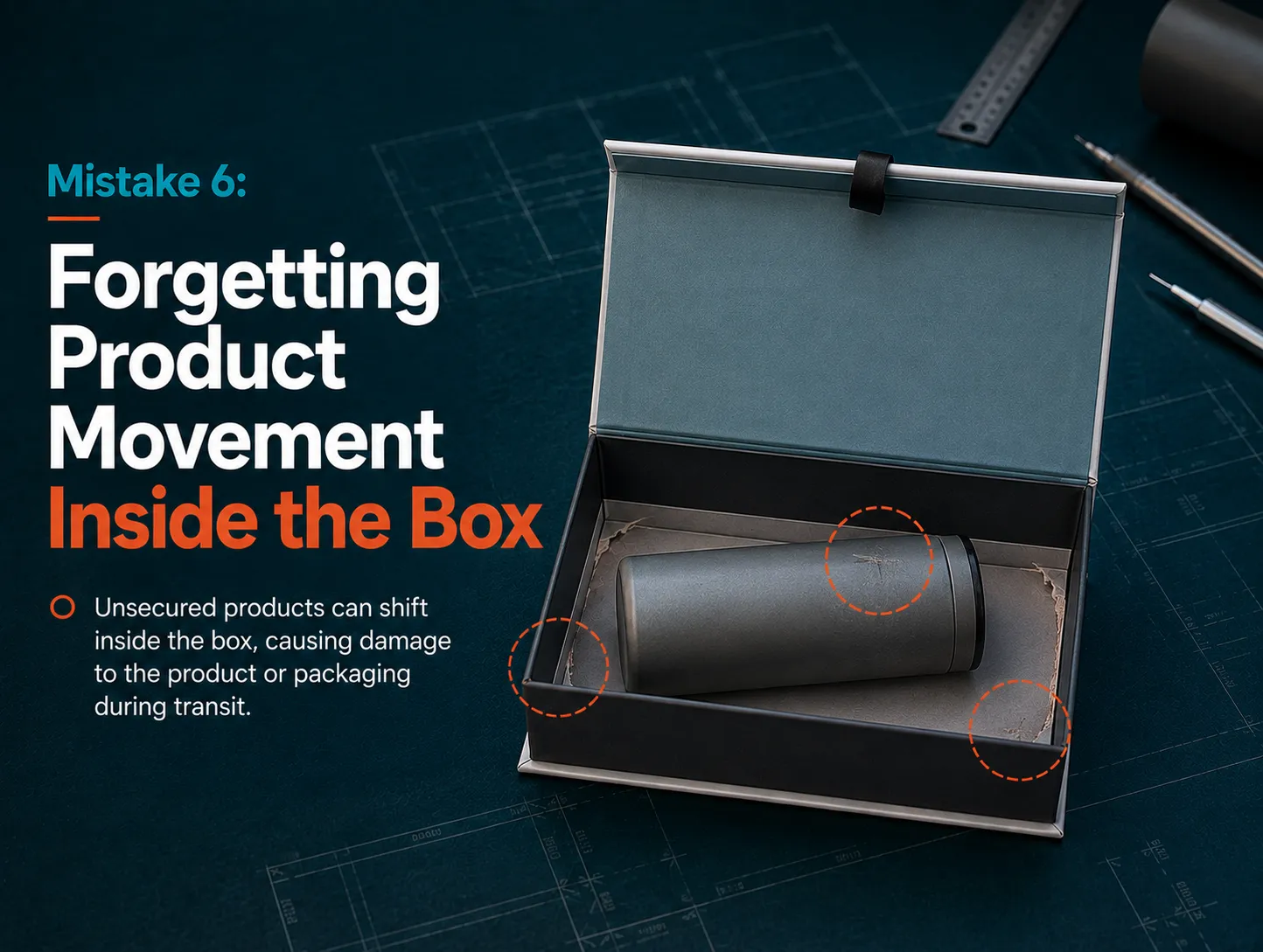
- Protective packaging must control product movement.
- If a product is significantly smaller than the internal cavity, it can shift during handling. Repeated movement increases the likelihood of scratches, dents, broken components, or cosmetic damage.
- This is where custom box inserts become valuable.
- Foam, molded pulp, paperboard partitions, card inserts, or other retention structures can be incorporated depending on the product. The insert should be designed alongside the box rather than added after the structural design has been completed.
- For premium products, the insert also contributes to the unboxing experience by presenting the product in a predetermined position.
Mistake 7: Treating Printing as an Afterthought
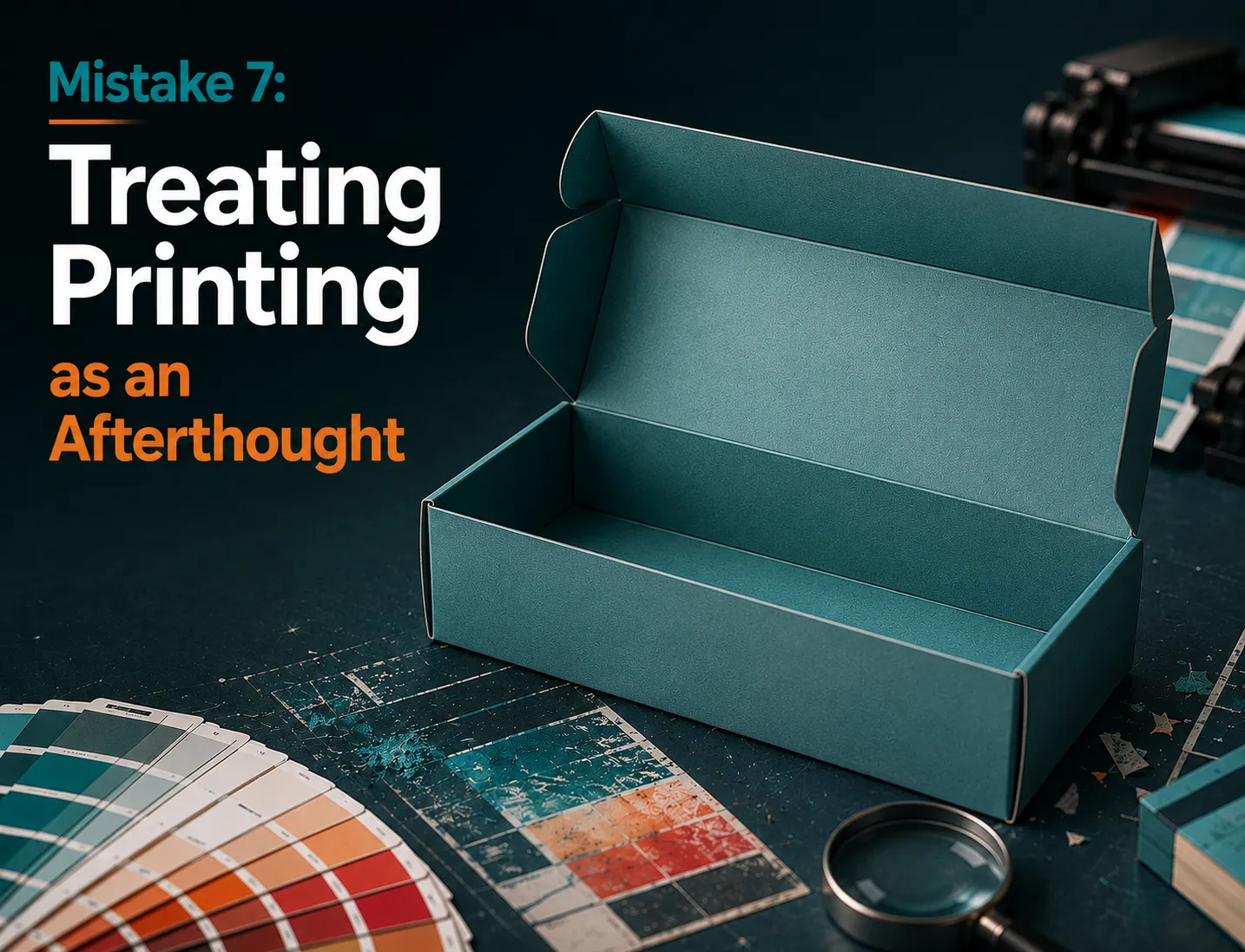
- Graphic design and structural design must work together.
- Important artwork should not be placed across fold lines, closure areas, glue zones, or high-stress regions without considering how these areas behave during conversion.
- Printing specifications should also be established according to the substrate and production method. Offset printing, for example, can provide excellent reproduction quality for detailed graphics and brand colors, but the final appearance can be affected by the paper surface, coating, ink coverage, and finishing process.
- Color management is particularly important for brands using specific corporate colors. A digital monitor preview should not be treated as an exact representation of the final printed result.
- A physical proof or production sample provides a much more reliable reference.
Mistake 8: Using Finishing Without a Structural Purpose
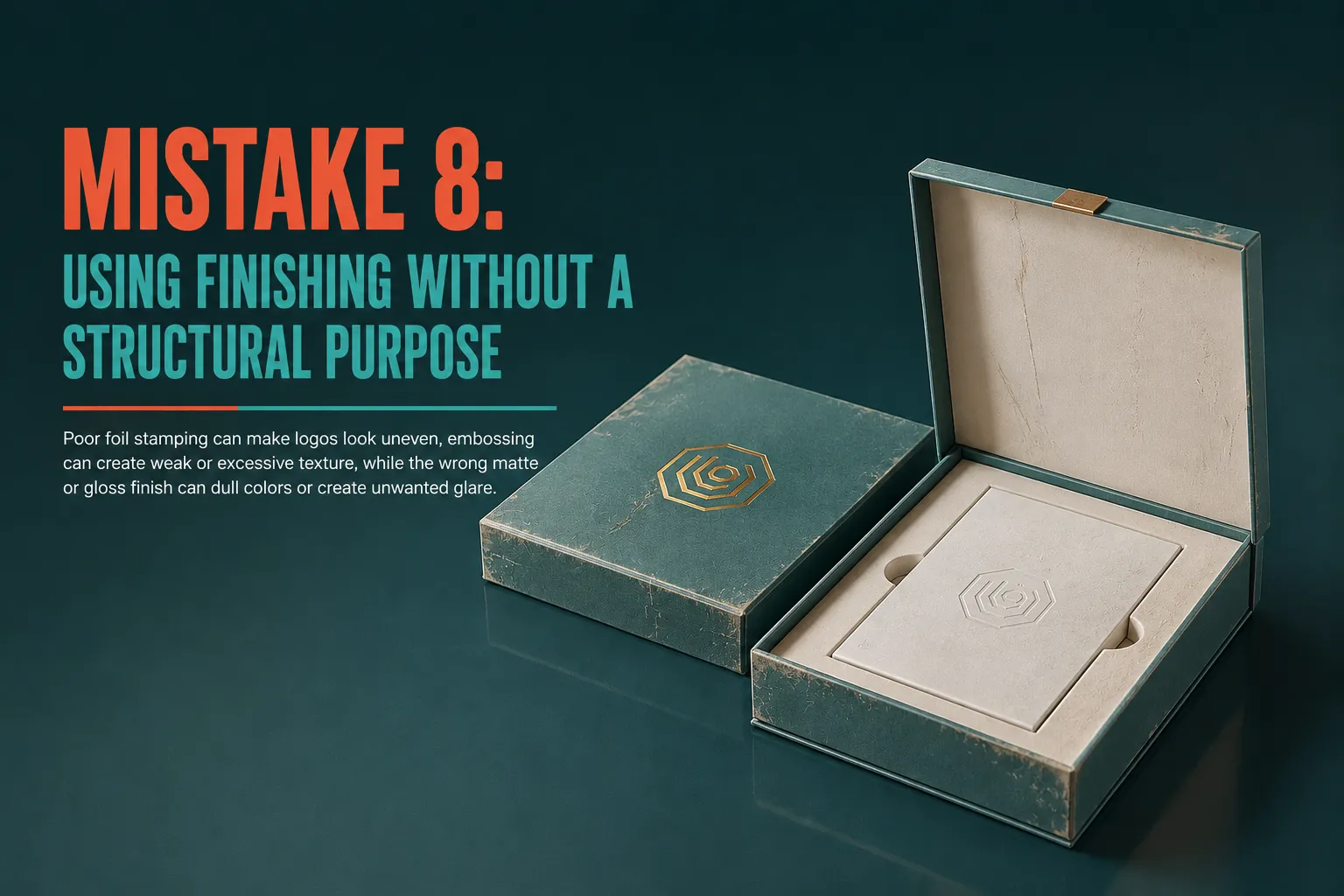
- Finishing options such as matte lamination, gloss coating, foil stamping, embossing, debossing, and spot UV can significantly improve visual appeal. However, finishing should support the packaging concept rather than compensate for weak design.
- For example, foil stamping can highlight a logo or product name, while embossing can create tactile hierarchy. Matte finishes can provide a sophisticated surface, whereas gloss finishes can emphasize color intensity.
- The technical compatibility of each finishing process with the substrate should also be considered. Excessive finishing layers can affect folding, scoring, adhesion, and overall material behavior.
Mistake 9: Ignoring Manufacturing Tolerances
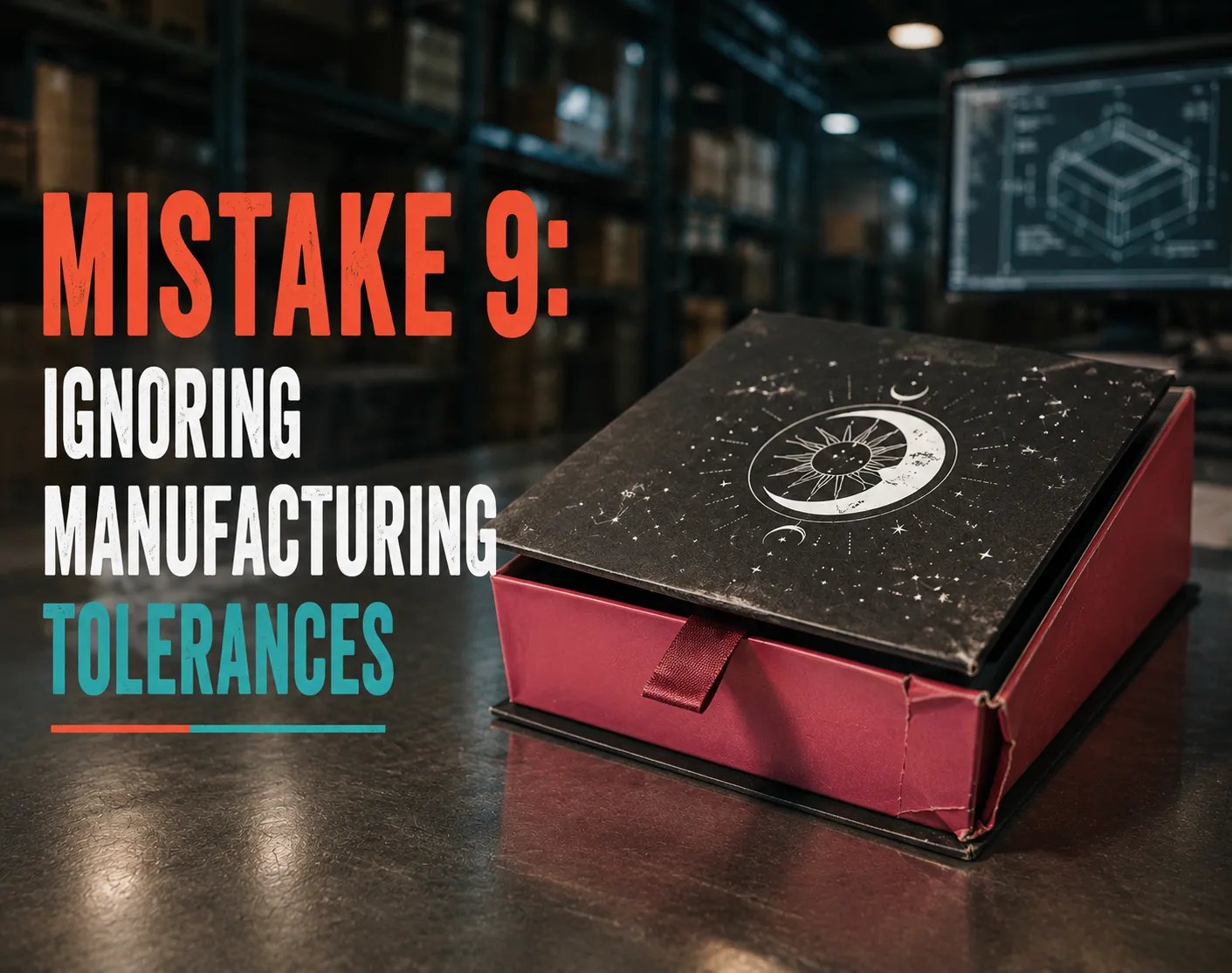
- No manufacturing process operates with absolute dimensional perfection. Cutting, creasing, laminating, gluing, printing, and assembly all have acceptable tolerances.
- A design that leaves no tolerance for production variation can become difficult to manufacture consistently.
- For commercial packaging, designers should therefore work with the manufacturer’s specified tolerances rather than assuming that every component will be produced to an infinitely precise dimension.
- This becomes especially important when the package contains multiple components that must align precisely, such as a rigid base, hinged lid, insert, and magnetic closure.
Mistake 10: Skipping Prototype Testing
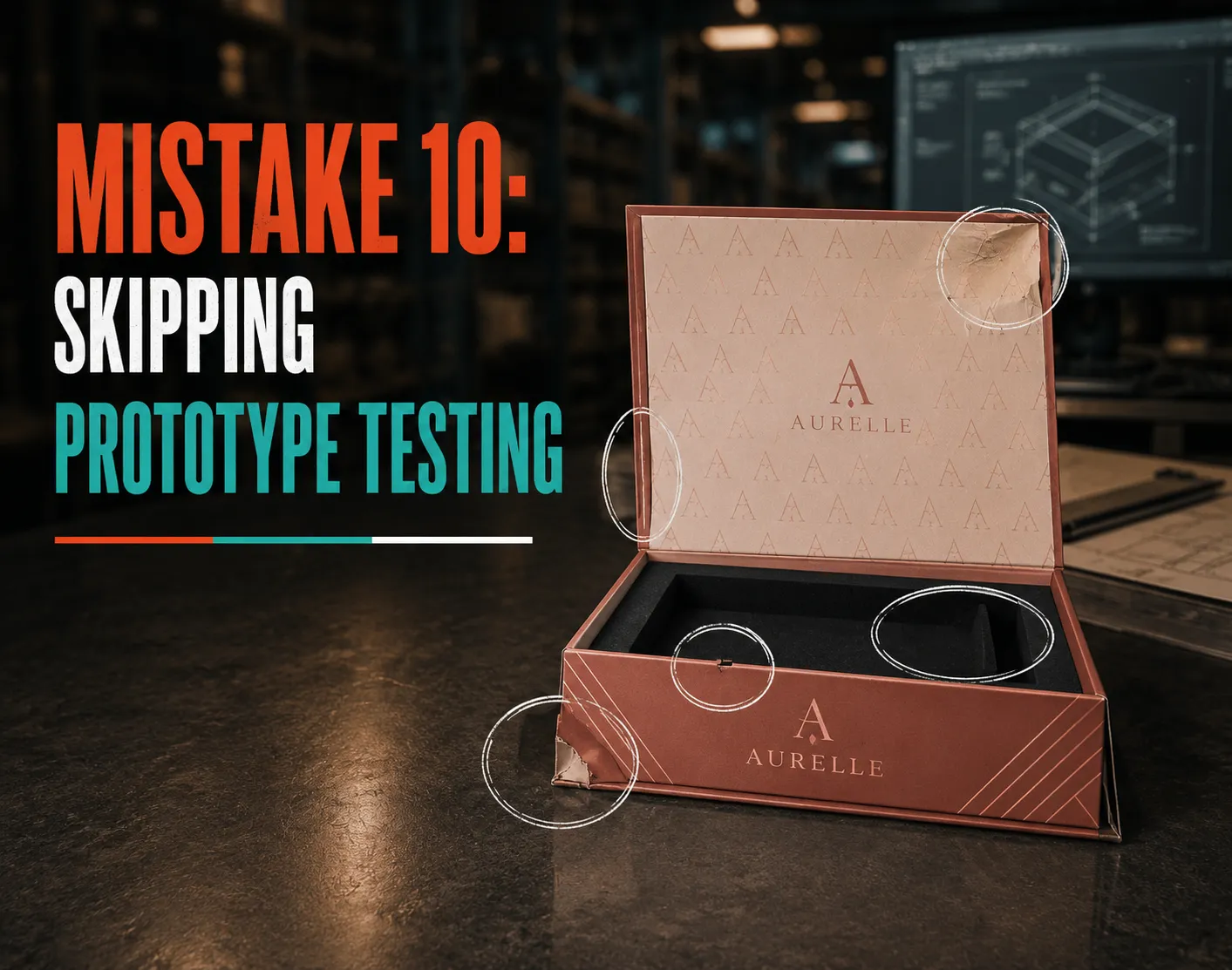
- A digital rendering cannot fully demonstrate how packaging will behave in the real world.
- Before placing a large production order, a physical prototype should be evaluated for dimensional accuracy, product fit, closure force, hinge movement, structural rigidity, print alignment, finishing quality, and overall usability.
- The prototype should also be handled repeatedly. Open and close the box several times. Insert and remove the product. Examine whether the product moves inside the package. Check whether the lid remains aligned and whether the closure performs consistently.
- For products intended for e-commerce, shipping simulation or basic drop and compression testing may also be appropriate depending on the product’s fragility and distribution requirements.
How to Design Custom Booklet Boxes for Better Performance
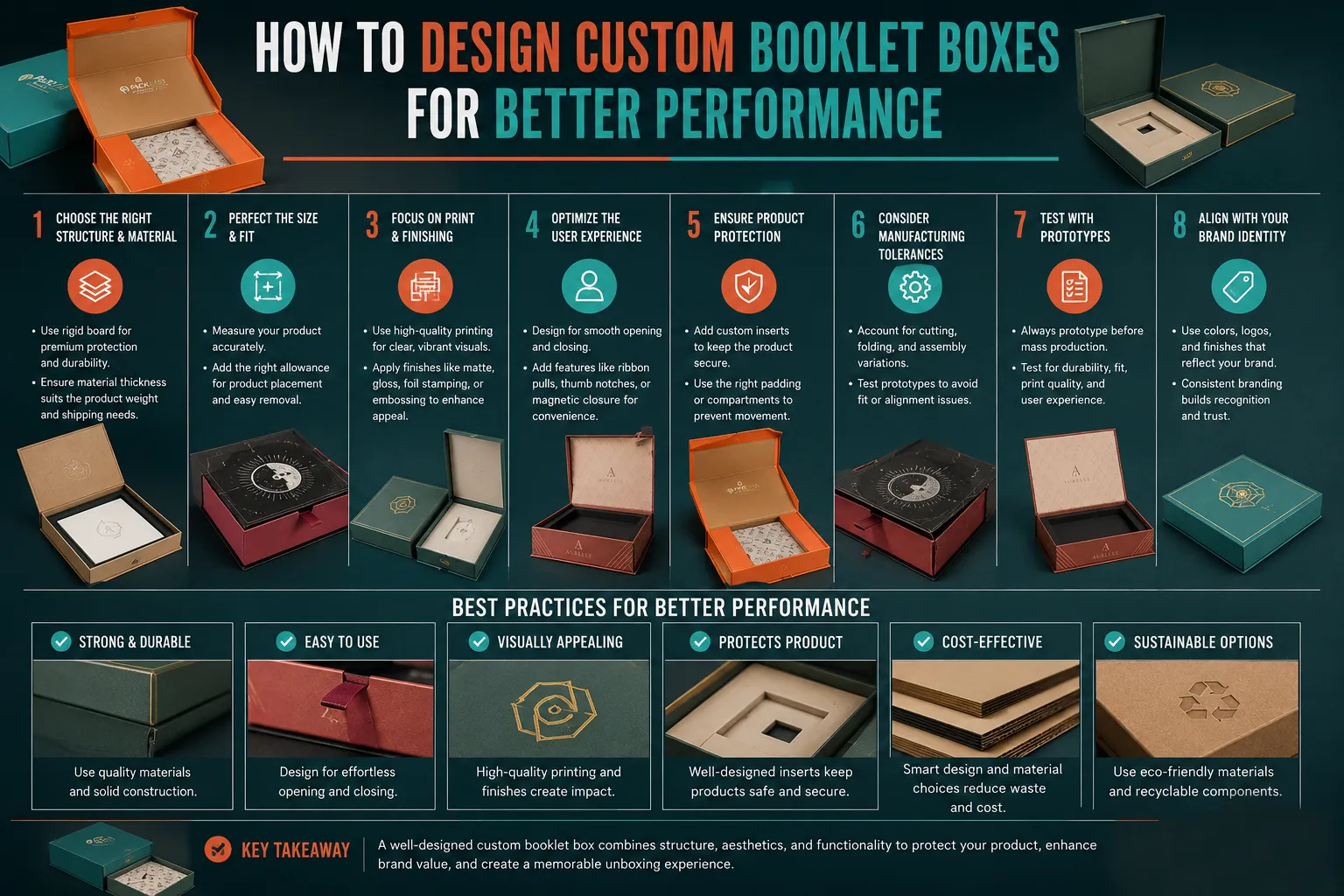
A reliable design process should begin with product analysis, not artwork.
First, measure the complete product and determine the required internal clearance. This can be done by measuring your product dimensions. Next, select the appropriate board based on product weight, structural requirements, printing method, environmental objectives, and target price.
The structural designer can then develop the dieline, incorporating the base, lid, hinge, closure, glue areas, and insert system. Once the structure is validated, the graphic designer can position branding and product information according to the finalized panels.
After artwork approval, a physical prototype should be produced. Testing the prototype allows structural and visual problems to be corrected before mass production.
This workflow minimizes production errors and creates a more reliable balance between packaging functionality, product protection, branding, and manufacturing cost.
How to Improve Booklet Box Packaging Design
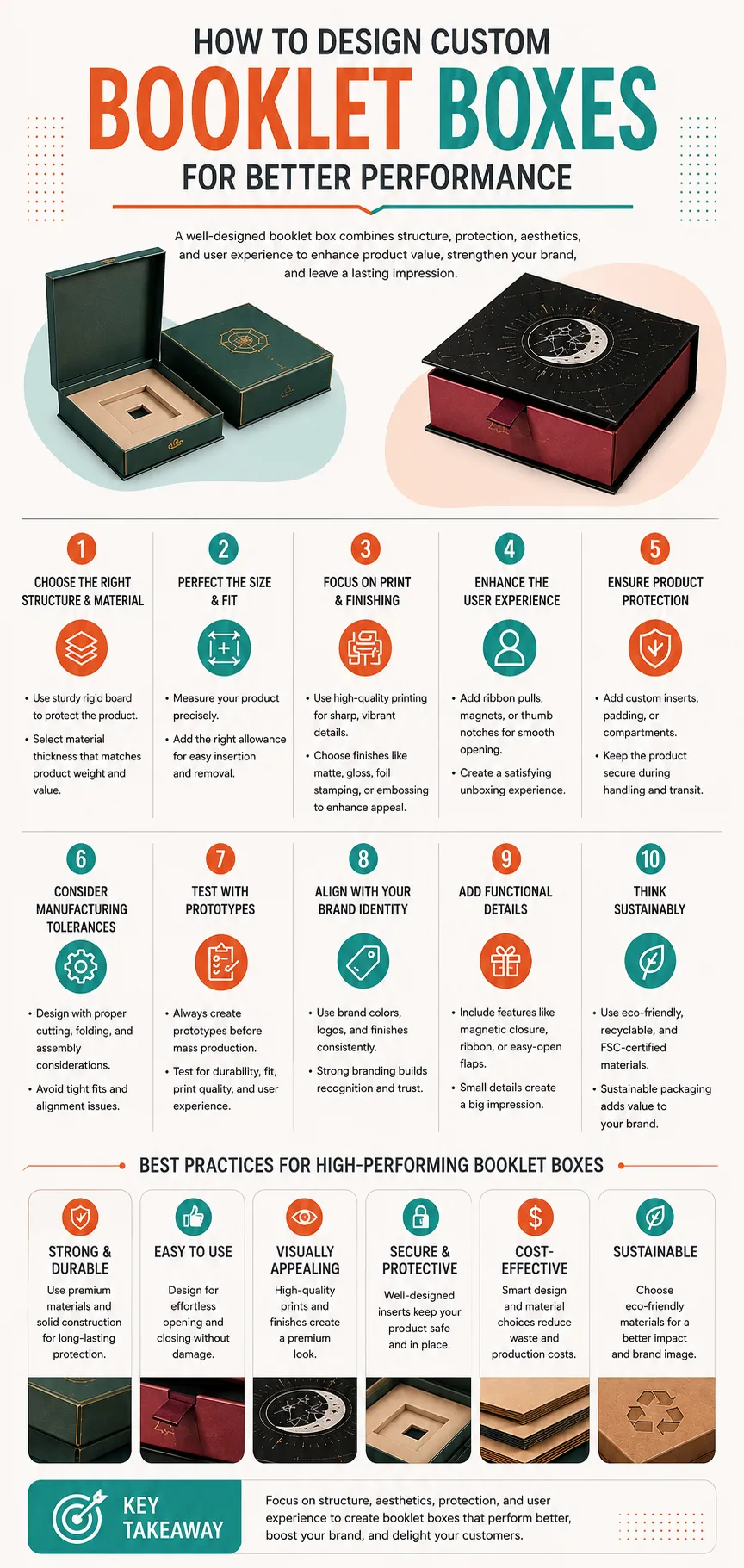
Improvement should be based on measurable packaging objectives.
If the problem is product movement, modify the internal clearance or introduce an insert. If the package feels weak, reconsider board caliper or structural reinforcement. If the lid does not align correctly, examine hinge geometry and manufacturing tolerances. If the design appears crowded, simplify the visual hierarchy rather than adding additional finishing.
This problem-solving approach is more effective than simply adding decorative elements.
For businesses developing Custom Booklet Packaging, the goal should be to optimize the complete packaging system rather than one isolated feature.
Working With a Custom Booklet Boxes Manufacturer
Manufacturing expertise should be considered during the design stage rather than after the artwork is complete.
A qualified Custom Booklet Boxes Manufacturer can advise on board selection, dieline construction, structural limitations, printing processes, finishing compatibility, and production tolerances. This collaboration can prevent design decisions that look attractive digitally but create manufacturing complications.
Businesses ordering at scale should also verify prototype approval procedures, quality-control standards, production tolerances, material specifications, and packaging performance before committing to a large manufacturing run.
This is particularly important when sourcing Custom Booklet Boxes Wholesale, where a small design error can be multiplied across thousands of units.
Practical Pre-Production Checklist
Before approving the final package, verify:
- Product dimensions and required clearance
- Board caliper and material specification
- Dieline accuracy
- Cut and crease positions
- Hinge geometry
- Closure mechanism
- Insert dimensions
- Artwork safe areas and bleed
- Color specifications
- Printing method
- Finishing compatibility
- Manufacturing tolerances
- Prototype performance
- Product protection during transportation
Conclusion
Knowing the best custom booklet box design common mistakes is necessary. On one side of the picture, it builds a box that passes every business expectation, no matter how higher it is. On the other hand, these mistakes if not removed can break the brand image.
A summary of these mistakes include incorrect dimension measurement, inappropriate board thickness, inaccurate dielines, and unsuitable board thickness. Poorly designed hinges, weak or improper closure mechanism, faded printing, and lack of protective inserts, and no traceability of prototyping represent other types of technical booklet box design errors.
Above all, one mistake that can be drastic for your box manufacturing process is choosing an illegitimate packaging supplier. Choose Packrole for its fastest growing network and great customer satisfaction. We help you choose the right packaging material, strength, thickness, interlocking mechanism, correct diet line, accurate printing, and perfect prototype.
Frequently Asked Questions
1. What are the most common mistakes in custom booklet box design?
The most common mistakes include incorrect product dimensions. To correct it see our guide on how to measure the correct product dimension.
2. How do I design custom booklet boxes for a fragile product?
Start by establishing the product’s dimensional envelope and impact sensitivity. Select a board with appropriate structural strength and incorporate an insert or retention system that prevents movement. The completed package should then be physically tested before mass production.
3. How do I choose the right booklet box size?
Measure the product at its maximum dimensions and determine the required clearance for insertion, removal, material thickness, and protective inserts.
4. Why is the dieline important in custom booklet packaging?
The dieline defines the exact structural geometry of the package, including cut lines, crease lines, folds, glue areas, and panel relationships.
5. What materials are suitable for booklet box packaging?
The appropriate material depends on product weight, structural requirements, printing method, finishing, shipping conditions, and budget.
6. Why should I create a prototype before ordering custom printed booklet boxes?
A prototype allows you to evaluate dimensions, product fit, hinge movement, closure performance, structural rigidity, printing alignment, finishing, and overall usability before committing to mass production.