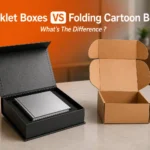
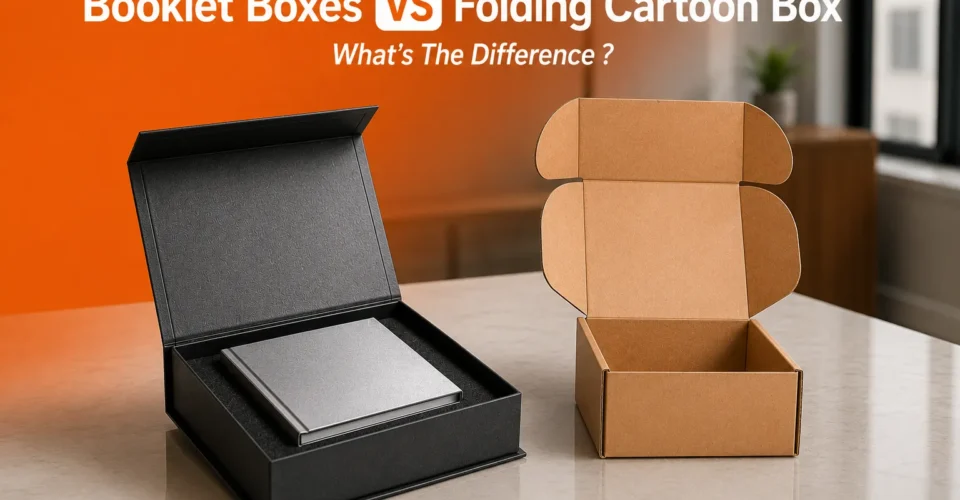
When you imagine your business getting bloomed, the first step to take is choosing the right type of packaging. Booklet boxes influence customers by its protection and outlook. Similarly, folding boxes enhance the user experience and stock management by occupying less space. Booklet boxes and folding boxes represent two different classes of packaging, known for its unique shape and manufacturing elements.
Booklet boxes with its unique book style appeal (a base tray, hinged spine, and cover lid) are reported to boost product perceived value up to 35%. Similarly, folding cartons help optimize space up to 25%.
If you are confused between booklet boxes and Folding Cartons, what to choose, this blog post is for you. This post helps you make an informed decision about the right selection of these boxes.
What Are Booklet Boxes?
Booklet boxes are rigid style packaging manufactured in book style. They are popular for their highly sophisticated look. The middle hinged part connects the base or tray with a printed cover. Magnetic closure, printed designs, ribbons, and fastening system make it more attractive for viewers. See custom booklet boxes guide to know more about these boxes.
Creative design elements like logos, graphics ( minimalist or flamboyant), embossing or debossing with metallic or foil stamping, and premium scartless finishes. These boxes are worth a short stay at store shelves- because they remain in a hurry to reach their customers without wasting much of their life.
In this era when books are judged by their cover, these book-style packaging help attract the 72% of the buyers who impulsively buy products when they like the product. High quality of custom booklet boxes enhance the customer stay with a brand. From first impression to long repurpose with custom inserts, these boxes are worth your skincare, and luxury products.
What Are Folding Cartons?
Unlike the booklet boxes, folding cartons vary greatly in terms of style, manufacturing, cost and paper stock. They are light in weight, come in a flexible structure that can go flat, and it takes less time to resembling. These are some basic features of these boxes. However, with some prints, color addition, logo placement, and die-cutting they also work perfectly well on shelves and retail settings.
Common folding carton structures include tuck-end boxes, reverse tuck-end cartons, auto-bottom cartons, sleeve packaging, and other custom structures. Remember, that folding cartons are different from rigid boxes. To know that difference see rigid vs. folding cartons.
TT tooWhether you are looking for shipping boxes, retail boxes, display boxes, cosmetic boxes, watch boxes, gift boxes, or even cake packaging these folding packaging finds its place.
Booklet Boxes and Folding Cartons: Key Differences
The most important differences between the two packaging formats come down to construction, material, durability, cost, logistics, and presentation.
| Feature | Booklet Boxes | Folding Cartons |
| Construction | Rigid or semi-rigid | Foldable paperboard |
| Opening | Hinged lid or book-style opening | Tuck, lock, or other folding closure |
| Material | Rigid board, wrapped paper, specialty materials | Paperboard |
| Product protection | Generally higher | Moderate, depending on board and structure |
| Storage | Requires more space | Efficient when stored flat |
| Shipping | Heavier and more rigid | Lightweight and space-efficient |
| Assembly | May require more handling | Often quick to erect |
| Branding | Excellent | Excellent |
| Premium presentation | High | Moderate to high |
| Production volume | Suitable for premium and medium-volume products | Particularly efficient for high-volume production |
| Typical cost | Generally higher | Generally lower |
The best option therefore depends on the priorities of the product and brand rather than one format being universally better.
Construction and Material
Construction is one of the clearest differences when evaluating Booklet Boxes vs Folding Cartons.
Booklet boxes are generally built around a rigid structure. The outer surface may be wrapped with printed paper, specialty paper, or other decorative materials. The rigid board gives the box its solid feel and allows it to maintain its shape.
Folding cartons, on the other hand, are made from paperboard that has been cut and scored to create folding lines. The carton is then folded and glued into its final shape.
This construction makes folding cartons lighter and easier to transport in flat form.
For brands prioritizing Rigid Packaging and a substantial feel, booklet packaging can have an advantage. For businesses that need lightweight Paperboard Packaging, folding cartons are often more practical.
Durability and Product Protection
Product protection is another important consideration.
Rigid booklet boxes generally provide stronger structural protection because the box maintains its shape and has a more substantial construction. This can be useful for delicate, premium, or higher-value products.
Folding cartons can also provide effective protection, but their performance depends heavily on paperboard thickness, structural design, and the product being packaged.
For lightweight products that do not require heavy-duty protection, folding cartons can be perfectly adequate.
For products that need additional protection or a more substantial package, rigid booklet packaging may be the better option.
Cost Comparison
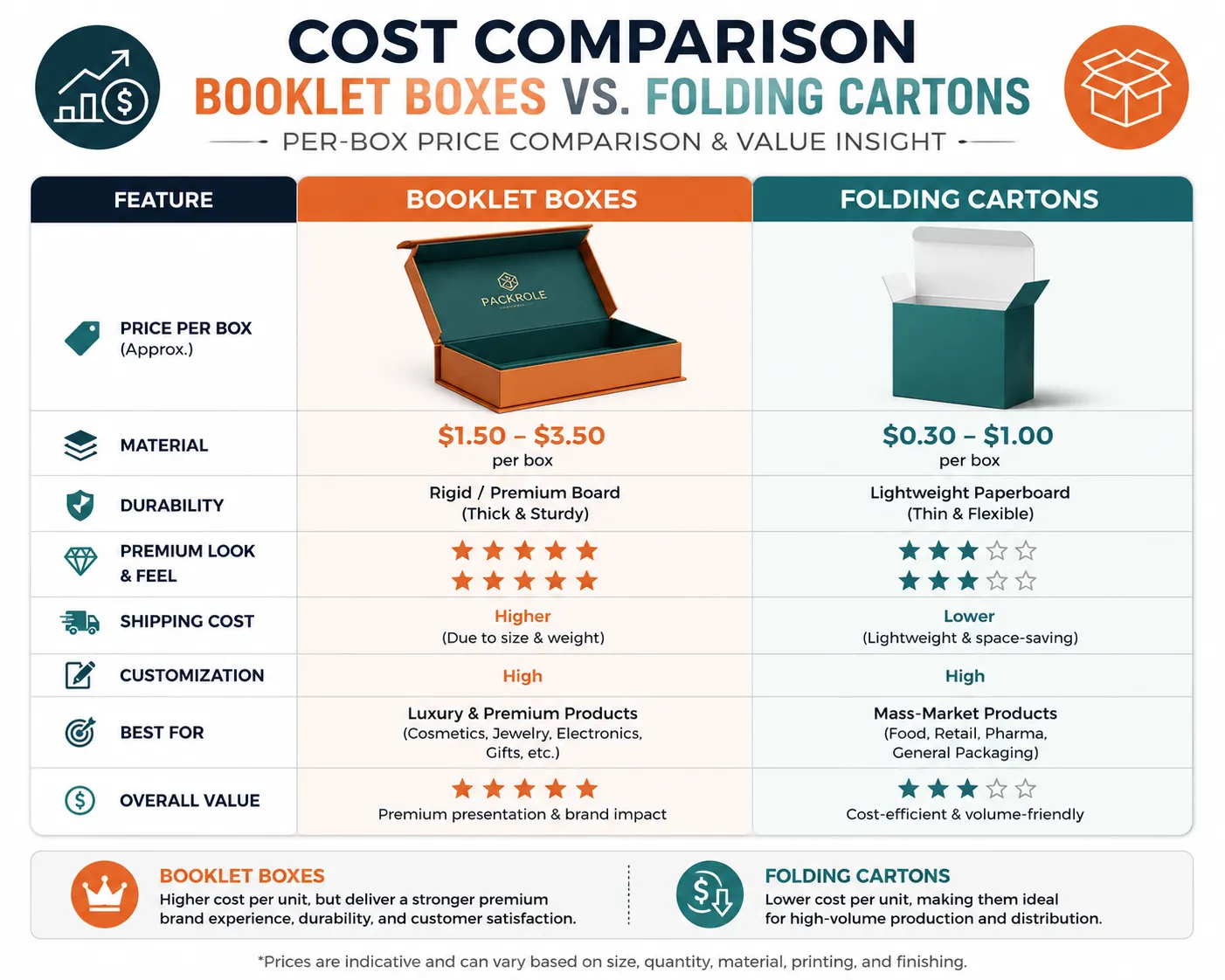
Cost is often one of the biggest differences between these packaging formats.
Folding cartons are usually more economical because they use lightweight paperboard and can be efficiently die-cut, printed, folded, and glued at scale. Their flat-pack design also reduces storage and transportation requirements.
Booklet boxes typically involve more material and additional manufacturing steps. The rigid structure, wrapping, hinged construction, magnetic closures, and specialty finishes can increase the overall cost.
Therefore, when considering Booklet Boxes vs Folding Cartons from a cost perspective, folding cartons generally make more sense for high-volume products where packaging cost per unit is a major consideration.
Booklet boxes may justify their higher cost when packaging presentation, durability, and perceived product value are priorities.
Storage and Shipping
Storage and logistics can significantly affect the total cost of packaging.
Folding cartons are usually supplied flat, meaning businesses can store a large quantity without using excessive warehouse space. Their lightweight construction also helps reduce shipping weight.
Booklet boxes occupy more space because their rigid construction means they cannot be flattened in the same way. They can also weigh more, which may affect transportation costs.
For businesses with limited warehouse space or high shipping volumes, folding cartons offer an important logistical advantage.
For premium products where presentation and structural protection are more important than compact storage, booklet boxes can still be worthwhile.
Branding and Retail Presentation
Both packaging types provide excellent opportunities for branding, but they create different visual experiences.
Custom Booklet Boxes can provide a premium, structured presentation. Their large panels can accommodate logos, product information, photography, patterns, and luxury finishes.
Options such as foil stamping, embossing, debossing, matte coatings, gloss finishes, and soft-touch treatments can further enhance the appearance.
Folding cartons also offer extensive branding possibilities. High-quality printing, custom colors, die-cut windows, coatings, and decorative finishes can create attractive retail packaging.
However, booklet boxes generally have an advantage when the goal is a more luxurious Unboxing Experience.
Applications: When Should You Use Each?
The intended product should play a major role in the decision.
When Booklet Boxes Make Sense
Booklet boxes are particularly suitable for:
- Luxury cosmetics
- Premium skincare
- Jewelry and accessories
- Electronics and specialty products
- Gift sets
- Subscription boxes
- Premium candles
- High-value retail products
Brands looking for Custom Booklet Boxes for Luxury Products often choose this format because the rigid construction contributes to a premium product presentation.
When Folding Cartons Make Sense
Folding cartons are commonly used for:
- Food products
- Pharmaceuticals
- Cosmetics
- Personal-care products
- Household products
- Small consumer goods
- Confectionery
- High-volume retail products
Custom Folding Cartons for Retail Products can be particularly useful when businesses need efficient packaging at larger production volumes.
Customization and Printing
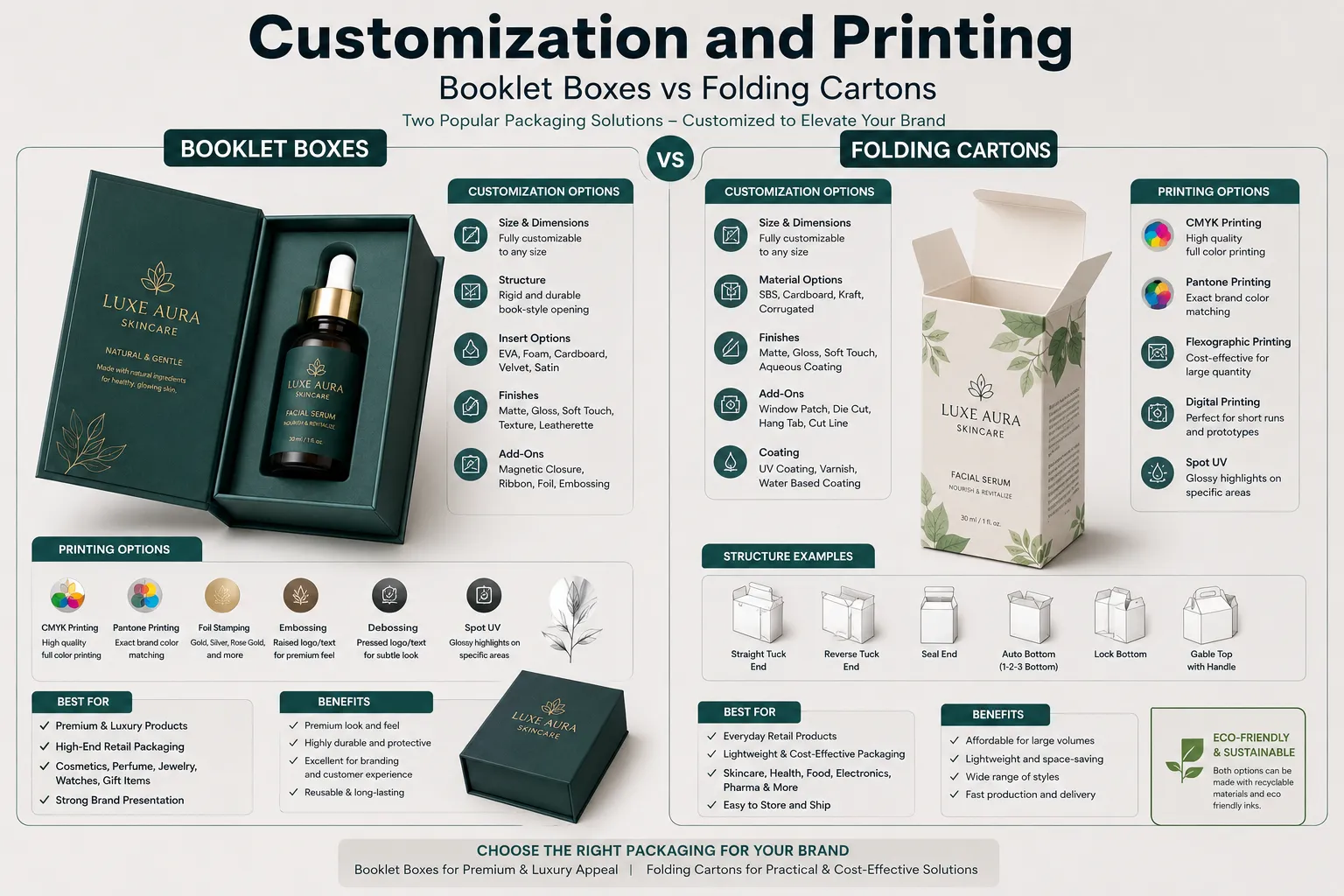
Both formats can be extensively customized.
For booklet boxes, customization can include:
- Custom dimensions
- Magnetic closures
- Hinged lids
- Custom inserts
- Specialty papers
- Foil stamping
- Embossing and debossing
- Matte or gloss finishes
- Custom printed interiors and exteriors
Folding cartons can be customized through:
- Custom dimensions
- Die-cutting
- Scoring
- Tuck-end closures
- Die-cut windows
- Offset printing
- Digital printing
- Matte and gloss coatings
- Specialty finishes
This means the choice does not have to be based solely on branding. Both packaging formats can support strong visual identity and detailed Packaging Design.
Production Volume: Which Is More Practical?
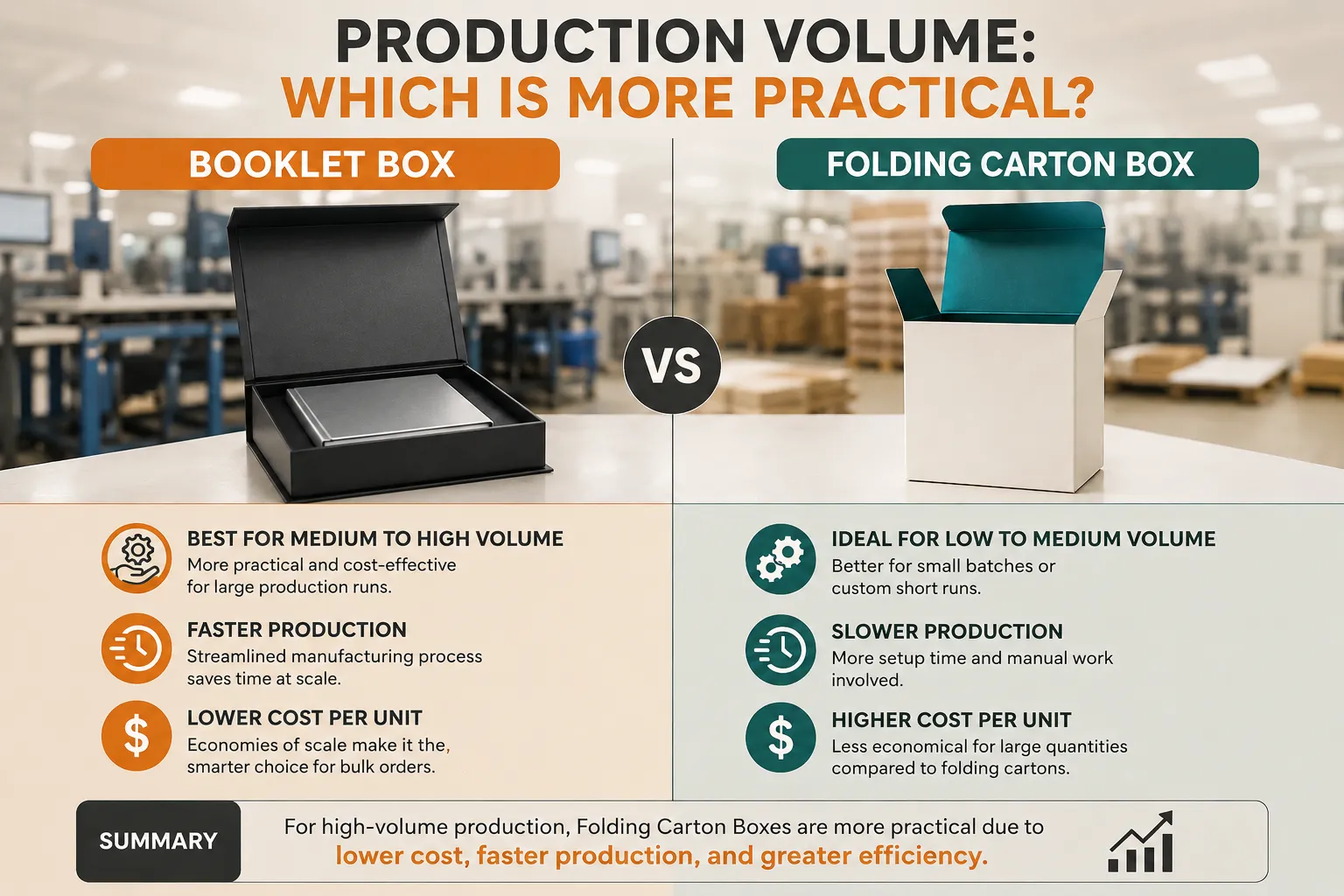
Production volume can strongly influence the decision.
Folding cartons are particularly efficient for large-scale production because their manufacturing process is optimized for die-cutting, printing, folding, and gluing at volume. Their flat-pack format also simplifies transportation and storage.
This makes Folding Cartons for High Volume Packaging a practical choice for products that require large quantities of packaging.
Booklet boxes can also be manufactured in larger quantities, but their rigid construction and additional production processes can make them more expensive.
For smaller premium product lines, the higher packaging cost may be justified by the added presentation and perceived value.
Booklet Boxes vs Folding Cartons for Retail
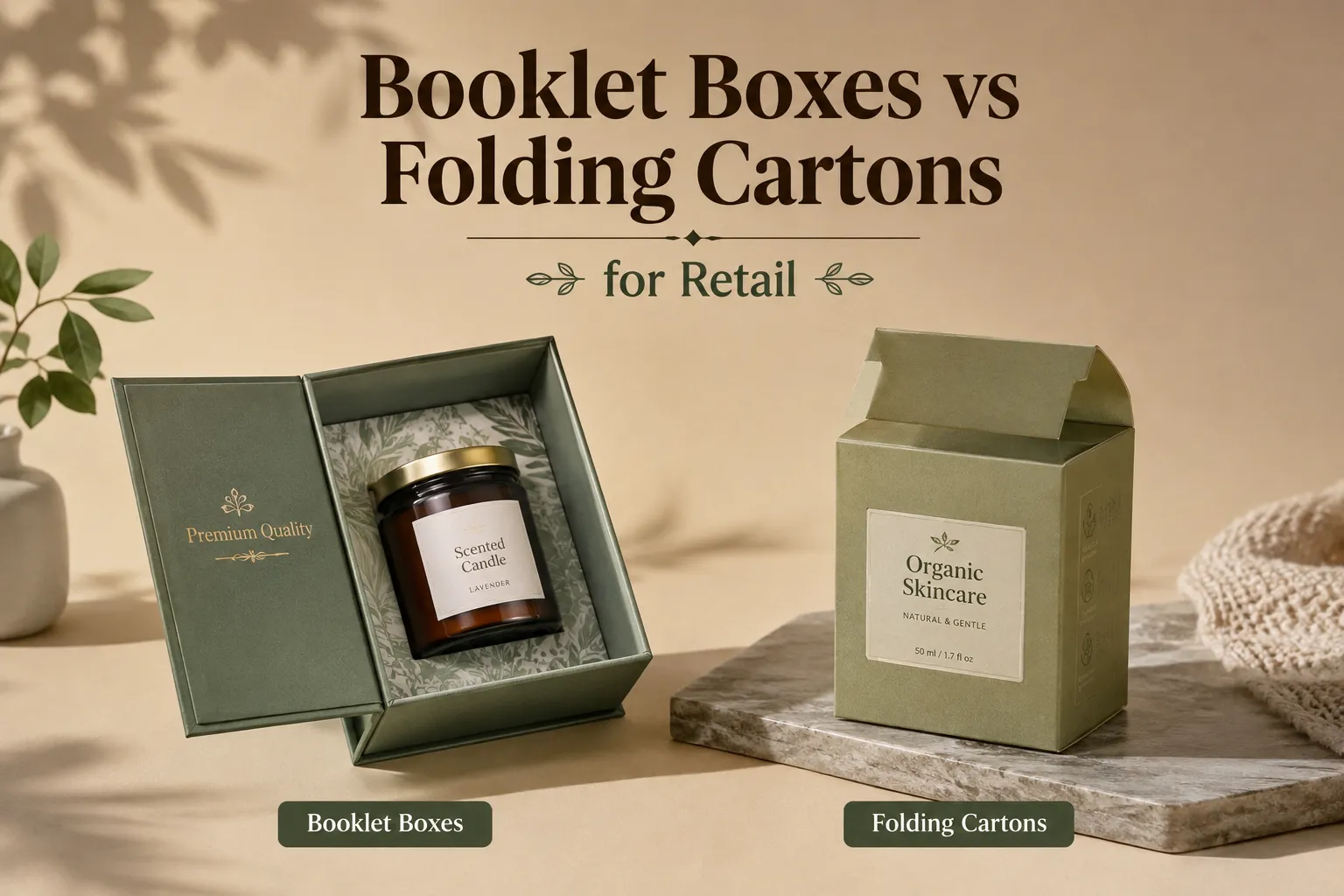
When comparing Booklet Boxes or Folding Cartons for Retail, consider the product category and customer expectations.
A mass-market product with a high production volume may benefit from lightweight folding carton packaging because it keeps packaging and logistics costs under control.
A premium product competing on presentation may benefit more from booklet packaging because the rigid structure can communicate higher perceived value.
Neither format is automatically better. The appropriate choice depends on the relationship between packaging cost, product value, protection requirements, and customer expectations.
Booklet Boxes vs Folding Cartons for Cosmetics
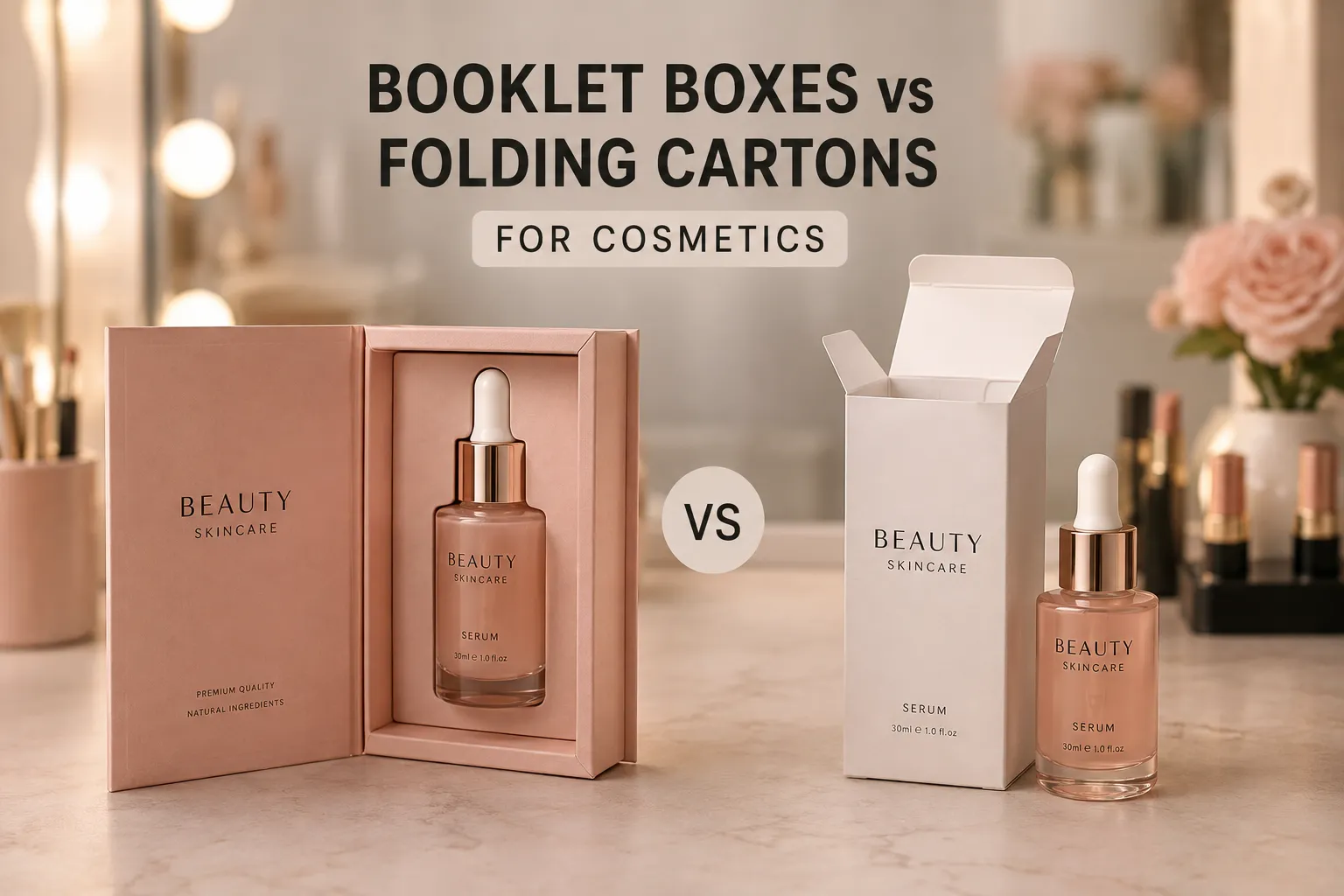
Cosmetics are a good example of where both options can work.
Folding cartons are widely suitable for products such as creams, soaps, makeup, skincare products, and other lightweight items. They offer efficient retail packaging and plenty of space for product information and branding.
Booklet boxes can be a stronger choice for premium cosmetic collections, gift sets, luxury skincare, or products where the packaging itself is intended to become part of the customer experience.
So, when considering Booklet Boxes vs Folding Cartons for Cosmetics, the key question is whether the priority is efficient retail packaging or premium presentation.
Which Is More Sustainable?
It’s not the box style that is responsible for sustainability. Rather, it’s the manufacturing process, printing inks, material selection, transportation, and end-of-life disposal. Soya-based, water- based inks, and plant-based stocks make these boxes sustainable.
Folding cartons have an advantage in logistics because they are lightweight and can be transported flat, reducing the space required during shipping and storage.
Booklet boxes can also be made using paper-based materials and responsible sourcing practices. However, their heavier rigid construction may require more material per package.
Brands should therefore evaluate the complete packaging lifecycle rather than selecting a format based solely on the word “eco-friendly.”
Which Is Better: Booklet Boxes or Folding Cartons?
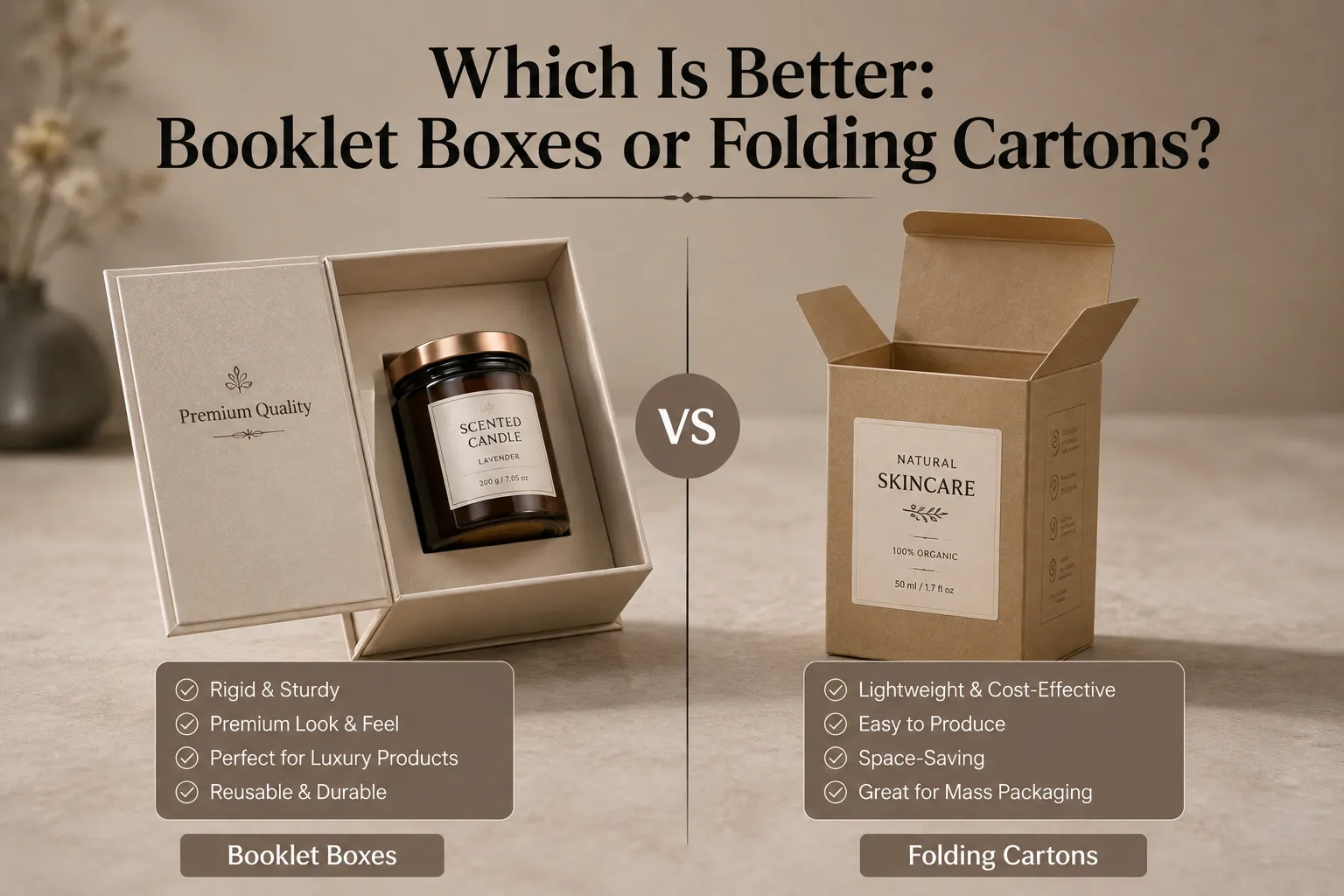
So, which is better, booklet boxes or folding cartons?
The answer depends on your priorities.
Choose booklet boxes if you prioritize premium product presentation, luxury branding, higher structural protection, and memorable unboxing. Custom inserts, and high class printing on booklet boxes raise the worth of your products.
Choose folding cartons if you prioritize lower packaging cost and lightweight construction. Flat-pack construction, efficient storage, and fast assembly requirements means your right product must be in folding carton style.
In simple terms, booklet boxes are generally better suited to products where presentation and rigidity matter, while folding cartons are often the practical choice for efficient, high-volume retail packaging.
How to Choose the Right Packaging for Your Product
Before making a decision, consider these questions:
- What is your product worth?
Premium products may justify the additional investment in rigid booklet packaging. - How much protection does it need?
Fragile or high-value products may benefit from a rigid structure. - What is your production volume?
High-volume products often benefit from the efficiency of folding cartons. - How much storage space do you have?
Folding cartons require less space when stored flat. - What kind of customer experience do you want?
If packaging is part of the product experience, booklet boxes can create a stronger impression. - What is your packaging budget?
Compare not only unit cost but also shipping, storage, assembly, and production costs.
Choosing a Packaging Supplier
After the right box style selection, the next step must be to focus on the qualities of a right supplier. Who will be your next custom booklet boxes manufacturer or folding carton manufacturer? This is because a right supplier can make or break your packaging choice aura.
Packrole is an emerging packaging manufacturer in the USA that is quick in production and precise in measurement. It means whether you are looking for a folding carton or any other custom packaging manufacturer, choosing Packrole means no side hassle from manufacturing to delivery.
Final Verdict: Booklet Boxes vs Folding Cartons
Booklet boxes and folding cartons- it’s a long debate to know which one your products need. What your product wants to get- public attention or folding efficiency. This one point of view can resolve the puzzle.
If you are in the quest of rigid construction, premium experience, brand upscaling, and wonderful product presentation- custom booklet packaging is for you.
Contrary to this, when you are expanding your product by emphasizing its portable sizing, efficient storage space reduction, low shipping cost or lightweight construction – never miss out the high quality folding cartons.
Frequently Asked Questions
1. Which is better, booklet boxes or folding cartons?
Neither is universally better. Booklet boxes are generally better for premium presentation, while folding cartons are often better for lightweight, cost-efficient, high-volume retail packaging.
2. Are booklet boxes more expensive than folding cartons?
Generally, yes. Booklet boxes typically require more material and manufacturing steps.
3. Are booklet boxes suitable for luxury products?
Yes. Book Style Boxes for Premium Products can provide a rigid, high-end presentation.
4. Are folding cartons good for high-volume packaging?
Yes. Folding cartons are particularly suitable for high-volume packaging because they are lightweight, and can be stored flat.
5. Which packaging takes up less storage space?
Folding cartons generally require less storage space because they can be supplied and stored flat.
6. Can both booklet boxes and folding cartons be customized?
Yes. Both can be customized with different dimensions, artwork, printing, colors, finishes, and structural features.
7. Which packaging is better for cosmetics?
Both can work well. Folding cartons are space efficient while booklet boxes are great for premium launches.
8. How do I choose between booklet boxes and folding cartons?
Focus on your objective of crafting custom packaging. Your main packaging goal helps you decide the right one.