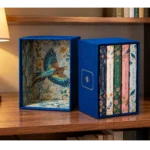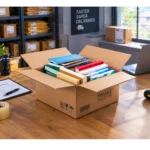
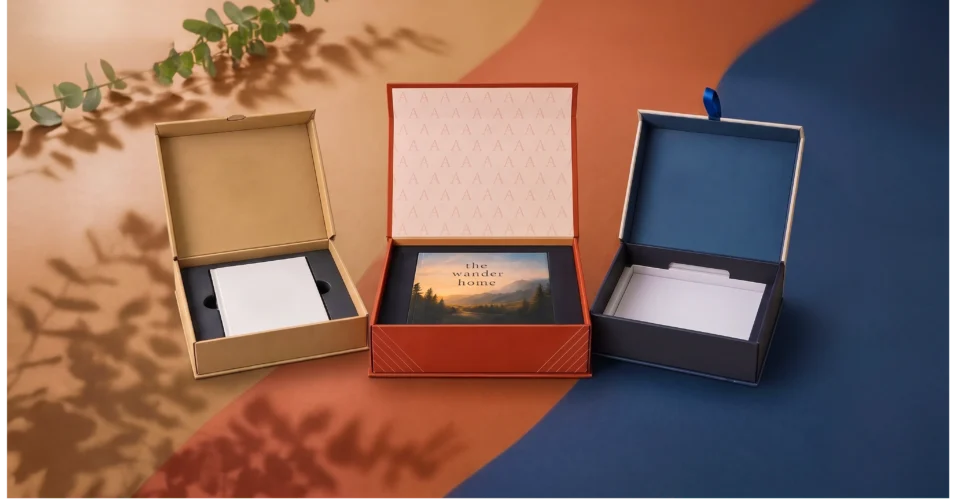
Book boxes are made to protect the books from all potential damage. The best option is always custom book mailer boxes as it allows businesses to get all the benefits, like protection, promotion, and branding, simultaneously.
A book is a surprisingly difficult product to ship well. It is not fragile in the same way as glass, but it is highly vulnerable to corner crushing, spine damage, bent covers, moisture, and abrasion. A customer may accept a slightly dented shipping box, yet still request a replacement if a new book arrives with a creased cover.
The book market is consistently blooming, reaching an amazing price of around $26 billion. It’s not just that; rather, the increase is expected to remain consistent till it reaches $32 billion by 2030. Further research on Europe’s Book Market added more interest to it. The number of books sold online in the EU in 2022 reached 482 million units. This rapid increase in book market value has a direct impact on the book mailer boxes industry. A recent report by Future Market Insights Inc highlighted that the market value of book mailer packaging was $ 4.4 billion in 2025. It added that the market is forecasted to reach 8.4 $ billion in 2035.
That is why choosing the right book mailers matters. The best option is not always the thickest or most expensive package. It is the one that provides the right combination of fit, rigidity, closure strength, and shipping efficiency for the specific book.
For online bookstores, publishers, subscription-box brands, university presses, independent authors, and used-book sellers, this guide compares the most effective book packaging options and explains how to choose them.
Quick Answer: Which Book Mailer Should You Choose?
| If You Are Shipping… | Best Packaging Choice | Why |
| Standard paperback | Adjustable bookfold mailer | Close fit with good bend protection |
| Premium paperback | Rigid book mailer | Better corner and cover protection |
| Hardcover | Rigid or corrugated book mailer | Handles weight and compression better |
| First edition or collectible | Rigid mailer + protective wrap | Maximum protection for condition-sensitive books |
| Thin, low-value book | Padded mailer | Lightweight and economical |
| Multiple books | Corrugated book shipping box | Better load distribution and stacking strength |
| Subscription books | Custom book mailer boxes | Protection plus branded presentation |
The simplest rule: choose packaging that stops the book from moving while providing enough resistance to bending and compression.
USPS packaging standards also emphasize this principle. Mailpieces must withstand normal transit and handling, and contents should be packaged so they do not shift inside the container.
Current USPS standards specifically state that books over 1 inch thick or 1 pound should not be sent in letter-style, non-reinforced flat envelopes without appropriate packaging.
Why Regular Envelopes Often Fail for Books
A standard paper envelope primarily protects against dirt and light surface contact. It does very little to protect a book from bending.
Think about a paperback traveling through a distribution network. The book may experience:
- Pressure from heavier parcels
- Mechanical sorting and conveyor movement
- Repeated loading and unloading
- Compression inside delivery containers
- Contact with sharp package edges
The most common mistake is assuming that because a book feels rigid, it does not need structural packaging.
In reality, the corners and spine are the pressure points. Once a mailer bends, the force is transferred directly to the book.
This is why a purpose-designed book mailer is usually a better choice than a generic envelope for commercial shipping.
Book Mailers vs. Other Packaging
| Packaging Type | Bend Protection | Impact Protection | Weight Efficiency | Best For |
| Poly mailer | Very low | Low | Excellent | Not recommended for unprotected books |
| Padded bubble mailer | Low to medium | Medium | Good | Thin, inexpensive books |
| Bookfold mailer | High | Medium | Excellent | Most paperbacks and standard books |
| Rigid book mailer | Very high | Medium to high | Good | Hardcovers and premium books |
| Corrugated box | Very high | High | Lower | Multiple or heavy books |
The Key Difference: Cushioning vs. Rigidity
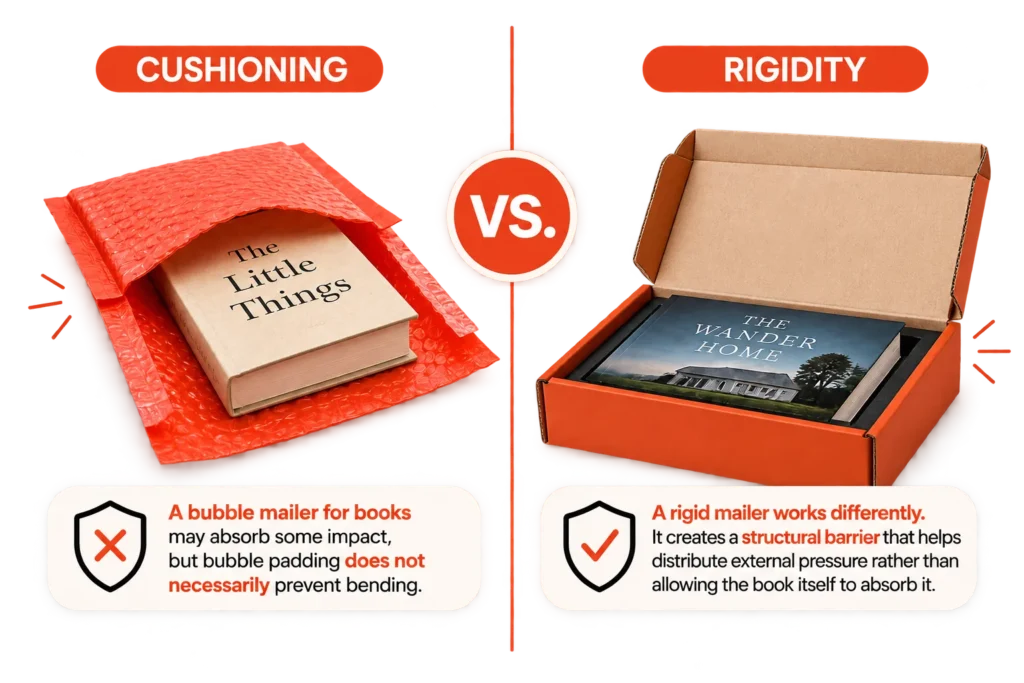
prevent bending.
A rigid mailer works differently. It creates a structural barrier that helps distribute external pressure rather than allowing the book itself to absorb it.
That distinction is important when comparing book mailers vs. poly mailers for books. Poly mailers may be lightweight and inexpensive, but they offer almost no structural resistance on their own.A bubble mailer for books may absorb some impact, but bubble padding does not necessarily
The Best Book Mailers for Shipping Paperbacks
For most eCommerce businesses, adjustable bookfold mailers are one of the most practical options for paperbacks.
These mailers wrap around the book and are folded into position. Their major advantage is the close fit.
Less space means:
- Less internal movement
- Less need for additional void fill
- Better protection against corner damage
- Lower material consumption
USPS specifically requires void spaces within containers to be filled or otherwise stabilized when necessary to prevent shifting and damage.
Example:
Imagine an online bookseller shipping a 6 × 9-inch, 350-page paperback.
Using a large shipping box may require kraft paper, bubble wrap, and tape. The book can still move if the void fill is insufficient.
A properly sized wraparound mailer, however, can hold the book securely with significantly less unused space.
This is why right-sized packaging is often smarter than simply using more packaging. USPS’s parcel-integrity standards also emphasize that parcel-priced pieces should be sized based on their contents to maintain package integrity during processing.
What Type of Book Mailer Is Best for Hardcovers?
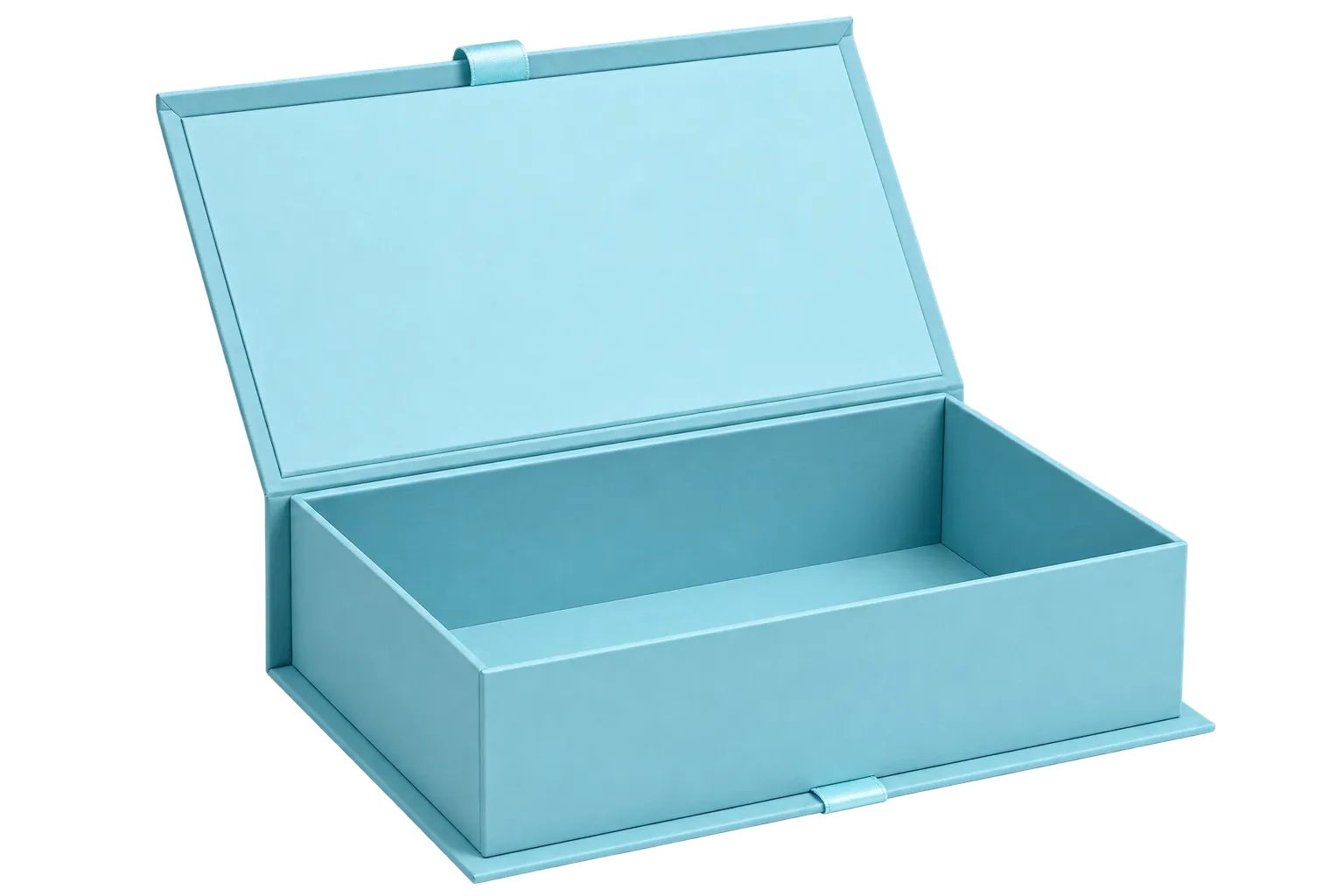
Hardcovers usually require more protection because they are heavier and have rigid edges that can damage the packaging or be damaged themselves.
A rigid book mailer is generally a strong choice for:
- Hardback novels
- Coffee-table books
- Art books
- Academic books
- Signed editions
- Gift books
For high-value books, consider a layered approach:
Book → moisture-resistant inner protection → rigid wraparound mailer → reinforced outer packaging when needed
Do not automatically use excessive cushioning. The goal is to stop movement and prevent direct exposure to damaging forces.
For heavier shipments, USPS provides increasingly specific closure and container requirements. For example, its current standards specify stronger packaging requirements as book shipments move into higher weight ranges, including 200-pound, 275-pound, and 350-pound test fiberboard requirements for certain large book shipments.
Book Mailer Size Sheet
| Book Type | Recommended Approach |
| Pocket paperback | Small close-fitting mailer |
| Standard 5 × 8 or 6 × 9 paperback | Adjustable bookfold mailer |
| Large paperback | Medium rigid mailer |
| Standard hardcover | Rigid wraparound mailer |
| Oversized art or photography book | Heavy-duty corrugated packaging |
| Two to five books | Corrugated box with stabilized interior |
Before ordering book mailer boxes, measure the complete product rather than relying only on the book’s listed dimensions.
Measure:
- Length
- Width
- Spine thickness
- Weight
- Any protective wrap or insert being used
For adjustable packaging, confirm the manufacturer’s stated minimum and maximum capacity.
How to Pack a Book in a Mailer
If you are wondering how to pack a book in a mailer, use this simple process.
Step 1: Inspect the Book
Check for existing defects before shipping. This is especially important for used, collectible, or signed books.
Step 2: Protect Against Moisture When Needed
Paper is sensitive to water. If the shipping environment presents a moisture risk, use an appropriate protective inner layer.
Step 3: Choose a Close-Fitting Mailer
The package should be large enough to close without forcing the book but not so large that the contents slide around.
Step 4: Secure the Edges
Make sure the mailer’s folds or flaps protect exposed corners.
Step 5: Test for Movement
Gently shake the sealed package. Significant movement usually indicates excess void space.
Step 6: Check the Closure
For lightweight shipments, a quality self-seal closure may be sufficient. Heavier or higher-value books may require additional tape or reinforcement.
USPS permits several closure methods for books up to five pounds, including adhesives and tape, while heavier shipments have additional closure requirements.
Padded, Rigid, or Self-Seal: Which Features Matter Most?
Padded Book Mailers
Best for light books where minor impact protection is more important than maximum bend resistance.
Best use: inexpensive paperbacks and journals.
Rigid Book Mailers
Best for products where condition matters.
Best use: hardcovers, premium editions, signed books, and gifts.
Self-Seal Book Mailers
Best for fulfillment efficiency.
A self-seal closure can reduce packing time and minimize tape usage. However, businesses should test the adhesive under real shipping conditions rather than assuming every peel-and-seal strip provides the same performance.
Tamper-Proof Book Mailers
These can provide an extra layer of security and make unauthorized opening more noticeable.
Best use: premium products, subscription shipments, and books containing additional merchandise or promotional materials.
Are Eco-Friendly Book Mailers a Good Choice?
For small businesses, eco-friendly book mailers can support both operational efficiency and sustainability goals.
Paper and corrugated packaging also have established recovery infrastructure in the United States. According to the American Forest & Paper Association, the 2024 U.S. recycling rate was 60%–64% for paper and 69%–74% for cardboard. About 46 million tons of paper were recycled in the United States during 2024.
For a small bookstore, practical options include:
- Recyclable corrugated book mailers
- Right-sized paperboard packaging
- Mailers made with recycled content
- Minimal plastic void fill
- Designs that reduce the need for excess tape
However, sustainability should not mean under-packaging. A weak mailer that causes a damaged book and a replacement shipment can create more waste than a properly designed protective package. Whether for
When Should You Buy Book Mailers Wholesale?
Businesses processing regular orders should consider buying book mailers wholesale when their packaging requirements are predictable.
Wholesale purchasing can make sense when you have:
- Consistent monthly shipping volume
- Standard book sizes
- Adequate storage space
- A repeatable packing process
But don’t choose cheap book mailers based on unit price alone.
Use this purchasing formula instead:
True packaging cost = mailer cost + labor + additional packing materials + damage/replacement risk
A mailer costing slightly more may reduce packing time or eliminate the need for extra cushioning. That can reduce the overall packaging cost.
Custom Book Mailers for Brand Growth
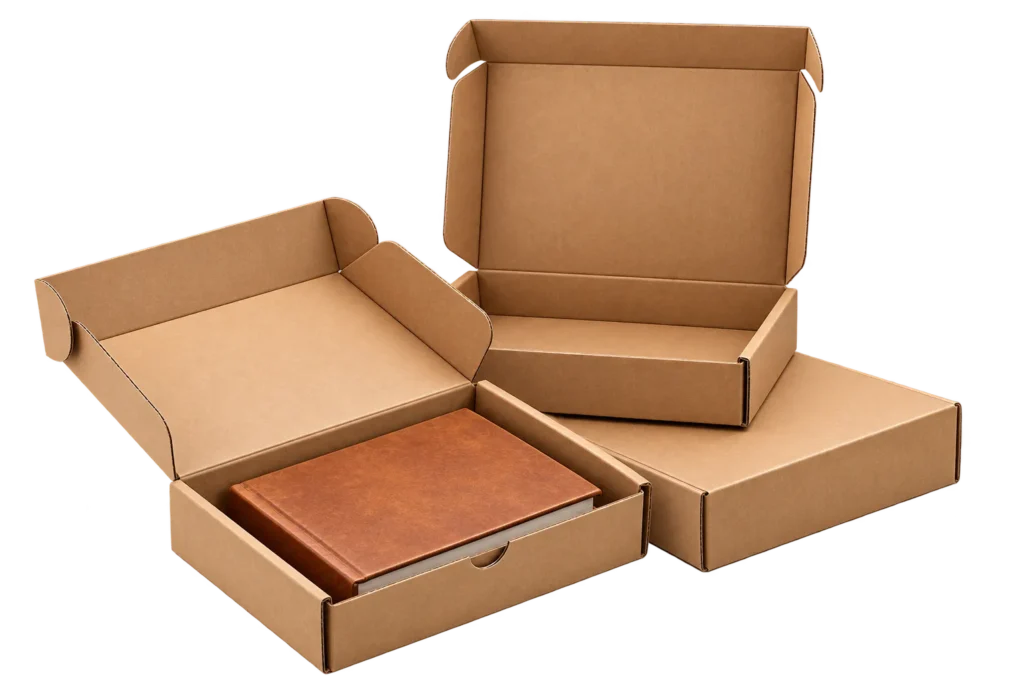
For publishers and established online sellers, custom book mailers can provide more than product protection. Corrugated boxes, rigid boxes, magnetic closure boxes, cardboard folding cartons, and cardboard boxes with inserts are best suited for extraordinary book safety.
A branded mailer can include:
- Your logo
- Brand colors and graphics
- Reading-related messages
- QR codes
- Promotional offers
- Social media calls to action
For example, a monthly book subscription could print a short message inside the mailer that encourages customers to share their current read online. The packaging then becomes part of the customer experience rather than disposable transportation material.
Final Buying Checklist
Before ordering book mailers for sale or wholesale quantities, ask:
- Does the mailer fit my most common book sizes?
- Does it prevent bending?
- Will the book move inside during transit?
- Is the closure strong enough for the shipment weight?
- Can my team pack orders quickly?
- Does the packaging match my sustainability goals?
- Is it strong enough for normal carrier handling?
- Does buying in bulk actually reduce my total packaging cost?
Final Thoughts
The best book mailers are not necessarily the heaviest, most expensive, or most heavily padded. The right choice depends on the book’s weight, dimensions, value, and vulnerability to damage.
For everyday paperbacks, adjustable bookfold mailers often offer an excellent balance of protection and efficiency. For hardcovers and premium editions, rigid book mailers provide greater structural protection. For multiple or heavy books, corrugated packaging is usually the safer option.
For U.S. businesses, the most reliable strategy is simple: right-size the package, prevent movement, protect vulnerable corners, and choose enough structural strength for normal transit. Those principles align closely with USPS packaging standards and help businesses reduce preventable damage without overpacking every order.
FAQs:
How to safely package a book?
It’s better to choose a corrugated mailer box that closely fits the book dimensions for safe arrival.
What is the best way to measure the dimensions of a book?
Use a measuring tape and note the height × length x depth of a book. You can share it with Packrole experts to transform your book dimensions into a perfect book box.
Can I ship a book in a poly mailer?
Shipping books in a poly mailer is possible. However, it would not protect the corners and edges from getting bent.
What are the common mistakes while choosing book boxes?
The biggest mistake of all is to pack them inside a large box. It can still damage the book due to extra space and excessive movement.