Mylar bags are transforming the way we store organic products, whether it is herbs and nuts.. These long-lasting packaging offer unparalleled resistance to factors that decays food. They also assist healthy food lovers, homesteaders, and preppers to have their food last as long as possible without losing its nutritional value and taste. Read this blog to know how Mylar bags have transformed the world of Packaging.
Why Mylar Bags Are a Game-Changer
Dried fruits, spices,and legumes are a well-known example of organic products that are susceptible to air, light, and moisture. Mylar bags are particularly made out of boPET (biaxial-oriented polyethylene terephthalate) film frequently with an aluminum foil coating to form a fortress-like shield which blocks 99 % of oxygen, UV, and humidity. This is not all hype as practical tests indicate that rice placed in Mylar with oxygen absorbers remains edible for approximately 25 years, much longer than when placed in standard plastic or paper wrappings.
Organic product sales reached 67 billion dollars in 2025 in the USA where consumers insist on being long-lived without the use of chemicals. Mylar performs, since it is food safe, recyclable in most programs, and can serve all purposes, such as pantry supplies, as well as emergency supplies. Urban gardeners and off-grid families have become its biggest fans. They are attested to keeping things as fresh as possible.
Best Performance Insights To Mylar Bags
Let’s geek out on the specifications. The multi-layered design of Mylar inner seal polyethylene, foil core, and outer polyester allows it to maintain oxygen transmission rate (OTR) of 0.5 cc/m²/day in temperature at 23°F, which is significantly lower than the 100+ cc/m²/day rate seen in standard poly bags. Thickness is important: 5 mil bags are the best to use at home and 7.5 mil is puncture resistant, making them ideal for sharp seeds or instruments.
Sealing at 250-400 °F forms an airtight bond and metallizing acts like a mirror to keep chlorophyll in herbs and stop rancidity in oils. They can freeze down to -40 degrees °F and microwave, but in the case of organics, room temperature storage at less than 70 degrees °F is best. The USA regulations such as FDA 21, CFR 177 are urging that there should be no migration of toxins which is important in meeting the organic certification.
Top Benefits for Organic Storage
- Long Shelf Life: Oxygen absorbers (300cc/qt) reduce the level of internal O2 to less than 0.01 percent, terminating aerobic bacteria and mold. Beans have a life span of 30 and above; nuts 2-5 years.
- Nutrient Retention: Prevents oxidation which destroys vitamins C and E in berries or spices, maintaining antioxidants.
- Pest Prevention: No entry to pantry moths, weevils, rodents – no use of toxic fumigants.
- Flavor Lock: Odor-proof layers make sure no strong smell like garlic will contaminate your other items like oats.
- Space Saving: Bags fit neatly in buckets, making stacking easy as opposed to large jars.
For organic consumers, buying in bulk at co-ops like Azure Standard proves cost-effective over time, since it minimizes waste.
Perfect Applications for Organic Goods
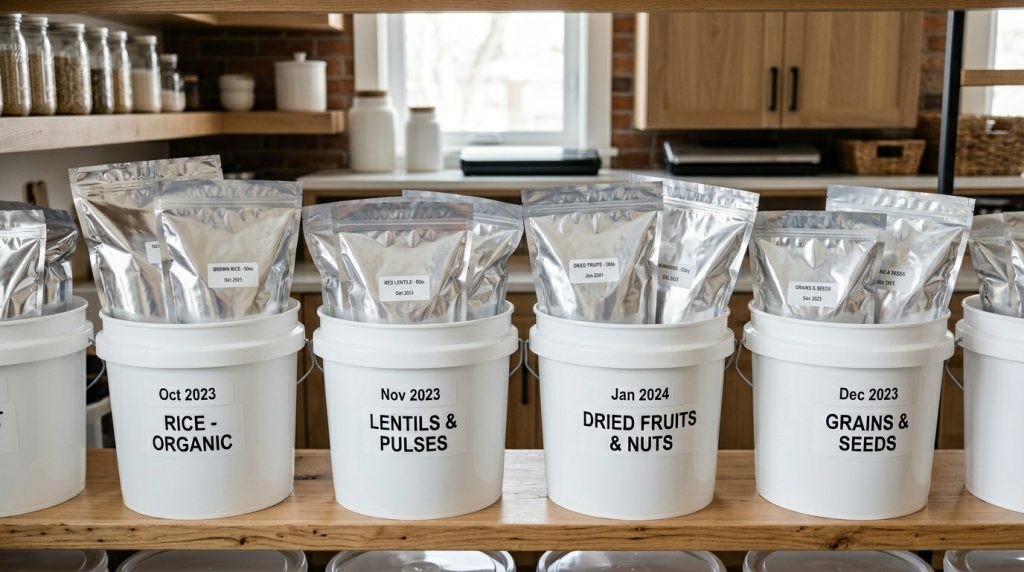
Storage of organic food requires accuracy. In the case of grains and legumes (quinoa, lentils), pour 1-gallon of Mylar 80% capacity, add an oxygen absorber, seal it, and place in a bucket. Nuts and seeds (almonds, chia) should be washed with nitrogen before being sealed to ensure an additional level of purity. Essential oils are preserved in dried herbs such as basil or echinacea when blocked out of sight, which is good in tea blends.
Dry vegetables (kale chips, tomatoes) will not have a freezer burn. Even such a superfood as goji berries or cacao nibs does not clump when exposed to the humid climate.
Pro tip: To make sure the test results are foolproof, pre-condition items with 10% desiccant drying.
Step-by-Step Usage Guide
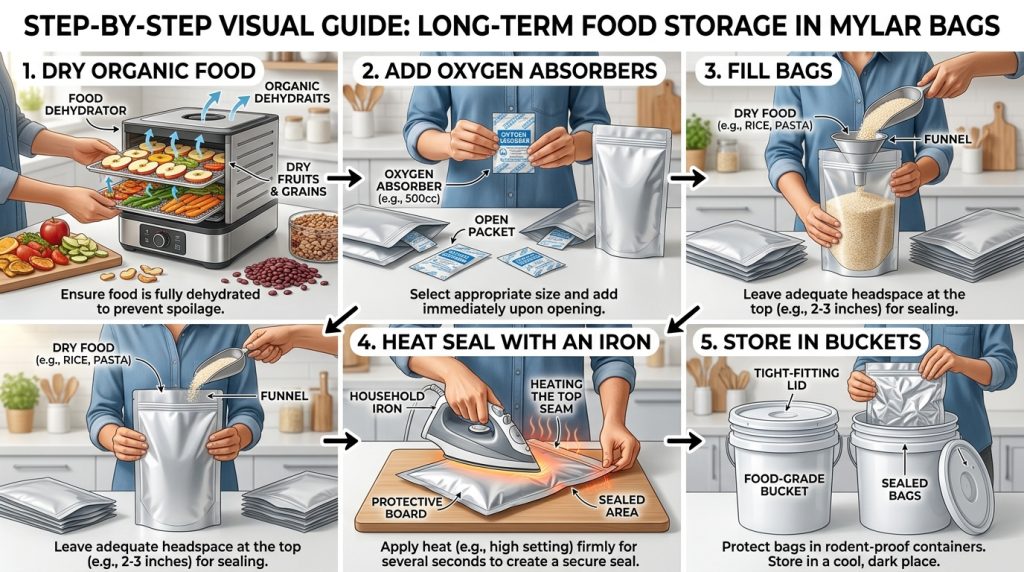
- Prep Items:Dry or air dry organics items to ensure less than 10% moisture, a home dehydrator at 95∘C dehydrates in 12-24 hours.
- Select Bag: Size of bags should be matched to the contents; 5-gallons bags with rice sacks, and quart bags with spices.
- Add Absorber: Use 100-500cc depending on the volume; the pink indicators turn green when exhausted.
- Fill & Seal: Leave 2-3″ headspace, fold top, press with 300°F iron or sealer 3-5 seconds.
- Store: Store at cool, dark places and label with date/content type.
- Test: Place bag in water bag; no bubbles means success.
Pro tip: Pair with a FoodSaver for vacuum sealing; Mylar’s low oxygen transmission rate (OTR) boosts effectiveness.
Potential Drawbacks and Smart Considerations
No packaging is perfect and so the Mylar bags. It is not breathable and thus not suitable for fresh products as it traps ethylene gas making it rot faster. However, it is highly effective for storing fatty organic products such as peanut butter when used in combination with a rigid container (e.g., a Mylar bag inside a bucket), which helps prevent oil leakage that could otherwise degrade the foil.
Likewise, they can be recycled under #1 PET, but are not compostable. In this era when zero-waste is of prime importance, use bio-based equivalents instead. Mylar bags are the best option because they reduce food waste by 90%.
Price comparison: It is usually reported that 1-gallon bags are purchased in bulk (100 packs cost between $ 25-40 on companies like Pack Role). It means 0.30/unit to buy, which is much less than 1$ that companies spent to buy glass packaging.
| Storage Method | Shelf Life (Dry Goods) | Cost/Gallon | Light Block | Moisture Block | USA Availability |
| Mylar + Absorber | 10-30 years | $0.50 | 99% | Excellent | High |
| Vacuum Plastic | 2-5 years | $0.20 | Poor | Good | High |
| Glass Jars | 5-10 years | $2.00 | Variable | Good | Medium |
| Plastic Buckets | 1-3 years | $1.50 | None | Fair | High |
How Does Proper Sealing Technique Affect Storage Success?
The effectiveness of Mylar bags in regard protecting organic products is based on proper sealing. The optimal heat seal forms a non-porous, airtight barrier preventing oxygen entry which is essential because any 2% of remaining oxygen can initiate oxidation and microbe growth of grains or herbs. Its absence reduces shelf life by decades or months, as the nuts and dried fruits get moisture and pests and thus become moldy or rancid.
The polyethylene inner layer is technically meltable at 250-400 °F and would join the layers to form an OTR of less than 0.5 cc/m 2 /day when properly done.
Irons are outperformed by impulse sealers because they work at even bursts of 3-5 seconds and minimize areas of weaknesses due to the irregularity of pressure. According to research carried out by the storage experts, properly sealed bags keep 95% of the nutrients after the 10 year period as compared to the leaky ones that keep 60 %.
For organic products, this translates to maintaining spice potency. Likewise, bad lids expose it to humidity, which quickly rises and exceeds 10% within the powder mass, causing sproutage of seeds or valleys of lumps of powder.
What Bag Sizes Work Best for Different Storage Needs?
The optimal size of the Mylar bag to use is one that maximizes space, minimizes air exposure, and increases the shelf life of organic products. Spices, herbs, or seeds are placed in small bags (1/8-1/4 oz) 3 inches to 4 inches (39 cm to 64 cm) in height, so that they are not crushed, yet oxygen absorbers are permitted. Nuts, dried fruits, or tea 5×8 to 6×9 inches (1/2-1 oz) handle: balances volume to avoid waste of space and at the same time maintains freshness.
- In bulk, 8×10 or 10×14 inches are good to store 1-gallon of flour, grains, or quinoa. It should be put in buckets.
- Large 14×20 or 20×30 inches (5 to -25 lbs) are used to store rice, beans, or emergency food. Typically they are lined with 5-gallon pails to facilitate rotation.
Think Out Of The Box For Making Miles Today!
By customizing Mylar bags for organic products, one can improve branding. But what matters the most is guarantee functionality and compliance. Begin with exact sizing (measure product size including 10-20% headspace of oxygen absorbers but not too large or too small, otherwise this will cause shortened shelf life). Select food-grade, FDA approved materials (5-7 mil thickness) having low OTR; do not use non-barrier laminates, which allow moisture to pass, which is essential with nuts or herbs.
Be smart:
Don’t forget that Sharp prints should maintain their elegance by using vector graphics. Branding effect goes extravagant with the logo situated below tears notches and hang holes to prevent cropping. Use glossy or matte finishes or fingerprint-resistant finishing is what people feel excited to see. Kid-safe zips, as mandated by USA safety requirements, are mandatory.
Bulk orders (500 or more) impact costs, which are lower than $0.40-1.50/unit, and require supplier certifications, such as REACH compliances, to ensure environmentally friendly properties. Seal integrity and light-exposure print are ensured at the prototyping stage of bags manufacturing.
USA Supplier and Buying Tips
The best USA stores are the Pack Role. Find bags meeting the RoHS requirements and certified by REACH. Bulk deals (1000+) drop to $0.15/unit. Reviews of quality checks on seal strength- do not take thin imports that are liable to leakages.
Prices soar during seasonal sales during Black Friday or emergencies; inventory during the year. Resellers can be compliant by certifications such as the USDA Organic-compatible packaging.
Advanced Techniques for Pros
- Use nitrogen purging through a $50 handheld flusher, it is better than using absorbers alone. It can eliminate 99.99% O2.
- For large scale storage, 5-gallon buckets with gamma lids and mylar liners make modular rotation systems. Check with O2 checkers(10 dollars) -levels exceeding 2-percent signal failure.
- Use software, such as Canva, for generating codes that connect with batch origins, which are crucial in USA markets. To homesteaders, Mylar allows seed banking:
Health and Safety Insights
Food-grade Mylar does not contain phthalates and BPA, which are safe to come in direct contact with. But the external punctures can add contaminants, so check regularly. They come to the rescue in crises, thus the Federal Emergency Management Agency (FEMA) suggests Mylar in 72-hour high-protein-organic kits. Combine with MRE-type absorbers to be ultra-long. Research conducted at Brigham Young University (BYU) reveals that wheat stored in Mylar has 90 % of the nutrition after 10 years, compared to 60 % when stored in the air.
Sustainability Angle
Mylar lowers the organic waste, which meets the objectives of the USA of zero-waste. Recycle through TerraCycle programs; certain brands have a take-back. Saving carbon footprint by 70 % through energy-efficient production (less material than glass). To eco-warriors, plant-based Mylar variants of Amcor will appear in the year 2026. So, yes Mylar Bags are Reusable.
Real-User Stories
Homesteader Sarah of Texas tells us:
“My 2015 wheat crop is still bakeable in Mylar- flour test passed!”
The prepper forums are abuzz with success stories: 20-year tasting oats fresh.
Comparison to Alternatives
Other than the table, foil pouches trail behind in resisting puncture, and vacuum bricks squash frail dried fruits. Mylar wins for balance.
Final Thoughts on Integration
Ultimately, Mylar packaging is more than just a storage solution, it is an investment in product quality, longevity, and preparedness, especially as demand for organic products continues to grow rapidly.
The best thing is that mylar bags are not just good for organic food but it has a number of other applications as well. Customize today and stay in word of mouth! To know more about mylar bags see our other posts
Can You Use Mylar Bags For Storing Liquids? What Should You Know
Mylar Bags vs. Vacuum Sealing: Which Is Better for Long-Term Storage?