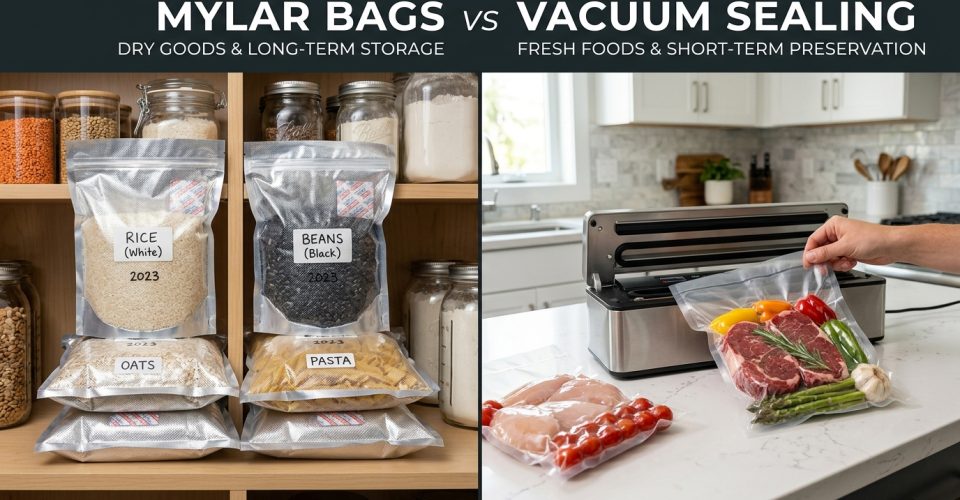
When you begin to consider serious long-term storage, you will inevitably think of two possibilities: Mylar bags and vacuum sealing. They both extend the freshness of food, though they are not synonymous, and they are not supposed to do the same tasks. Mylar is ideal in decades long dry storage and vacuum sealing in short to medium term storage and freezing particularly in moist or fresh foods.
The following is a simple, straightforward list to guide you in making the decision of which one would suit your goals of storage, products, and budget for food packaging.
How Mylar Bags and Vacuum Sealing Work
What Are Mylar Bags?
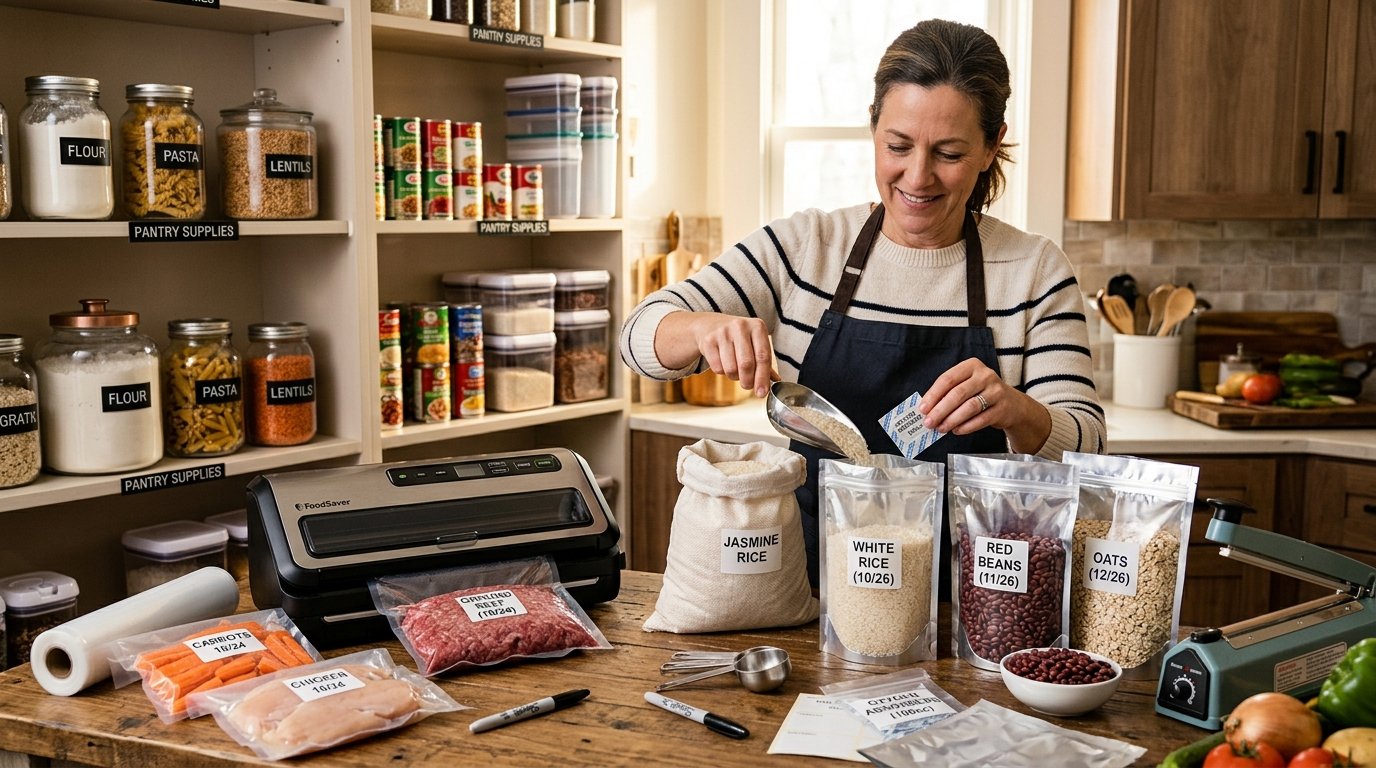
Mylar bags are composed of a potent polyester film (BoPET) that is frequently covered with aluminum to form a potent oxygen, moisture, and light obstruction. By placing oxygen absorbers and sealing them with a heat-seal, you create an environment with low oxygen and light. This environment is very conducive to storing dry goods long-term.
They are commonly used for:
- Dry items like rice, beans, grains, pasta, oats, powdered milk, and freeze dried foods.
- Non-food products like papers, seeds, electronics, and emergency.
What Is Vacuum Sealing?
Vacuum sealing involves a special machine that removes air (and oxygen in particular) out of a plastic bag and then it is heat-sealed. It is a tight seal that prevents oxidation, loss/gain of moisture, and bacteria growth and thus increases the shelf life by an enormous margin in comparison with regular storage.
Vacuum sealing can be used particularly on:
- Cooked and fresh meat and fish.
- Vegetables and fruits
- Remainders and meal preparation portions.
Shelf Life: How Long Will each of the sealing methods preserve food?
Mylar Bags – Long-Term Storage
A significant number of dry foods can be preserved in properly sealed Mylar bags containing oxygen absorbers. It lasts between 10 and 30 years or longer depending on the product, and storage conditions.
They deter three of the largest shelf life foes:
- Oxygen (promotes rancidity and oxidation)
- Dampness (causes mould and decay)
- Light (destroys nutrients and color)
Mylar can be used because it is a lead option in:
- Emergency preparedness
- Pantries or Basement bulk dry storage.
- Long-term survival food kits
Short to Medium-term Storage Vacuum Sealing
Vacuum sealing dramatically increases shelf life – however not for kipdecades. In the case of the majority of foods, you have:
Meats and vegetables ( Fresh or frozen): These products stay for several years in the freezer, when vacuum packed, with considerably less freezer burn.
Dry goods: Long life vs. normal storage, although air can creep in slowly as time progresses, therefore it can usually last not many years, but some decades.
Vacuum sealing is appropriate when:
- Cook and freeze food on a regular basis.
- Wish to save junk, and make your daily grocery last longer.
- Require fridge/ freezer control and organization.
- Air, light, moisture as well as pest protection.
Barrier Strength of Mylar Bags
Mylar bag offers a good solution in preserving food against environmental factors that destroy it:
Block most light completely
- Majorly restrict oxygen transfer particularly if oxygen absorbers are involved.
- Resist change of moisture and humidity.
- Provide a higher level of puncture and tear resistance than regular plastic bags.
- This triple protection (air, light, and moisture) provides Mylar with a very long storage life for low moisture foods.
Protection with Vacuum Sealed Bags
Most air is eliminated by vacuum bags, significantly retards oxidation and dehydration, however:
- Most of them do not restrict light (usually they are clear or translucent).
- Gradually, particularly over the years, the air may creep into the plastic and seals.
- The heavy Mylar is more puncture resistant than standard vacuum bags particularly in sharp edges or bones.
- Vacuum sealing is very protective in short and medium term, especially in the freezer, but not as protective as Mylar in terms of decades long storage.
What Foods Are Best for Each Method?
Best Uses for Mylar Bags
Mylar bags are suitable in dry and low fat, shelf stable foods that include:
- Rice, wheat, oats, barley
- Dry beans, lentils, peas
- Pasta, cornmeal, flour (white flour in particular).
- Milk, powdered, drink mixes, cocoa.
- Fruits, vegetables and meals, frozen.
The water content is low and the fat levels are low in these foods which means:
- Reduced chances of botulism or spoilage when there is removal of oxygen.
- Fewer likelihoods of rancidity with time.
- Mylar is not advised to be used with wet, fresh or high-fat food by itself.
Best Uses for Vacuum Sealing
Vacuum sealing is a very flexible technique and can work with both dry and moist foods such as:
- Fresh meats, fish, and poultry
- Deli, cured meat, and cheese
- Vegetables which have been blanched and then frozen).
- Frozen and pre-frozen soups, batch-cooked meals,and leftovers.
- Coffee beans, nuts, and snacks
Vacuum sealing can be of great help particularly in:
- Reducing freezer burn
- Extending and preserving flavors and textures in months.
- Sous vide preparation and portioning.
Equipment, Cost, and Ease of Use
Mylar Bags: What You Need
To store Mylar with a long shelf life, you will normally require:
- Mylar bags (various sizes)
- Oxygen absorbers (size to bag size weight to food type)
- An iron to seal or a heat sealer to make airtight seals.
- Additional protection and sorting of storage containers (e.g. buckets).
Pros:
- No need for an electric vacuum machine.
- The bags are space efficient, lightweight, and stackable.
- When opened properly, can be used over years with little care.
Cons:
- Primarily used for dry goods only
- Careful consideration to the right selection of the oxygen absorbers and method of sealing is required.
Vacuum Sealing: What You Need
For vacuum sealing, you need:
- A vacuum sealing machine
- Rolls or vacuum bags of matching size.
Pros:
- Quick and easy to use on a daily basis.
- Good with fresh, cooked, and frozen foods.
- Clear bags to easily observe the content can be easily observed
Cons:
- Needs a machine (initial investment) and constant bag/rolls purchases.
- Bags do not last very long as long as Mylar.
- Power depending unless you have some manual or backup option.
Shelf Life and Food Quality: Side-by- Side
| Factor | Mylar Bags (with O₂ absorbers) | Vacuum Sealing |
| Best for | Dry, low-moisture foods, long-term storage | Fresh, moist, and frozen foods; everyday & medium-term storage |
| Typical shelf life | 10–30+ years for many dry goods | Months to a few years, depending on food and storage |
| Protection from light | Excellent (opaque/metalized) | Limited (usually clear) |
| Protection from oxygen | Excellent with absorbers | Very good initially, but some air can seep over time du |
| Moisture barrier | Strong | Strong, especially in freezer |
| Works for wet foods | No (risk of spoilage) | Yes, ideal for many wet/fresh items |
| Equipment needed | Heat source + oxygen absorbers | Vacuum sealer machine + bags |
| Ideal use case | Emergency storage, bulk dry goods, prepping | Meal prep, freezer storage, reducing waste, sous vide cooking |
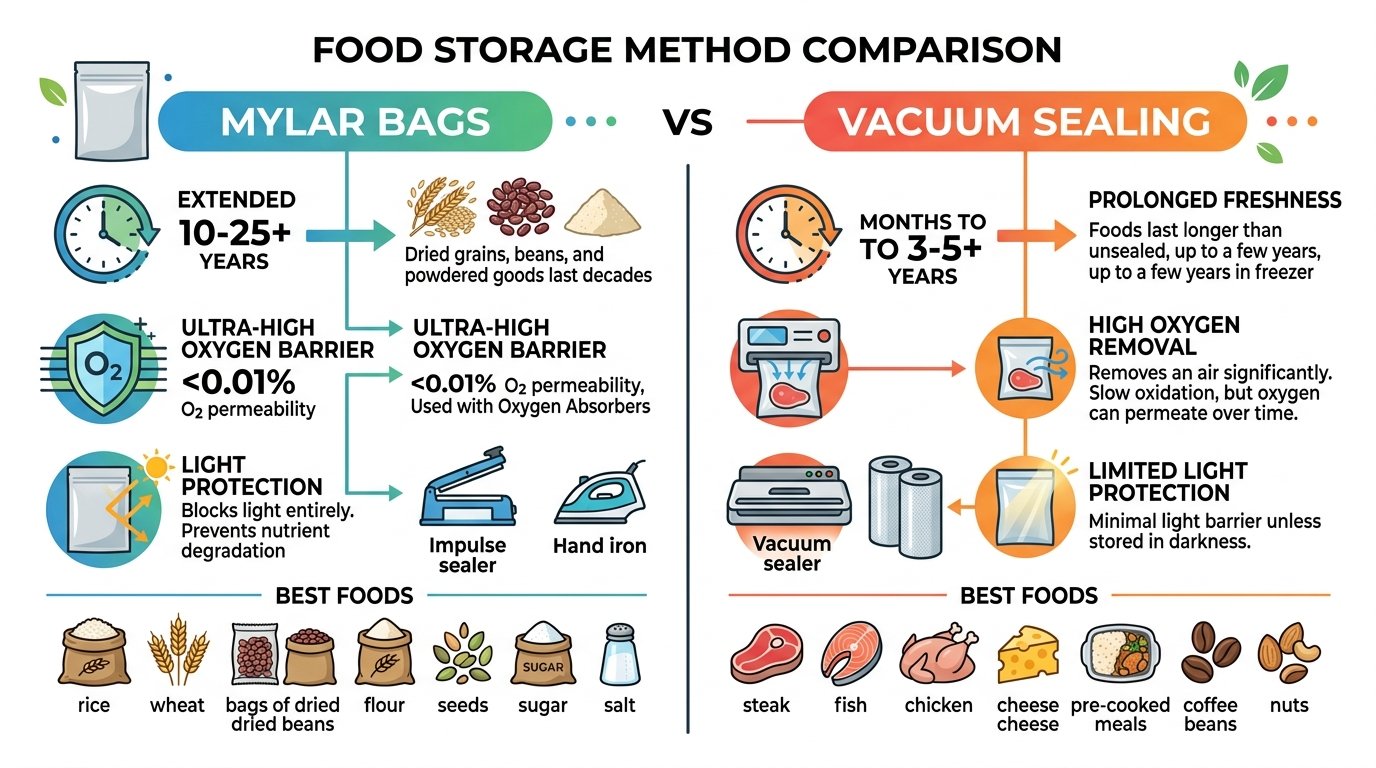
Safety and Storage Considerations
Safety with Mylar Bags
Mylar bags are food safe and most of them are free of BPA, provided one can find reliable suppliers. For safety:
- When eliminating oxygen, only low-moisture, low-oil foods should be used in order to decrease botulism.
- Take Mylar, place it along with oxygen absorbers in a cool dark place.
- Do not use sharp items that have the effect of puncturing bags; use two containers where necessary.
Safety with Vacuum Sealing
Vacuum sealing does not sterilize food, rather it lowers bacterial growth.
Best practices:
- Refrigerate or pre-chill perishable food then seal.
- Adhere to safe refrigeration/freezing time- even vacuum-packed foods go bad ultimately.
- Vacuum-packed, perishable food should not be kept at room temperature over long durations.
So, Which Is Better for Long-Term Storage?
The straight truth- it depends on the type of product you are storing and storing time.
Choose Mylar Bags If:
- The purpose of your storage is highly-long-term (years to decades).
- You are storing dry and shelf-stable foods such as grains, beans, pasta, and freeze dried foods.
- You desire a high level of light, oxygen, and moisture protection.
- You are creating a survival kit, long-term emergency pantry, or survival kit.
- Mylar bags (along with oxygen absorbers) tend to be better in this case.
- You can also use Mylar bags for liquids and organic food.
Choose Vacuum Sealing If:
- You would like to maintain fresh or already cooked food (meat, vegetables, leftovers) longer.
- You are interested in short- to medium-term storage (weeks to a few years, in the freezer in particular).
- You are concerned with convenience, portion control, and waste reduction of daily foodstuff.
- You cook using sous vide or you cook a lot of meals.
In this case, a vacuum sealer would make a great hand peon in the kitchen.
Best of Both Worlds: Combining Methods:
A large part of the serious preppers and the house cooks use both:
- Mylar bags + oxygen absorbers of bulk dry goods and long-time reserves.
- Vacuum packing of daily food, meat ,and preservation of produce.
Some may also be vacuum sealed with Mylar or Mylar bags may be put in buckets to add a physical barrier and better organization. Customize your vacuum sealed mylar bags or heat sealed mylar bags as per your food requirements.
Final Thoughts
Mylar bags with oxygen absorbers are preferable in case of long-term storage of dry foods in general- they are supposed to keep foodstuffs safe against light, oxygen, and moisture in many years. In normal and freezer preservation of raw or cooked foods, there is no better option than vacuum sealing since it is very convenient and very protective in a span of months or few years.
Most households and businesses should not use either/or as the best solution but use each technique where it works best. Consider Pack Role for getting the best quality mylar bags or vacuum sealed bags today!