Packaging boosts business not only by its appearance. However, customers and brands today would also like to ponder whether a Packaging is responsible, practical and durable. That is why this question appears time after time: Are Mylar bags reusable?
Stating straightforwardly, yes. It is possible to reuse many Mylar bags, but the complete response is a bit more complex. Reusability will be based on the type of the bag material structure, the type of the closure, the thickness, the state after the initial use, and the product that the bag initially contained.
Packaging Is A Blessing in Disguise!
That is important since one of the greatest environmental problems is packaging. The U.S. Environmental Protection Agency report indicates that in 2018, 82.2 million tons of municipal solid waste were generated in containers and packaging, or 28.1 percent of the total generation. EPA also explains that the first stage of waste management is to reduce or reuse products and the reuse should be placed first before recycling by the Sustainable Packaging Coalition in the waste hierarchy.
Thanks to Pack Role, which creates smart packaging design. Reusability does not only concern the fact that a pouch has survived the second use. It concerns whether the packaging continues to fulfill its function safely, representing a part of a broader sustainability plan.
What makes Mylar bags so durable?
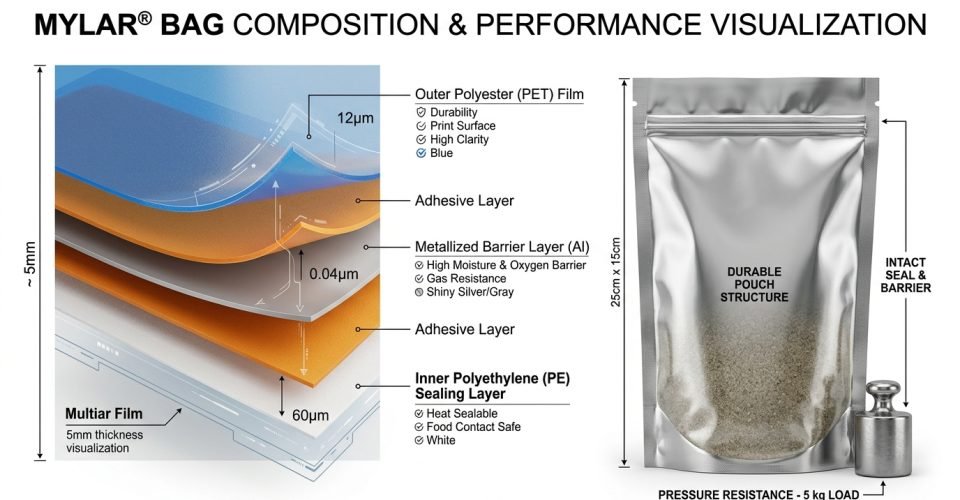
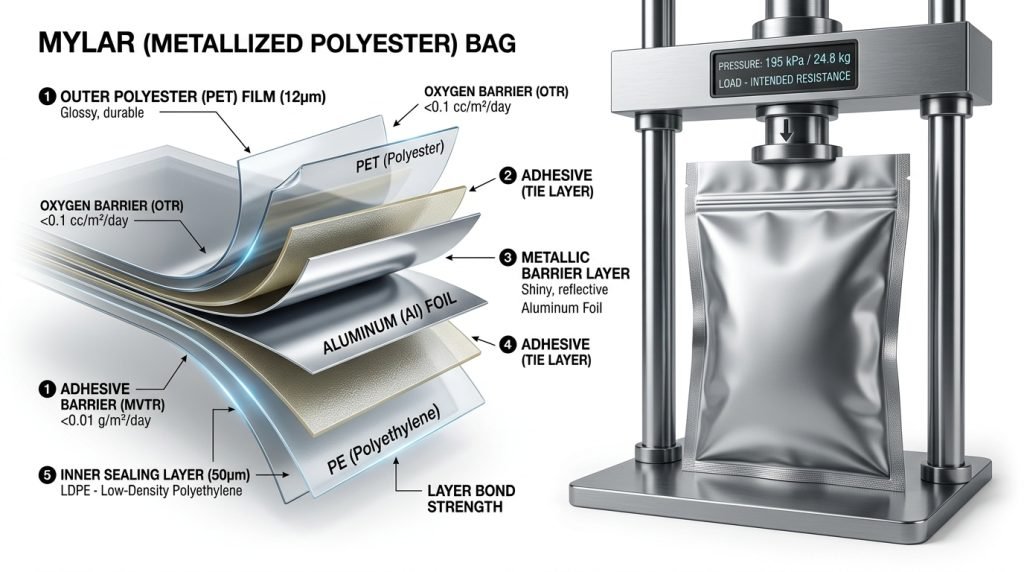
Mylar bags due to their construction to protect against damage are popular. A high-barrier flexible pouch, typically using polyester-based film and typically metalized layers, is commonly referred to as a Mylar bag when it is discussed in the context of packaging. The reason why flexible packaging is a good idea is that it is lightweight and durable.
According to the Recycling Partnership, flexible packaging constitutes 34 percent of the plastic packaging industry, but only 2 percent of households in the United States currently have access to curbside recycling of these products.
Role of Brands In Making Packaging Responsible
Brands continue using such bags because of its performance.
According to Mylar Specialty Films, polyester film is powerful, yet ductile, and resists heat, abrasion, chemicals and water.
As a matter of fact, the historical comment of the company on Mylar itself points out the toughness of the material by reminding of the fact that it had once proved the strength of the film by lifting a three-ton car and platform.
Such a combination of durability and barrier performance is the reason as to how Mylar-style pouches have become common in foods, supplements, coffee, powders, pet products and specialty retail packaging.
Simply put, Mylar bags are not cheap disposable wrappers. Most of them are made puncture resistant, content protectionist, and structure preserving enough to be useful even after the initial usage. By investing in Mylar bags, the brand can go Eco-responsible.
So, are Mylar bags reusable?
In many cases, yes.

Assuming that a Mylar bag is thick, has a resealable zipper, it is always clean inside, and there is no evidence of tears, pinholes, or seal damage, it can be frequently reused on dry, non-perishable items. A large percentage of consumers use these bags as snack bags, dry goods bags, small accessories bags, craft material bags, travel organization bags, and home storage bags.
However, not all Mylar bags ought to be reused. Brands cannot advertise all pouches as able to be re-used indefinitely.
- A heat-sealed pouch, which needs to be ripped open, will not be that reusable as a zip-lock stand-up pouch.
- A bag that contains oily, strongly perfumed, or moisture sensitive contents may also be less easily cleaned and successfully reused.
- After the layer is broken, the bag itself might still appear alright, however it now does not work as it was supposed to.
Thinking of reusability is best done in a practical sense, not a promotional one? Whether or not the pouch can still close appropriately, seems structurally sound, and can be washed, the pouch has reuse potential. Otherwise, reuse will be an empty slogan rather than a functionality.
When should a Mylar bag not be reused?
This is where most brands fail to understand and it is important.
A Mylar bag is not supposed to be reused when the material is poked, the seals are splitting, the zipper has lost its strength, and has traces of unpleasant smells. Bags containing products that are greasy, highly acidic, or hard to clean can also be unfavorable when it comes to being reused. This also applies to pouches which have not been made to be opened and closed again.
This is particularly significant to business. Reuse must not be done at the expense of either the product integrity or the trust of the customers. A premium-looking pouch on a shelf but one that fails during the second usage will destroy the brand experience as fast as an inadequately crafted packaging.
Does reusing Mylar bags make them sustainable?
It is not a yes-and-no category and can help sustainability.
The most compelling case of environmental argument supporting reuse is the mere fact that the longer the package remains in use, the less the probability of having to replace the bag immediately. That is in line with the EPA guidance that emphasizes reduction, reuse, and not recycling. The same argument is made by the Sustainable Packaging Coalition, which states that correctly designed reuse packaging can be ecologically superior to single-use packaging since the source reduction is better than end-of-life management.
There is also a product-protection argument. There are other packaging materials that might have a higher footprint in the short term yet their net benefit is achieved by preventing spoiling of the product. It is particularly so with food packaging.
According to USDA, 30 to 40 percent of food supply is wasted in the United States and EPA National Strategy of Reducing Food Loss and Waste observes that packaging technologies can be used to preserve products, increase shelf life and minimize food waste.
That is, sustainability does not only concern the package. It is also concerning what the package does not allow wasting up.
How This Sustainability Is Achieved?
But the sustainability scenario is more complex at disposal. Flexible packaging tends to have a variety of layers of material, which makes traditional recycling hard.
According to the Recycling Partnership, these stratified structures introduce significant processing issues, and that restricted collection and end markets yet do not permit large-scale recovery.
Therefore reuse is a good move but that will not address the entire environmental issue.
The most correct conclusion is that Mylar bags can be used to deliver a more sustainable packaging strategy in case they are reused, right-sized, and used to deliver products that actually require a barrier protection. They do not represent a sustainability panacea, however, neither are they necessarily a bad one.
What should brands consider before choosing reusable Mylar-style packaging?
To the expanding brands, it is not only a matter of whether or not customers will be able to reuse this. It is Will they actually want to?
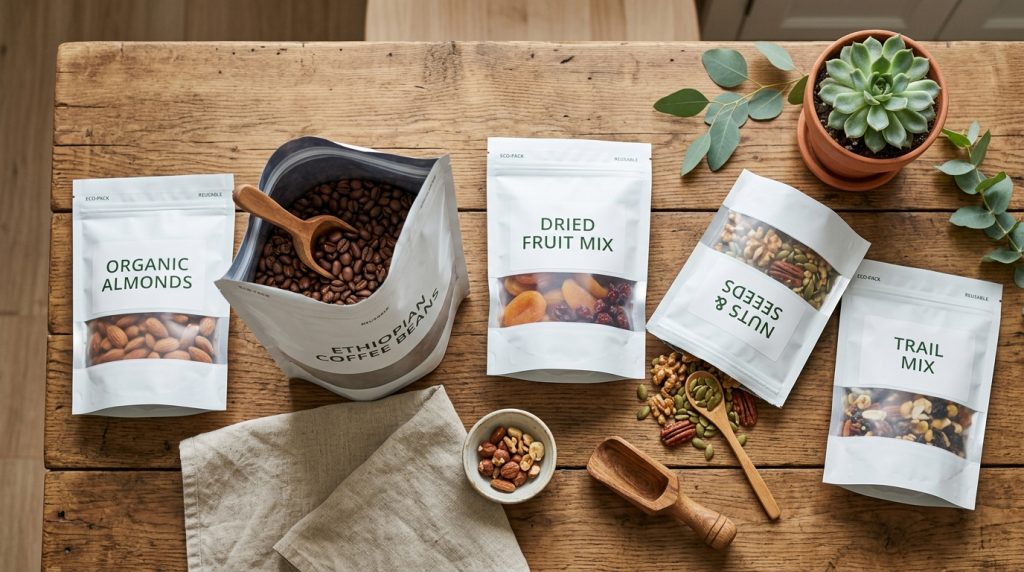
That comes down to design. A pouch will be more reused in case it has:
- A good zipper
- Tear-resistant structure
- Clear label
- Beautiful look
Dual-open notch, matte or soft-touch finish, systematized sizing, and longevity of print quality are all that will increase the likelihood of a pouch having a second life.
Above all, brands can use mylar bags for storing organic products. Moreover, you can use mylar bags for storing liquids as well.
This is a place where Pack Role will be able to add value. Pack Role, as a custom packaging service provider, is well-positioned to assist brands in selecting pouch formats that offer a more reasonable performance. It balances off both barrier protection and shelf appeal. The best packaging decision in most situations is not the one with the most aggressive sustainability statement. It is the one that is designed in good faith on behalf of the product, the customer, and the lifecycle of the pack in a real-life.
Final thoughts
So, are Mylar bags reusable?
Yes, many of them are. They can be reused in numerous practical circumstances. This is made easy by their ability to survive, withstand moisture as well as offer protection.
However, sustainability is to be talked about accurately. Reuse is a genuine advantage. Barrier protection can also eliminate wastes of the products and this is more important than many people may think it is.
Meanwhile, the majority of flexible multi-layers packaging remains subject to the actual recycling constraints, and, therefore, one should not indulge in easy claims made by the brands.
To the brands that desire a packaging, which not only works but also conveys in an ethical way, the route to go is careful design. So there is where Pack Role may come in to provide a practical, durable. and more in tune with the current sustainability demands of packaging. Customize now!